
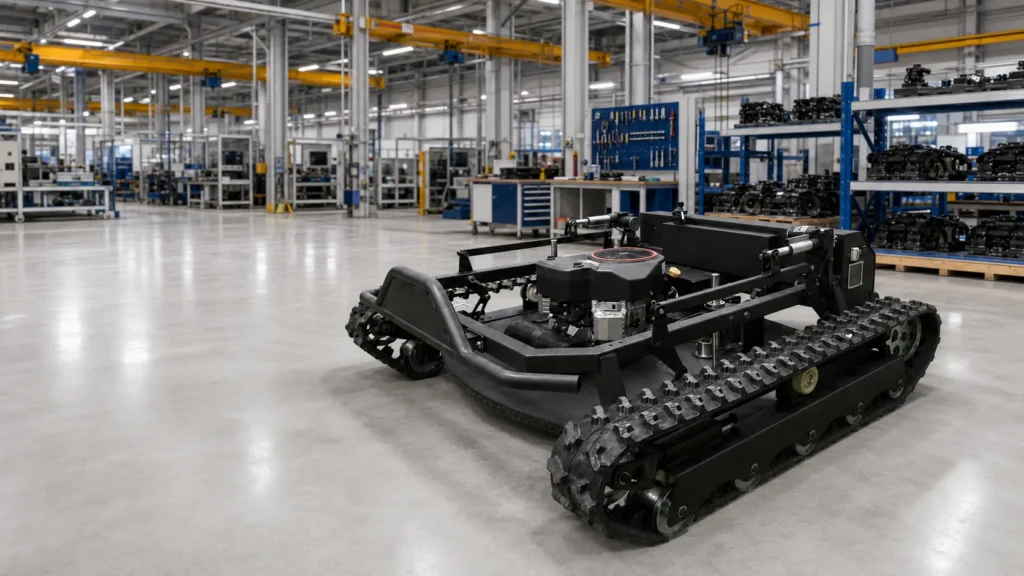
A remote control lawn mower for uneven ground can help professional crews manage slopes, rough grass, and difficult access areas while keeping the operator away from the cutting path. The right choice depends on more than a maximum gradient figure. Buyers should compare terrain geometry, cutting height, machine weight, remote-control operation, transport requirements, and the conditions behind each published specification.
Remote-controlled equipment is different from a fully autonomous robot lawn mower. The operator remains responsible for steering, speed, start and stop actions, observation, and site control. This guide explains the main selection criteria and compares six Yitaiwei models using the supplied product parameter tables.
What to Look For in a Remote Control Lawn Mower for Uneven Ground
Listed gradient is only one selection point
Uneven ground may include slopes, dips, loose soil, ruts, rocks, wet grass, and abrupt transitions. A mower may encounter several of these conditions during one job, so a single gradient number cannot describe the complete operating environment.
The supplied tables list a max gradient from 45° to 60° for the six YTW models. Treat that field as a model-specific listed value, not as a recommended safe working slope or an all-terrain guarantee. Direction of travel, surface condition, load, vegetation, weather, test method, and safety margin are not defined in the tables. Operators should follow the final manufacturer manual and establish an exclusion zone before cutting on sloped ground.
Remote control should support deliberate operation
A remote control lawn mower is useful when the operator needs to stand at a visible, safer position while controlling movement and mowing. That does not make the machine autonomous. The operator still needs a clear view of the mower, the surrounding area, people, vehicles, obstacles, and the direction of travel.
All six supplied YTW models list an RC range of 500m. This is a range specification, not a guaranteed operating limit. Line of sight, interference, terrain screening, weather, and the selected machine configuration can affect practical control. Confirm the control procedure, emergency stop behavior, and operating limits before ordering.
Cutting width and height affect job planning
Cutting width determines how much ground the machine covers per pass, but a wider deck may require more clearance around trees, drainage edges, fences, and irregular boundaries. The six models range from 550mm to 1000mm in mowing width.
Cutting height is equally important for rough vegetation. A mower intended for taller growth may need a higher cutting range than one used for routine grass maintenance. The supplied specifications range from 1-20cm on the YTW-550L-B to 100-200mm on the YTW-800T and YTW-1000T. Buyers should confirm whether the height is manually adjusted or electrically adjusted and whether the stated range applies across the complete machine configuration.
Weight, access, and transport matter
Machine weight affects loading, unloading, access routes, and recovery planning. A compact mower may be easier to move through narrow gates, while a heavier model may require dedicated transport equipment and a stronger loading method. Do not select a model from cutting width alone.
Compare net weight, gross weight, unit dimensions, package size, gate width, turning space, ramps, and the surface used for loading. The supplied tables include weight ranges for the YTW-900T and multiple configurations for some engine and power fields, so the final configuration should be confirmed in the quotation and shipping documents.
Yitaiwei Remote Control Mower Comparison
The following table brings together the main supplied parameters for six YTW models. The max gradient is shown exactly as a listed model field, and the RC range is shown in meters.
| Model | Mowing width | Cutting height | RC range | Max gradient listed | Travel speed |
|---|---|---|---|---|---|
| YTW-550L-B | 550mm | 1-20cm | 500m | 50° | 0-4km/h |
| YTW-550S-Z | 550mm | 30-70mm | 500m | 60° | 0-5km/h |
| YTW-800L | 800mm | 20-100mm | 500m | 45° | 5km/h |
| YTW-800T | 800mm | 100-200mm, electric adjustment | 500m | 60° | 0-6km/h |
| YTW-900T | 900mm | 20-200mm, adjustable | 500m | 60° | 0-6km/h, adjustable |
| YTW-1000T | 1000mm | 100-200mm, electric adjustment | 500m | 60° | 0-6km/h |
Actual performance may vary with terrain, vegetation, operating conditions and machine configuration. Confirm the final specification with the manufacturer before ordering.
Compact 550mm models
The YTW-550L-B and YTW-550S-Z both list a 550mm mowing width. The YTW-550L-B lists a 1-20cm cutting-height range, while the YTW-550S-Z lists 30-70mm. The YTW-550S-Z also lists a lower net weight of 98kg compared with 153kg for the YTW-550L-B. These differences are useful when access and transport are major parts of the job, but they do not by themselves establish which model is suitable for a particular property.
800mm models for broader passes
The YTW-800L list an 800mm mowing width. The YTW-800L lists a 20-100mm cutting-height range, while the YTW-800T lists 100-200mm with electric adjustment. The YTW-800T also lists a 0-6km/h travel-speed range, compared with 5km/h for the YTW-800L. Confirm the intended vegetation, height-setting procedure, and configuration before comparing these models for a specific contract.
900mm and 1000mm models
The YTW-900T lists a 900mm mowing width, a 20-200mm adjustable cutting height, and a 0-6km/h adjustable travel speed. The YTW-1000T lists a 1000mm mowing width, a 100-200mm electrically adjusted cutting height, and a 0-6km/h travel speed. Their listed net weights are 366-377kg and 340kg respectively. These figures should be reviewed alongside access, loading, and transport requirements.
How Professional Buyers Should Evaluate a Model
Map the worksite before requesting a quotation
- Record the steepest sections and whether the machine will travel across, up, or down the slope.
- Note wet areas, loose soil, ruts, rocks, drainage channels, low branches, fences, and narrow access points.
- Measure gates, ramps, storage doors, and turning areas.
- Identify public access, pedestrians, workers, livestock, vehicles, and other exclusion-zone concerns.
This information gives the manufacturer a practical operating context and helps prevent a specification sheet from being treated as a complete site assessment.
Confirm the control and stopping procedure
Ask how the machine starts, stops, pauses, changes speed, reverses, and responds when the control signal is interrupted. The supplied controller images show functions such as speed, throttle, start, pause, emergency button, and automatic frequency selection, but the exact operating procedure and safety conditions are not defined. Request the current manual and configuration-specific operating instructions.
Resolve configuration details
Several supplied fields contain alternatives or configuration-dependent values. Examples include 7.5/9HP on the YTW-550S-Z, 16 or 23HP on the YTW-800L, 22/25/27HP on the YTW-1000T, and a 366-377kg net weight range on the YTW-900T. Confirm the exact engine, power, weight, start system, and drive configuration shown on the final order.
Also confirm the meaning of terms such as remote start, 800w2, split transmission, and the tank-capacity entries. A clear model-and-configuration line on the quotation is more useful than a general family specification.
Operating Practices for Uneven Ground
- Inspect the work area and remove objects that could damage the machine or become projectiles.
- Keep people, vehicles, and animals outside the controlled mowing area.
- Maintain a clear view of the machine and stop when visibility or signal quality is uncertain.
- Use conservative speed on uneven surfaces, near edges, and during direction changes.
- Avoid assuming that a published gradient applies equally to wet grass, loose soil, side-slope travel, or every attachment.
- Stop the machine before clearing a blockage or approaching the cutting system, following the manufacturer procedure.
For contractors and land-maintenance companies, these practices should be incorporated into job planning, operator training, site briefings, and equipment handover documentation.
Frequently Asked Questions (FAQ)
What is the best remote control lawn mower for uneven ground?
There is no single best model for every uneven site. Compare the actual slope direction, vegetation height, access width, transport method, cutting width, control procedure, and final configuration. The listed max gradient should be treated as a model parameter rather than a safe operating recommendation.
Are remote control lawn mowers fully autonomous?
No. A remote control lawn mower is operated by a person using a transmitter or controller. The operator remains responsible for movement, mowing decisions, observation, stopping, and keeping the work area controlled. That differs from a fully autonomous robot lawn mower designed to navigate without continuous manual steering.
How far can the YTW remote control mowers operate?
The supplied tables list an RC range of 500m for all six YTW models. The tables do not define the test environment, line of sight, interference conditions, or safe operating limit, so the number should not be treated as a guaranteed working distance.
What cutting height is useful for rough or tall vegetation?
The appropriate height depends on the vegetation and the intended finish. The supplied YTW models list cutting-height fields from 1-20cm through 100-200mm. Confirm the adjustment method, the target vegetation, and whether the selected configuration supports the required height before ordering.
What should I confirm before buying a remote mower for slopes?
Confirm the current manual, exact model configuration, listed gradient conditions, control and emergency-stop procedure, cutting-system limits, transport dimensions, machine weight, service support, and any attachment compatibility. Ask the manufacturer to relate the specification to the conditions of the intended site.
For professional buyers, the right remote control lawn mower for uneven ground is the model whose verified configuration matches the site, access route, vegetation, operating procedure, and crew capabilities. Use the supplied parameters to build a shortlist, then confirm the final machine and operating limits with the manufacturer before placing an order.