
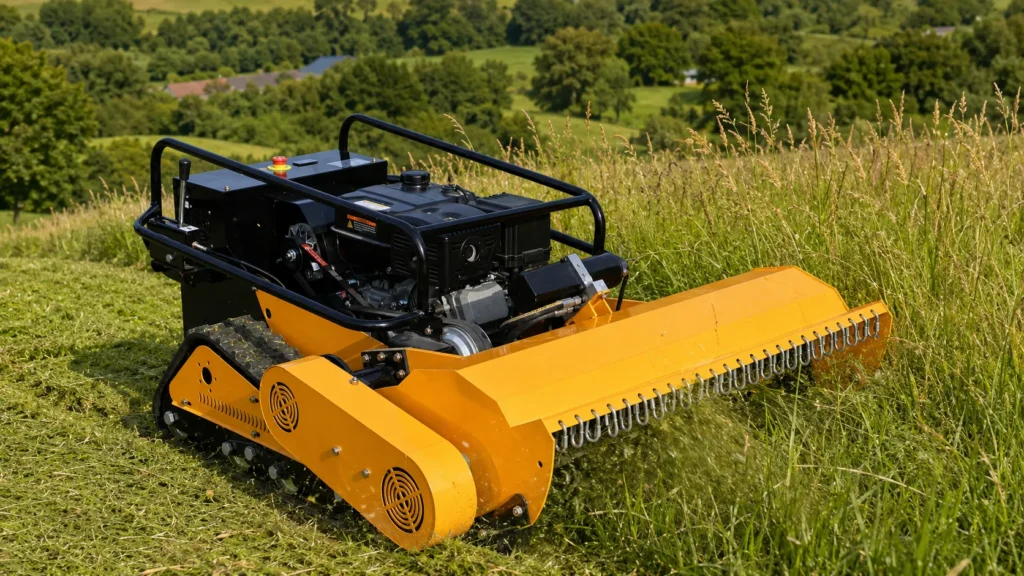
A remote control lawn mower works by transmitting operator commands from a handheld controller to an onboard receiver and control system. The mower converts those commands into movement, steering, speed, starting, stopping, and cutting actions. The operator remains responsible for guiding the machine and monitoring the mowing area, so this equipment is different from a fully autonomous robot mower.
For contractors, land-maintenance companies, municipalities, commercial property operators, and dealers, the important question is not only how the signal reaches the machine. It is how the control system, drive system, cutting deck, power system, and safety procedures work together in real operating conditions.
What a Remote Control Lawn Mower Is
A remote control lawn mower is a powered cutting machine operated from a distance by a person. The controller sends commands through a wireless radio link. An onboard receiver accepts those commands, and an electronic control unit sends corresponding instructions to the drive motors, transmission, engine controls, cutting system, or adjustment mechanisms.
The exact configuration varies by model. Some machines use gasoline engines with electric drive or control components, while others may use different combinations of engine, motor, gearbox, and electrical systems. Buyers should therefore evaluate each model’s technical documentation rather than assume that all remote mowers use the same architecture.
The handheld transmitter
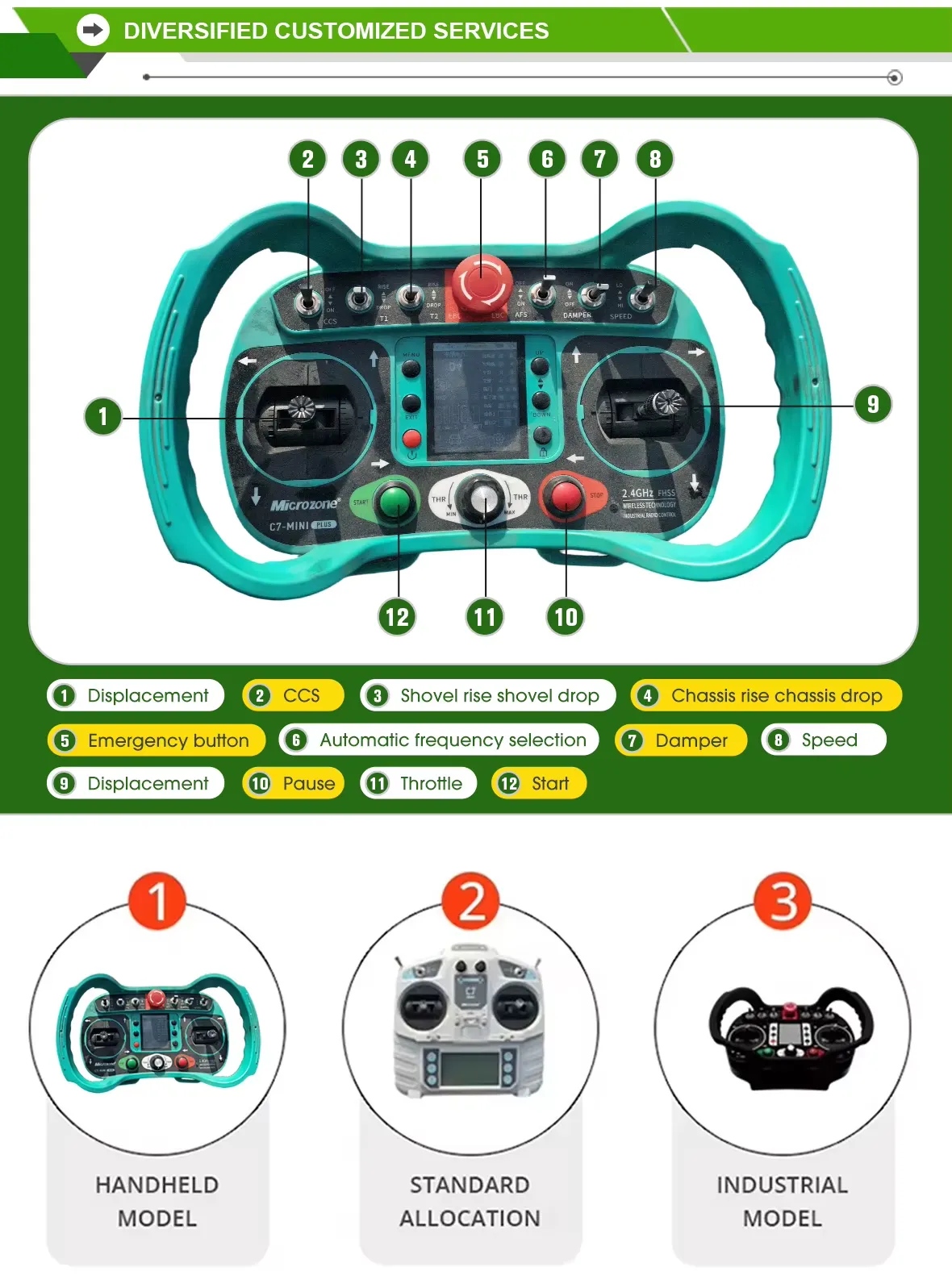
The transmitter is the operator’s interface. Depending on the machine, it may include controls for direction, speed, throttle, starting, stopping, pause, cutting-height adjustment, chassis movement, or other functions. A supplied controller diagram for Yitaiwei equipment labels displacement, CCS, shovel rise and drop, chassis rise and drop, emergency button, automatic frequency selection, damper, speed, pause, throttle, and start.
Those labels show the range of functions presented on the controller, but the exact operating procedure and the meaning of individual controls must be confirmed in the manual for the selected model. A button labeled for a particular function does not by itself establish how the machine will respond in every condition.
The receiver and control unit
The receiver is the communication point on the mower. It listens for commands from the transmitter and passes valid inputs to the control system. The control system then coordinates the requested action. For example, a direction command may be converted into different drive speeds on the left and right sides so the machine turns.
This arrangement allows an operator to stand away from the cutting deck and guide the machine from a position with a better view of the work area. It does not remove the need for supervision. Radio range can be affected by terrain, obstructions, interference, antenna position, and operating conditions, and a listed range should not automatically be treated as a safe working distance.
Drive, cutting, and adjustment systems
The drive system moves the mower and provides steering. The cutting system powers the blades or other cutting components, while adjustment mechanisms set the cutting height when the model provides that function. These systems may be linked through a central control unit, but they do not all perform the same job.
Remote operation is useful because it separates the operator from the machine during the mowing pass. However, the operator still has to select a suitable route, monitor obstacles and people, manage speed, and stop the machine when conditions change.
How the Mowing Cycle Works
1. Inspect the area and prepare the machine
Before starting, the operator should review the site, identify people, animals, vehicles, debris, drop-offs, wet areas, drainage features, and other hazards, then follow the manufacturer’s inspection and maintenance procedure. The cutting area should be clear enough for the selected machine and operating method.
Professional crews should also confirm fuel or electrical requirements, controller charge, communication status, cutting-height setting, and access around the work zone. Safety guidance from OSHA and the National Institute for Occupational Safety and Health provides general lawn-mower injury-prevention principles that should supplement, not replace, the model’s manual.
2. Start and position the mower
The operator uses the specified start control, then confirms that the machine responds correctly before beginning the cutting pass. Depending on the model, the start system may be manual, electric, remote, or an optional combination. The supplied YTW tables, for example, list manual/electric start optional for YTW-550L-B, manual/electric start for YTW-550S-Z, remote control for YTW-800L and YTW-800T, remote start for YTW-900T, and standard starter for YTW-1000T.
These descriptions should be kept attached to their exact models. They should not be generalized into one start procedure for the whole product range.
3. Guide the cutting pass
Once the mower is positioned, the operator uses directional and speed controls to guide it through the planned pass. Steering may be achieved by changing the speed of separate drive sides or by operating a steering mechanism, depending on the design. The operator normally adjusts speed to the vegetation, ground conditions, visibility, and available stopping distance.
The mower cuts only where the deck and cutting system physically travel. Remote control does not make the machine aware of property boundaries, obstacles, pedestrians, or the quality of the finished cut unless the model documentation specifically describes additional sensing or automation functions.
4. Pause, stop, and secure the machine
At the end of a pass, the operator pauses or stops movement, disengages the cutting system when required, and follows the shutdown procedure. The controller diagram supplied for the Yitaiwei range labels an emergency button, but the response time, stopping behavior, and required safety checks must be confirmed for the exact machine.
When clearing material, inspecting the deck, changing settings, refueling, or performing maintenance, use the manufacturer’s isolation and shutdown procedure. Never treat a stopped remote command as proof that all stored energy or moving parts are safe to approach.
Remote Control Versus Autonomous Robot Mowers
A remote control mower and an autonomous robot mower can both reduce the operator’s time on the machine, but they work differently.
- Remote control mower: A person sends movement and operating commands through a handheld transmitter and monitors the machine during the task.
- Autonomous robot mower: The machine is designed to plan or follow mowing activity with less continuous human steering, usually through defined navigation, scheduling, boundary, or sensing functions.
A remote control model may be the more relevant category when a professional operator needs active control over direction, speed, starting, stopping, or cutting passes. It should not be marketed or evaluated as autonomous unless the manufacturer specifically documents autonomous navigation and the associated operating limits.
How to Compare Remote Control Lawn Mower Models
Read range and gradient figures correctly
The supplied YTW product tables list an RC range of 500m for all six models below. They also list a field called Max gradient. That field is useful for identifying differences in the published parameter tables, but it is not a guaranteed safe working slope. The tables do not define the test method, surface, load, direction, weather, or safety margin.
| Model | Mowing width | Cutting height | RC range | Max gradient | Travel speed |
|---|---|---|---|---|---|
| YTW-550L-B | 550mm | 1-20cm | 500m | 50° | 0-4km/h |
| YTW-550S-Z | 550mm | 30-70mm | 500m | 60° | 0-5km/h |
| YTW-800L | 800mm | 20-100mm | 500m | 45° | 5km/h |
| YTW-800T | 800mm | 100-200mm, electric adjustment | 500m | 60° | 0-6km/h |
| YTW-900T | 900mm | 20-200mm, adjustable | 500m | 60° | 0-6km/h, adjustable |
| YTW-1000T | 1000mm | 100-200mm, electric adjustment | 500m | 60° | 0-6km/h |
Actual performance may vary with terrain, vegetation, operating conditions and machine configuration. Confirm the final specification with the manufacturer before ordering.
Match cutting controls to the work plan
Compare mowing width with the required pass pattern, but remember that width alone does not determine productivity. Vegetation density, overlap, turning time, obstacles, operator visibility, and site layout all influence the completed work. Cutting-height information also needs careful reading: a range such as 20-200mm is different from a single listed setting, and electric adjustment does not describe the adjustment procedure or operating conditions by itself.
Review whether the machine offers the controls the crew actually needs, including speed adjustment, pause, start, emergency stopping, and cutting-height control. Confirm the controller layout and operating sequence before purchase or deployment.
Review power, weight, and delivery details
Power and weight affect transport planning, access, loading equipment, and service arrangements. The supplied tables list different power, engine, displacement, tank, and weight values across the six YTW models. Some fields contain multiple values, such as 7.5/9HP, 16 or 23HP, or 22/25/27HP, without identifying the configuration mapping.
Do not combine values between models or select one option from a multi-value field without written model confirmation. Ask for the final configuration, dimensions with defined measurement order, delivery weight, starter type, engine designation, and the operating manual for the exact unit.
Check support and operating documentation
A professional purchase should include more than a headline range or gradient figure. Request documentation covering inspection, controller pairing, emergency stopping, cleaning, blade or cutting-component service, lubrication, fuel or electrical requirements, storage, transport, and operator training.
Also confirm how the machine behaves if communication is interrupted, how quickly it stops, whether the cutting system disengages, and what visual or audible indicators are provided. These are operating questions, not assumptions to make from a product photograph or controller diagram.
Safety and Operating Discipline
Remote operation can improve operator positioning, but it does not eliminate hazards from rotating cutting components, moving machinery, slopes, debris, traffic, or other people entering the work area. Establish a controlled mowing zone, keep unauthorized people away, maintain a clear view of the machine where required, and use a communication process when more than one worker is present.
Do not use a published RC range as permission to operate beyond visual awareness or outside the manufacturer’s instructions. Do not use a published gradient value as a safe slope rating. Stop work when traction, visibility, signal quality, weather, vegetation, or site conditions become unsuitable.
Frequently Asked Questions (FAQ)
How does a remote control lawn mower work?
A handheld transmitter sends wireless commands to a receiver on the mower. An onboard control system interprets the commands and directs the drive, steering, starting, stopping, speed, and cutting-related systems that the model supports.
Is a remote control lawn mower fully autonomous?
No. Remote control means that a person operates the machine from a distance. Unless the manufacturer documents autonomous navigation, mapping, obstacle detection, or scheduling functions, the operator remains responsible for route selection and continuous monitoring.
How far can a remote control lawn mower operate?
The six supplied YTW tables list an RC range of 500m. The listed distance is not automatically a safe operating limit because the tables do not define line-of-sight, interference, terrain, or test conditions. Confirm the practical operating procedure with the manufacturer.
Can a remote control mower cut steep slopes?
Some product tables list a Max gradient value, but that value should not be described as a guaranteed safe working slope. Surface, direction, load, vegetation, weather, traction, stopping distance, and test method can affect operation. Use only the exact manufacturer’s operating limits.
What should a contractor verify before buying one?
Verify the exact model configuration, cutting width and height, control functions, start system, power and engine details, machine and package weight, transport dimensions, RC test conditions, slope limits, communication-loss behavior, maintenance requirements, spare parts, training, and service support.
Practical Conclusion
A remote control lawn mower combines a handheld transmitter, wireless receiver, control electronics, drive system, and cutting equipment so an operator can guide the machine from a distance. The right selection depends on the exact control functions, documented operating limits, site conditions, transport requirements, and service support. Use product-table values for comparison, confirm the final configuration with the manufacturer, and treat safe operation as an active operator responsibility rather than an automatic benefit of remote control.