
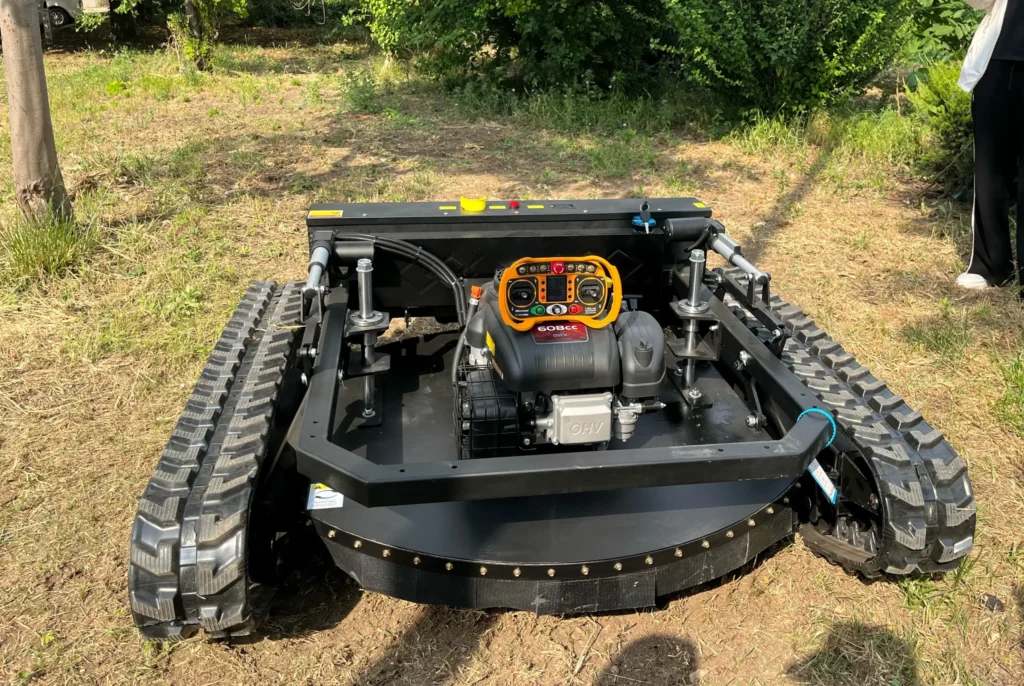
For most commercial mowing in hard-to-reach areas, the best mower category is a remote-control mower matched to the site’s access width, terrain, vegetation, cutting height, and operating requirements. Remote control allows an operator to direct the machine from a position away from the cutting deck. That makes this equipment different from a fully autonomous robot lawn mower, which relies on automated navigation and programmed operation.
Professional buyers should compare measurable specifications first. Cutting width, cutting-height range, listed gradient, travel speed, remote-control range, overall dimensions, and machine weight determine whether a model can be evaluated for a particular site. The figures below are supplied Yitaiwei product parameters and remain tied to their exact models.
- Choose remote control when direct operator control is important on difficult terrain.
- Compare the machine’s physical dimensions with the narrowest access route.
- Read a listed maximum gradient as a product parameter, not as a guaranteed safe working slope.
- Confirm test conditions, operating limits, runtime, service requirements, and configuration before ordering.
Why Remote-Control Mowers Suit Difficult Access
Hard-to-reach mowing areas can include steep embankments, uneven ground, roadside slopes, drainage edges, orchards, vineyards, overgrown lots, and sites where a conventional ride-on mower cannot approach safely or physically fit. The common problem is not simply grass height. It is the combination of access, traction, surface condition, visibility, clearance, and operator position.
Remote control is different from autonomous mowing
A remote-control lawn mower is directed by an operator using a controller. The operator controls movement and mowing activity while observing the machine and the surrounding area. A fully autonomous robot mower is designed to navigate and operate through automated programming, sensors, boundaries, or mapping. These are different equipment categories and should not be evaluated with the same buying criteria.
For professional work, remote control can be useful when the operator needs immediate control over direction, speed, stopping, or repositioning. The supplied Yitaiwei controller diagram labels functions including speed, throttle, pause, start, displacement, and an emergency button. The exact operating procedure and safety conditions still need to be confirmed in the model’s manual.
Access is a design requirement
Before comparing engine power or mowing speed, measure the site. Record the narrowest gate, path, bridge, ramp, turning area, overhead clearance, and loading point. A mower that cannot reach the work area, turn without striking an obstacle, or be transported to the site is not the best mower for that property, regardless of its nominal cutting capacity.
Yitaiwei Remote-Control Mower Specifications Compared
The following table focuses on fields that directly affect an initial equipment comparison. It does not rank the models or assign a model to a particular customer, terrain, or application.
| Model | Mowing width | Cutting height | Operation | RC range | Max gradient listed |
|---|---|---|---|---|---|
| YTW-550L-B | 550 mm | 1-20 cm | Remote control | 500 m | 50 degrees |
| YTW-550S-Z | 550 mm | 30-70 mm | Remote control | 500 m | 60 degrees |
| YTW-800L | 800 mm | 20-100 mm | Remote control | 500 m | 45 degrees |
| YTW-800T | 800 mm | 100-200 mm, electric adjustment | Remote control | 500 m | 60 degrees |
| YTW-900T | 900 mm | 20-200 mm, adjustable | Remote start | 500 m | 60 degrees |
| YTW-1000T | 1000 mm | 100-200 mm, electric adjustment | Remote control | 500 m | 60 degrees |
The max-gradient field is a value listed in the supplied parameter tables. It is not a recommended or safe working slope. The RC range is also a listed range, not a guarantee of reliable operation at every distance or site. Actual performance may vary with terrain, vegetation, operating conditions and machine configuration. Confirm the final specification with the manufacturer before ordering.
How to Choose the Best Mower for Hard-to-Reach Areas
1. Match the machine to the terrain
Describe the work surface precisely. A smooth embankment, loose soil, wet grass, rocks, ruts, and dense brush create different operating conditions. Measure the slope and identify whether the machine will travel across the slope, straight up and down, or on changing grades. Direction, surface, load, weather, attachments, and operator visibility can all affect the practical operating decision.
Do not convert a listed gradient into a safe operating recommendation. Instead, ask the manufacturer for the relevant operating manual, test method, surface conditions, load assumptions, and safe operating limits for the exact model and configuration. This is especially important for roadside slopes, drainage areas, and properties where a machine could roll or slide into a hazard.
2. Check width, height, and transport dimensions
Mowing width affects coverage, but it is only one part of access planning. A 550 mm mower may pass through a narrower opening than an 800, 900, or 1000 mm model, while a wider deck may reduce the number of passes on an open section. The correct comparison depends on the full route, not just the mowing area.
Check unit dimensions, package size, machine weight, gross weight, ramps, trailers, bridges, and lifting equipment. The supplied tables do not define the order of the listed dimensions, so confirm which measurement is length, width, and height before finalizing transport or storage arrangements.
3. Compare cutting height with the vegetation
Cutting-height range matters when a site contains long grass, weeds, brush, or areas that require a higher first pass. The YTW-550L-B lists a cutting height of 1-20 cm. YTW-550S-Z lists 30-70 mm. YTW-800L lists 20-100 mm, while YTW-800T and YTW-1000T list 100-200 mm with electric adjustment. YTW-900T lists 20-200 mm with adjustable cutting height.
These fields describe the supplied model parameters. They do not establish blade design, vegetation limits, mowing efficiency under a specific crop, or wet-grass capability. Ask for the operating manual and attachment information when the work involves dense growth, woody stems, wet vegetation, or a specialized finish.
4. Evaluate control range and operator workflow
All six YTW models in the supplied table list an RC range of 500 m. For site planning, confirm whether that figure assumes line of sight, open ground, no radio interference, a particular antenna position, or another test condition. Also confirm what happens if the signal is interrupted and how the operator stops or repositions the machine.
Pay attention to the exact operation wording. Most of the listed models say remote control, while YTW-900T says remote start. That wording should not be expanded into a broader claim about remote operation without model-specific documentation.
5. Consider speed, power, and configuration together
Travel speed can affect positioning and work rhythm, but it is not a direct measure of mowing output. The supplied table lists travel speeds from 0-4 km/h for YTW-550L-B, 0-5 km/h for YTW-550S-Z, 5 km/h for YTW-800L, and 0-6 km/h for YTW-800T, YTW-900T, and YTW-1000T, with the latter two table entries including adjustable wording where stated.
Some models also show configuration options. YTW-550L-B lists 9.5HP and a Loncin engine brand. YTW-800T lists a 16HP gasoline engine and Loncin 452. YTW-1000T lists a 22/25/27HP gasoline engine and Loncin 608. These values should remain attached to their exact model and configuration. Confirm which option will be supplied, along with the engine rating method, fuel requirements, runtime, and maintenance schedule.
A Practical Commercial Buying Process
- Survey the route. Measure access width, slope, surface, obstacles, turning space, overhead clearance, and transport requirements.
- Define the vegetation. Record normal height, maximum height, density, moisture, woody material, and the required finish.
- Set specification thresholds. Identify the minimum width, cutting-height range, control method, speed, weight, and dimensions required for the job.
- Request model-specific documentation. Ask for the manual, configuration sheet, slope test conditions, RC-range conditions, service information, and compatible attachments.
- Confirm the commercial package. Clarify delivery configuration, spare parts, training, support, warranty, and lead time in the quotation.
For general powered-mower safety planning, consult OSHA’s lawn mower safety guidance and the U.S. Consumer Product Safety Commission lawn mower safety alert, then apply the exact instructions supplied for the machine.
Frequently Asked Questions (FAQ)
What is the best mower for hard-to-reach areas?
The best category is usually a remote-control mower when the site has difficult access, steep or uneven ground, dense vegetation, or limited room for an operator to work beside the cutting deck. Select the exact model by comparing access dimensions, listed operating parameters, vegetation requirements, control conditions, transport needs, and manufacturer guidance.
Are remote-control lawn mowers fully autonomous?
No. A remote-control lawn mower is directed by an operator using a controller. A fully autonomous robot lawn mower is designed to navigate and mow through automated programming and sensing. The supplied YTW tables identify operation as remote control or remote start, so buyers should not treat these models as autonomous systems without separate documentation.
Can a remote-control mower work on steep slopes?
Some parameter tables list a maximum gradient, but that number is not automatically a safe working slope. Ask for the exact test method, surface, direction of travel, load, weather assumptions, configuration, and operating limit. The operator should follow the model manual and site safety procedures before using equipment on a slope.
What specifications should commercial buyers compare?
Start with mowing width, cutting-height range, unit dimensions, machine weight, travel speed, operation method, RC range, listed gradient, power configuration, and transport requirements. Then confirm runtime, service intervals, attachments, warranty, and safety procedures because these fields are not all provided in the supplied YTW parameter tables.
Can these mowers cut wet grass or overgrown vegetation?
The supplied product parameters do not establish wet-grass limits or a universal overgrown-vegetation capability. Treat wet ground, dense growth, woody stems, and poor visibility as separate operating conditions. Confirm the permitted vegetation, cutting system, weather limits, and attachment compatibility for the exact model before including it in a work plan.
Conclusion
The best mower for hard-to-reach areas is the remote-control model whose verified dimensions, cutting range, control method, and operating parameters match the actual site. Use the YTW comparison table to create a shortlist, then confirm configuration, test conditions, safety limits, service support, and transport details with the manufacturer before placing an order.