
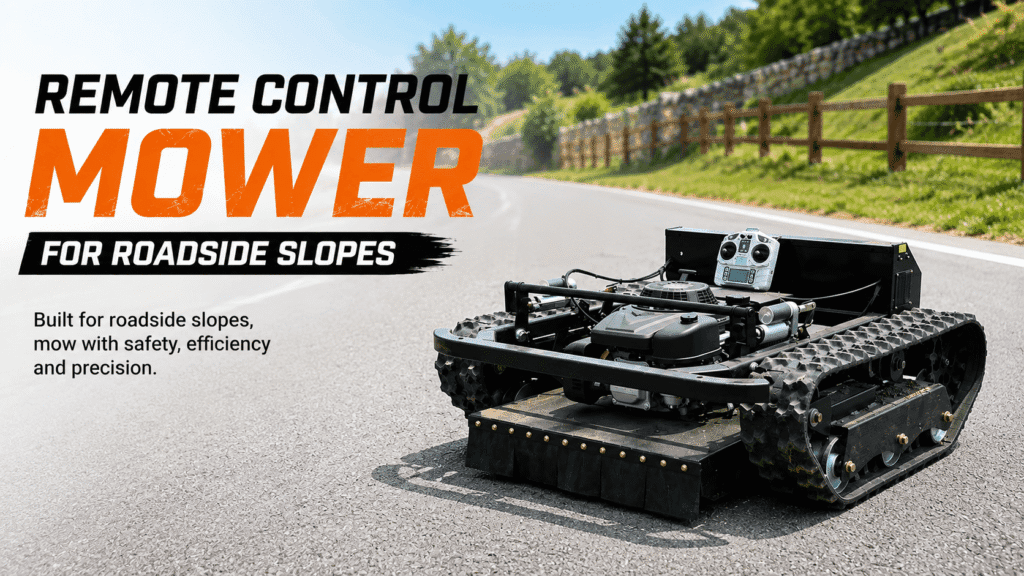
A remote control mower for roadside slopes can help professional crews maintain embankments, verges, ditches, and other areas where placing an operator on a ride-on mower is impractical. The right choice depends on the machine’s model-specific gradient rating, traction, cutting width, control system, transport needs, and the actual site conditions.
These machines are operator-controlled through a handheld transmitter. They are not fully autonomous robotic lawn mowers. The operator still controls travel, steering, speed, cutting, and emergency response while maintaining a clear view of the machine and work area.
What Makes a Remote Control Mower Suitable for Roadside Slopes?
Remote control is different from autonomous mowing
A remote control mower follows commands from an operator who remains away from the machine. This can reduce direct exposure to vibration, exhaust, noise, and the mower’s immediate travel path, but it does not remove hazards to workers, road users, pedestrians, property, or nearby traffic.
An autonomous robotic lawn mower follows a programmed route or navigation system. A remote control slope mower requires active human operation and observation throughout the task. For roadside work, that distinction matters because changing shoulders, drainage edges, vehicles, debris, and unexpected obstacles require immediate judgment.
Roadside work requires more than cutting capacity
Roadside slopes are rarely uniform lawns. They may combine compacted soil, loose gravel, wet grass, ruts, drainage channels, rocks, guardrails, signs, culverts, and limited access. A machine that appears suitable by cutting width alone may be difficult to deploy, recover, or control on a constrained route.
A California Department of Transportation study on roadside mowing found that obstacles and restricted maneuvering could make areas unsuitable for conventional equipment even when the grade itself was shallower. The study also identified steep or constrained roadside areas otherwise maintained with string trimmers as candidates for remote-control mowing. Read the California roadside mower evaluation for the specific equipment and conditions covered by that research.
How to Choose a Remote Control Mower for Roadside Slopes
Interpret gradient ratings carefully
Manufacturers may publish a maximum gradient or climbing angle, but that value should remain attached to the exact model and original field wording. It should not automatically be treated as a recommended working slope, a safe operating guarantee, or an all-terrain promise.
Before comparing numbers, determine whether the rating applies to cross-slope travel, uphill or downhill travel, a particular attachment, a specific surface, or a controlled test. Wet grass, loose soil, side-hill turning, uneven loads, weather, and visibility can change the practical operating conditions. The safest procurement process uses the model’s operating manual together with a site survey and a defined work method.
OSHA’s riding-mower guidance advises following the manufacturer’s slope limits and evaluating terrain hazards such as wet areas, embankments, drop-offs, and waterways. Although that guidance is written for riding mowers rather than remote machines, its emphasis on documented limits, inspection, training, and hazard control is relevant to professional mowing programs.
Match traction and cutting design to the vegetation
Roadside mowing may involve fine grass, tall weeds, brush, or mixed vegetation. Ask the manufacturer which cutting deck and attachment are available for the exact model, and confirm the permitted vegetation type, cutting height, debris limits, and maintenance requirements.
Cutting width affects the number of passes required, but a wider deck is not automatically better. Narrower equipment may be easier to position near barriers, drainage features, and tight access points. Wider equipment may reduce passes on open verges if the route, transport method, and ground conditions support it.
Traction should be assessed alongside ground pressure, weight distribution, turning behavior, braking or holding behavior, and the effect of wet or loose ground. If the machine uses tracks, ask how track tension, cleaning, and replacement are handled. If it uses wheels, confirm how wheel slip and side-hill movement are managed on the intended surface.
Review the control and emergency systems
Compare more than the advertised remote-control range. A professional specification review should cover line-of-sight requirements, signal-loss behavior, emergency-stop controls, restart behavior, controller feedback, speed adjustment, cutting engagement, and the operator’s required position.
The operator should be able to see the mower, the route, the discharge area, and nearby people or vehicles. A long nominal range does not make a blocked view or a hazardous operating position acceptable. Confirm whether the machine stops, brakes, disengages the cutter, or follows another response when communication is interrupted. These functions vary by model and must be confirmed in the relevant manual.
Use a clearly defined exclusion zone around the mower and its potential slide, rollover, travel, and debris paths. Clear loose rocks, wire, branches, and other objects before cutting. The University of Minnesota Extension notes that rotary mower blades can throw objects and recommends removing debris, keeping spectators away, and delaying mowing when grass is wet. Review its mowing safety guidance for general principles, while giving the selected machine’s manual priority.
Plan transport and field deployment
Roadside equipment must be transported to the work area, unloaded safely, positioned without blocking traffic, and recovered at the end of the task. Compare net weight, gross weight, unit dimensions, package size, loading equipment, trailer capacity, and access restrictions.
Also ask about dealer coverage, replacement parts, service access, cleaning points, engine or motor support, control-system troubleshooting, and operator training. A mower that fits the slope rating but cannot be transported or serviced efficiently may not be the right commercial asset.
Yitaiwei YTW Model Comparison
The supplied Yitaiwei parameter tables list the following six YTW models. The comparison keeps the original model-specific fields and does not convert the listed maximum gradient into a safe working limit.
| Model | Mowing width | Max gradient listed | RC range | Travel speed | Power listed |
|---|---|---|---|---|---|
| YTW-550L-B | 550mm | 50° | 500m | 0-4km/h | 9.5HP |
| YTW-550S-Z | 550mm | 60° | 500m | 0-5km/h | 7.5/9HP |
| YTW-800L | 800mm | 45° | 500m | 5km/h | 16 or 23HP |
| YTW-800T | 800mm | 60° | 500m | 0-6km/h | 16HP gasoline engine |
| YTW-900T | 900mm | 60° | 500m | 0-6km/h, adjustable | 1500W |
| YTW-1000T | 1000mm | 60° | 500m | 0-6km/h | 22/25/27HP gasoline engine |
The table is useful for narrowing the specification conversation. For example, the YTW-550L-B and YTW-550S-Z list 550mm mowing widths, while the YTW-1000T lists 1000mm. The YTW-900T lists a 900mm width and adjustable travel speed. Those differences can affect route planning, access, transport, and expected pass count, but they do not establish which model is suitable for a particular property.
The supplied tables list a 500m RC range for all six YTW models. Confirm the operating environment, line of sight, interference conditions, and the manufacturer’s defined safe operating limit before relying on that figure in a roadside workflow. Actual performance may vary with terrain, vegetation, operating conditions and machine configuration. Confirm the final specification with the manufacturer before ordering.
Roadside Procurement Checklist
Survey the work route
- Measure representative slopes and identify whether the work requires cross-slope, uphill, downhill, or mixed travel.
- Mark drop-offs, ditches, water, culverts, retaining walls, guardrails, signs, utility features, and soft ground.
- Identify public access, traffic exposure, pedestrians, workers, animals, and areas that require exclusion.
- Record vegetation height, density, woody growth, debris, wetness, and seasonal changes.
- Confirm where the operator can stand while maintaining visibility and a clear escape route.
Compare the complete operating system
- Model-specific maximum gradient and operating manual.
- Traction system, ground-contact behavior, steering, braking, and slope holding.
- Cutting width, height adjustment, cutter engagement, deck design, and debris tolerance.
- Remote range, line-of-sight requirements, signal-loss response, and emergency stop.
- Transport weight, dimensions, loading method, fuel or electrical requirements, and service access.
Request configuration details before ordering
Several supplied YTW tables preserve alternative configurations, including 7.5/9HP, 16 or 23HP, and 22/25/27HP. Ask the manufacturer to identify the exact engine, drive, tank, weight, and control configuration for the quotation. Also confirm the meaning of terms such as Remote start, the listed motor or drive notation, and any optional start system.
Request the current manual, parts information, maintenance schedule, training materials, and written operating limits for the exact model. Keep the selected configuration and intended attachment together in the purchasing record so the field crew receives instructions for the machine actually delivered.
Frequently Asked Questions (FAQ)
Are remote control mowers fully autonomous?
No. A remote control mower is operated by a person using a handheld controller. The operator directs the machine and must continue to monitor the route, cutting area, surroundings, and emergency conditions. That is different from a fully autonomous robotic lawn mower that follows a programmed mowing pattern.
What gradient should a roadside remote control mower handle?
There is no universal answer. Use the exact model’s published limit and operating manual, then account for surface, direction, moisture, vegetation, turning, obstacles, load, and required safety margin. A listed maximum gradient is not automatically a safe working slope.
Is a 500m remote-control range enough for roadside work?
It may be adequate for some sites, but range alone does not determine suitability. The operator needs a reliable connection, clear visibility, awareness of the machine’s path, and a safe position. The supplied YTW tables list 500m for six models, but the manufacturer should confirm the test conditions and operating limits for the selected configuration.
Which Yitaiwei YTW model has the widest mowing width?
The supplied table lists the YTW-1000T with a 1000mm mowing width. The YTW-900T lists 900mm, the YTW-800L and YTW-800T list 800mm, and the YTW-550L-B and YTW-550S-Z list 550mm. Width should be evaluated together with access, terrain, transport, vegetation, and the required operating method.
Can a remote control mower cut wet roadside grass?
Wet grass can change footing, traction, visibility, cutting behavior, and access conditions. Inspect the route and follow the selected model’s manual before starting. Where the surface becomes unstable or visibility is inadequate, postpone the task or use a different approved work method.
A remote control mower for roadside slopes is best selected as a complete work system rather than by gradient or mowing width alone. Match the exact model to the route, vegetation, control requirements, transport plan, and trained operating procedure, then confirm the final configuration and limits with the manufacturer.