
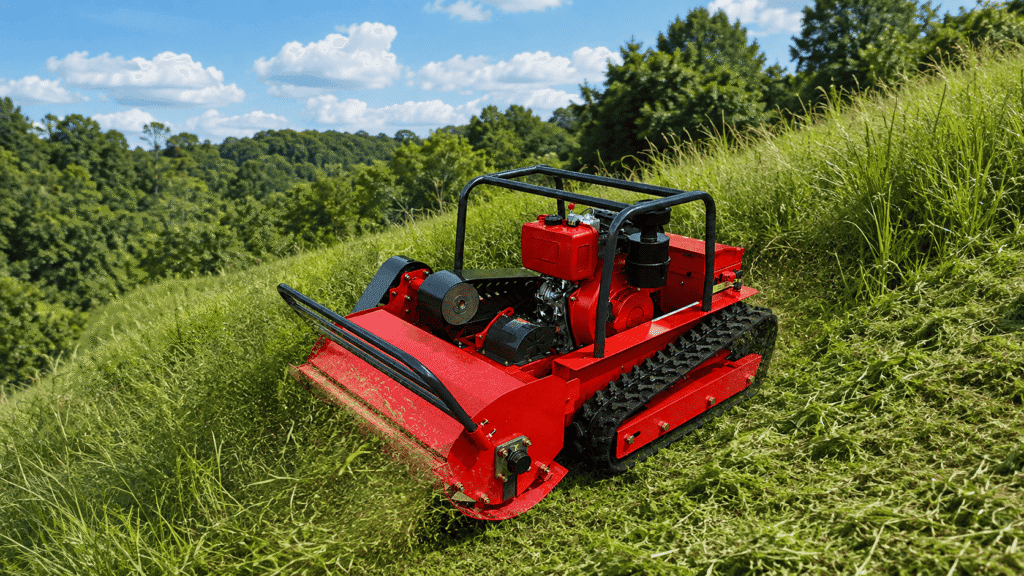
The best lawn mower for hills and uneven ground is usually a remote control mower configured for the dominant terrain and vegetation. A tracked mower is the first type to evaluate for steep, rutted, rough, or loose ground. A flail mower is more relevant when tall and dense grass is the main problem, while a wheeled remote mower may suit firmer, more even sections with clear access.
Most mixed properties contain more than one condition. Instead of expecting one feature to solve every problem, divide the land into work zones and match the chassis, cutting system, and machine size to each zone. YITAIWEI develops tracked, flail, and wheeled remote control mower families that can be considered within this zone-based approach.
Table of Contents
- Why Hills and Uneven Ground Need a Different Approach
- Divide the Property Into Mowing Zones
- Terrain-to-Mower Decision Table
- Why a Tracked Remote Mower Often Leads the Shortlist
- When a Flail Mower Is the Better Choice
- When a Wheeled Remote Mower Makes Sense
- How to Compare Mowers Without Reading Every Parameter
- A Practical Buying Process
- Frequently Asked Questions (FAQ)
- Conclusion
Why Hills and Uneven Ground Need a Different Approach
Level lawn mowing is mainly about coverage and finish. Hilly, uneven land adds ground contact, visibility, hidden obstacles, difficult turns, and changing cutting loads. A wide deck or high horsepower figure does not resolve those issues by itself.
The Average Slope Can Be Misleading
A property may have a gentle average grade but include short steep banks, drainage channels, transitions, and crests. Measure the most demanding sections and the routes needed to reach them. The machine must complete turns and exits as well as straight passes.
Uneven Ground Changes Cutting Height
Ruts, humps, roots, and depressions can cause scalping or ground contact if the cutting system cannot follow the surface. Cutting-height adjustment, deck shape, ground clearance, and a deliberate travel speed should be considered together. Starting higher may be appropriate when reclaiming unknown or overgrown ground, where permitted by the equipment instructions.
Vegetation Can Hide the Terrain
Tall grass and weeds may conceal stones, wire, holes, stumps, or soft soil. Inspect and mark the area before mowing. Where the ground cannot be fully seen, plan a conservative first pass and stop after any unexpected impact, vibration, or change in machine response.
Divide the Property Into Mowing Zones
Zone planning prevents a buyer from selecting one mower around the easiest part of the property and then using it on terrain it was not chosen to handle. Draw a basic property map and label each area by slope, surface, vegetation, access, and nearby hazards.
Steep and Rough Zones
These sections may include banks, ruts, exposed roots, loose soil, or irregular transitions. A tracked remote control mower is the product family to investigate first. Remote operation separates the operator from the machine, while the tracked chassis provides a different ground-contact layout from normal turf wheels.
Heavy Vegetation Zones
Areas with tall grass, dense grass, repeated seasonal growth, or neglected vegetation require attention to the cutting system. A flail configuration can be more appropriate than a finish-mowing deck. The exact vegetation limit must be confirmed for the supplied cutting head rather than assumed from the mower’s engine rating.
Firm and Accessible Zones
Some parts of a hilly property may be relatively even, firm, and open. A wheeled remote control mower can be considered where maneuverability, simpler access, and frequent turning are priorities. The exact model still needs documented approval for the measured slope and surface conditions.
Hand-Finish and No-Mower Zones
Posts, rocks, narrow drainage features, retaining edges, and confined corners may require a handheld tool or manual clearing. Other areas may be unsuitable for mowing under current conditions. Identifying these zones is part of selecting the best equipment, not evidence that the mower has failed.
Terrain-to-Mower Decision Table
| Property zone | Mower type to evaluate | Primary reason | What to confirm |
|---|---|---|---|
| Steep, rutted, or rough hill | Tracked remote control mower | Chassis developed for difficult-terrain movement | Slope limits, travel direction, stopping behavior, and track condition |
| Loose-stone or gravelly route | Tracked remote control mower | Ground-contact layout suited to rough surfaces | Obstacle removal, guarding, route visibility, and surface stability |
| Tall or dense grass | Remote control flail mower | Cutting concept aimed at heavier vegetation management | Flail head, vegetation limits, cutting height, and wear parts |
| Firm, more even slope | Wheeled remote control mower | Maneuverability on accessible ground | Tire grip, slope approval, turning room, and weather limits |
| Level maintained lawn | Appropriate finish mower | Coverage and cut quality become higher priorities | Deck width, height adjustment, access, and desired finish |
| Obstacles and narrow edges | Handheld or specialist tool | Reaches areas unsuitable for a full mower | Footing, debris control, and operator protection |
The table is a shortlisting tool. It does not replace the operating limits and instructions for the exact machine.
Why a Tracked Remote Mower Often Leads the Shortlist
When both hills and uneven ground are central to the job, a tracked remote mower often deserves first consideration. The operator can select a separate viewing position, and tracks are designed around difficult-terrain movement. This combination can be useful for banks, rough fields, orchard slopes, roadside areas, and properties where walking behind a mower would be difficult.
Tracks Address Ground Contact, Not Every Hazard
Track performance changes with tread design, wear, soil, moisture, vegetation buildup, speed, load, and travel direction. Tracks do not guarantee traction or eliminate sliding. Loose stones should be treated as obstacles: remove visible debris where practical and avoid intentional contact with the cutting system.
Remote Operation Requires Visibility
The operator should maintain a clear view of the mower, the route ahead, and nearby people or property. Remote range is not a substitute for sightlines. Hills, vegetation, trees, and buildings can block the view even when a control signal remains available.
Machine Width Still Matters
A terrain-capable mower is not useful if it cannot pass through gates, travel between trees, turn at the top of a bank, or load onto the available trailer. Measure access and transport routes before comparing cutting widths or engines.
When a Flail Mower Is the Better Choice
If the ground is manageable but vegetation is tall, dense, or repeatedly overgrown, the cutting system may be more important than the chassis. YITAIWEI positions its remote control flail mower family for tall and dense grass management. A flail configuration should be considered when ordinary lawn finishing is not the primary objective.
Match the Flail Head to the Material
Do not assume that every flail head handles the same weeds, stems, or brush. Confirm the supplied cutting components, documented vegetation limit, cutting-height range, guarding, and replacement wear parts. If the site contains material outside those limits, use a separate clearing method.
Plan for Inspection and Maintenance
Heavy vegetation can wrap around moving parts or conceal debris. The machine should be fully stopped and disabled according to its instructions before inspection or clearing. Check flails, mounts, guards, and accumulated material after impacts or unusual vibration.
When a Wheeled Remote Mower Makes Sense
Not every uneven property requires tracks. A wheeled remote mower may be appropriate for firm, more predictable surfaces where access is straightforward and turning flexibility matters. It can also serve the easier zones of a larger property while tracked or flail equipment handles the difficult sections.
Evaluate the Surface After Weather Changes
Firm soil can become soft, slick, or rutted after rain. Dry cut grass can also reduce grip on an incline. Establish conditions under which the wheeled mower should not enter the slope and reassess after weather or irrigation changes.
Do Not Transfer Limits Between Models
Wheel size, tire pattern, machine weight, center of gravity, drive arrangement, and attachments differ. Use only the operating limits for the exact configuration. A limit associated with one wheeled mower should not be applied to another machine with a similar appearance.
How to Compare Mowers Without Reading Every Parameter
A focused shortlist is more useful than a complete catalog table. Compare the fields that answer a known site problem and omit specifications that do not affect the decision.
- For access: machine width, transport dimensions, turning space, and loading method.
- For terrain: chassis type, documented slope limits, travel direction, ground clearance, and stopping behavior.
- For vegetation: cutting system, documented material capability, cutting height, and guarding.
- For operation: control response, emergency stop, visibility requirements, inspection access, and training.
- For ownership: wear parts, filters, tracks or tires, service instructions, warranty terms, and supplier support.
This method also reduces the risk of choosing a mower because it has the largest number in a brochure. A specification matters only when it connects to a measured property requirement.
A Practical Buying Process
- Map the property into steep, rough, heavy-growth, firm, maintained, and hand-finish zones.
- Measure slopes, gates, passages, turns, transport access, and nearby hazards.
- Inspect vegetation and identify whether the job needs lawn finishing, heavy-grass cutting, or separate brush clearing.
- Select the chassis and cutting system for the hardest recurring zone.
- Decide whether one machine can cover the remaining zones within its documented limits.
- Confirm the exact configuration, controls, safety information, parts support, and maintenance requirements with the supplier.
- Create a work plan with weather limits, exclusion zones, operator positions, and stop-work conditions.
For a mixed property, the best answer may be a primary remote mower plus a smaller supporting tool. Forcing one machine into narrow obstacle zones or vegetation beyond its cutting system can reduce both efficiency and control.
Frequently Asked Questions (FAQ)
What type of mower is best for both hills and uneven ground?
A tracked remote control mower is usually the first type to evaluate because its chassis is developed for difficult terrain and the operator can work from a separate position. Final suitability depends on the measured slope, surface, vegetation, route, and exact manufacturer limits.
Are tracks always better than wheels on uneven ground?
No. Tracks can be useful on steep, rough, rutted, or loose surfaces, while wheels may be more practical on firm, relatively even areas. Neither layout is universally better. Match the chassis to the dominant zone and verify the exact operating conditions.
What mower should I use for tall grass on a hill?
Consider a remote control flail mower when tall or dense grass is the main cutting challenge. Also verify that the chassis matches the hill. The supplied flail head, vegetation limits, cutting height, guarding, and travel instructions should be confirmed before operation.
Can a mower travel over loose stones?
A tracked chassis can be evaluated for rough or loose-stone ground, but stones are not material for the cutting system. Inspect the route, remove visible debris where practical, avoid intentional blade contact, and stop after unexpected impact or vibration.
Do I need more than one mower for a mixed property?
Possibly. One remote mower may handle the main hillside while a wheeled mower or conventional finish mower covers easier turf and a handheld tool reaches obstacles. Dividing the property into zones helps determine whether one configuration can cover the work within documented limits.
Conclusion
The best lawn mower for hills and uneven ground should be chosen by property zone, not by one headline specification. Start with a tracked remote control mower for steep or rough terrain, consider a flail configuration for tall and dense grass, and use a wheeled mower where the surface is firmer and more even. YITAIWEI offers these three remote control mower families, allowing buyers to build a shortlist around the actual terrain and vegetation. Confirm the exact configuration and operating limits before ordering.