
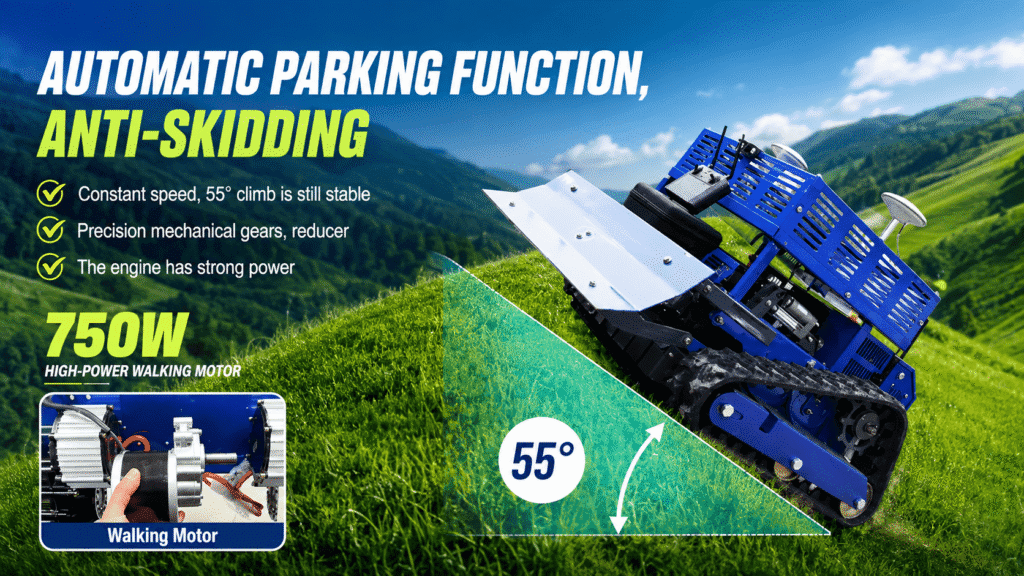
A slope mower should be selected from the property backward: measure the terrain, identify the vegetation, map access and turns, then choose the chassis and cutting system. For steep or rough ground, a tracked remote control mower is usually the first type to evaluate. For tall and dense grass, a flail configuration may be more important than deck width. For firm, relatively even slopes, a wheeled remote mower may provide a practical alternative.
This slope mower buying guide focuses on the questions that affect real ownership rather than presenting every catalog specification. YITAIWEI offers tracked, flail, and wheeled remote control mower families, allowing buyers to shortlist a configuration around the job instead of forcing one machine type onto every property.
Table of Contents
- Start With a Written Site Brief
- Choose Tracked or Wheeled Drive
- Select the Cutting System
- Slope Mower Buying Checklist
- Compare Access and Transport Before Cutting Width
- Evaluate the Remote Control System
- Review Maintenance and Parts Support
- Put the Exact Configuration in the Quotation
- Common Buying Mistakes
- Frequently Asked Questions (FAQ)
- Conclusion
Start With a Written Site Brief
Before comparing products, write a short description of the work. Include the steepest sections, total area, vegetation, ground condition, access restrictions, nearby hazards, expected mowing frequency, and desired finish. A supplier cannot recommend a suitable configuration from acreage alone.
Measure the Difficult Sections
Measure several points on the property, especially banks, transitions, drainage channels, approaches, and turning areas. Record whether the intended route runs across the slope or up and down it. The machine must be suitable for the complete route, not only the easiest straight pass.
Describe the Surface
State whether the site has firm turf, wet soil, loose ground, gravel, exposed roots, ruts, or hidden holes. Note seasonal changes. A dry hillside in summer may behave differently after rain or irrigation, so the buying brief should include the conditions under which work is expected.
Define the Vegetation
Separate maintained grass from tall grass, dense weeds, mixed growth, and woody material. Include approximate height, density, frequency of cutting, and the finish required. The cutting system should be selected from this description rather than from horsepower alone.
Choose Tracked or Wheeled Drive
The chassis determines how the machine moves through the site. Tracks and wheels can both be appropriate, but they solve different access and ground-contact problems.
When to Consider a Tracked Slope Mower
A YITAIWEI tracked remote control mower is the product family to investigate for steep, uneven, rutted, rough, or loose-stone terrain. Tracks provide a different contact pattern from ordinary wheels and are developed for difficult-terrain mowing applications. Actual grip still depends on track design, condition, surface, moisture, travel direction, speed, and machine configuration.
A tracked chassis does not make stones safe for the cutting system. Buyers should plan obstacle removal and ask about guarding, inspection, and stop-work procedures for rough routes.
When to Consider a Wheeled Slope Mower
A wheeled remote control mower can suit firm, relatively even slopes with clear access and adequate turning room. It may offer straightforward maneuverability for maintained areas or for the easier zones of a mixed property. Confirm tire arrangement, documented slope limits, weather restrictions, and travel direction for the exact model.
Do Not Choose by Appearance Alone
Two machines with a similar tracked or wheeled layout may have different weight distribution, drive systems, controls, cutting assemblies, and operating limits. Request documentation for the quoted configuration and avoid transferring a specification from another model.
Select the Cutting System
The best chassis can still produce poor results if the cutting system does not match the vegetation. Decide whether the job is lawn maintenance, heavy-grass management, reclamation, or brush clearing.
Flail Cutting for Tall and Dense Grass
A remote control flail mower should be considered when the recurring task involves tall or dense grass. YITAIWEI positions its flail mower family for heavier vegetation management. Ask which flail head is supplied, what material it is documented to handle, and which wear parts are included or readily available.
Rotary Cutting for Maintained Grass
A rotary-style cutting system may be sufficient where the site is mowed regularly and a lawn-like result matters. Compare cutting-height adjustment, deck protection, contour following, access for cleaning, and the effect of uneven ground on scalping.
Separate Brush From Grass
Woody stems and mixed brush may require a specialist head, attachment, or separate clearing step. Do not infer brush capacity from engine power or the word heavy-duty. Put the required vegetation capability in writing and ask the supplier to identify the matching cutting assembly.
Slope Mower Buying Checklist
| Buying factor | Information to provide | What to ask the supplier | Why it matters |
|---|---|---|---|
| Terrain | Measured slopes, travel direction, soil, ruts, and stones | Documented operating limits for the exact configuration | Determines whether the chassis fits the route |
| Vegetation | Grass height, density, weeds, and woody material | Cutting-head type and documented material capability | Prevents choosing by horsepower alone |
| Access | Gates, row spacing, turns, trailer, and storage | Machine and transport dimensions | Confirms the mower can reach and leave the site |
| Controls | Operator position, visibility, and work-zone layout | Normal stop, emergency stop, and signal-loss behavior | Supports predictable remote operation |
| Maintenance | Expected hours, dust, vegetation, and service location | Inspection schedule, wear parts, filters, and tools | Shows the real ownership workload |
| Commercial terms | Required configuration and delivery location | Included items, training, warranty, parts, and support | Reduces misunderstandings after ordering |
Compare Access and Transport Before Cutting Width
A wider mower may reduce passes on open ground, but it can become less useful if it cannot pass a gate, turn between trees, load onto the available trailer, or fit the storage area. Measure the complete logistics route from delivery to the work zone.
Machine Width and Turning Space
Record the narrowest gate or passage and the space available at slope tops, bottoms, and row ends. Ask whether guards, attachments, or transport components change the machine width. Include a practical clearance margin rather than matching the machine exactly to the opening.
Loading and Tie-Down
Confirm machine weight for the ordered configuration, the required loading method, approved tie-down points, and trailer capacity. Transport should be planned as part of the purchase, not after the mower arrives.
Recovery Planning
Ask how the machine should be recovered if it stops on a slope. A suitable procedure may require specific equipment or attachment points. Avoid a plan that depends on workers manually pushing or pulling a disabled machine on difficult ground.
Evaluate the Remote Control System
Remote operation is valuable because it allows the operator to choose a separate viewing position, but transmitter range alone is not enough to judge the system. Controls should be understandable, proportional where applicable, and supported by clear stopping procedures.
Ask About Stop Functions
Confirm how normal stopping, emergency stopping, cutting disengagement, and signal interruption work. Ask whether the mower stops movement and cutting functions in a defined way after communication is lost. Operators should receive the instructions before the machine enters a slope.
Visibility Matters More Than Maximum Range
The operator should see the mower, route, and nearby hazards continuously. Buildings, vegetation, terrain crests, and interference can affect the work even when a signal remains available. Plan the operator’s positions around visibility rather than the largest listed distance.
Confirm Controller Functions
Request a list of the functions included in the quoted controller and the startup, shutdown, pairing, charging, and emergency procedures. Do not assume every controller shown in a product-family image is supplied with every model.
Review Maintenance and Parts Support
A slope mower works close to dust, cut vegetation, uneven surfaces, and impact hazards. Maintenance access and parts availability can affect useful ownership as much as initial performance.
Identify Wear Parts
Ask for a list of flails or blades, belts, filters, tracks or tires, fasteners, guards, and other regular service items. Confirm part numbers, expected stock, and the tools needed for replacement. A buyer should know which parts are included with delivery and which must be ordered separately.
Understand Daily Inspection
Request the manufacturer’s checklist for cutting components, guards, movement system, fluids, battery, controller, emergency stop, and vegetation buildup. The machine should be stopped and isolated according to its instructions before cleaning or inspection.
Confirm Technical Support
Clarify who handles commissioning questions, troubleshooting, warranty claims, replacement parts, and operator guidance. For commercial buyers and dealers, response process and documentation can be more important than a general promise of after-sales service.
Put the Exact Configuration in the Quotation
A product family may offer different engines, cutting heads, controllers, colors, accessories, or emission options. The quotation should identify what is actually included. Avoid relying on a catalog image or a list of options that is not mapped to the ordered model.
- Exact mower model and chassis type
- Exact cutting system and included cutting parts
- Engine or power configuration
- Controller and listed control functions
- Machine, package, and transport details
- Included tools, accessories, manuals, and spare parts
- Delivery terms, training, warranty, and service process
- Any required compliance documentation for the destination market
Where a capability is central to the job, describe the application and required configuration in the purchase documents. This is more reliable than assuming a general brochure statement applies to every version.
Common Buying Mistakes
- Choosing from the largest advertised slope angle without examining test conditions or route details.
- Buying the widest deck before measuring gates, turns, transport, and storage.
- Using horsepower as proof of dense-grass or brush capability.
- Assuming tracks guarantee grip on wet or loose ground.
- Treating remote range as the recommended working distance.
- Failing to identify the exact cutting head and controller in the quotation.
- Ignoring wear parts, service access, recovery, and operator training.
- Expecting one machine to handle every zone of a mixed property.
Frequently Asked Questions (FAQ)
Should I buy a tracked or wheeled slope mower?
Consider tracks for steep, rough, uneven, rutted, or loose ground. Consider wheels for firm, relatively even and accessible slopes. The correct choice depends on the exact route, surface, weather, travel direction, and documented limits rather than the chassis label alone.
Is a flail mower better for tall grass?
A flail configuration is the relevant option to investigate for tall and dense grass because it is developed for heavier vegetation management. Confirm the supplied head, documented vegetation capability, cutting height, guarding, and wear parts for the exact machine.
What specifications matter most when buying a slope mower?
Start with documented slope limits, chassis type, cutting system, access dimensions, stopping behavior, and vegetation capability. Then review transport, maintenance, parts, controller functions, and supplier support. Other specifications matter only when they connect to a site requirement.
Can one slope mower maintain an entire mixed property?
Sometimes, but not always. A tracked mower may handle difficult slopes while a wheeled or finish mower covers easier turf and a handheld tool reaches obstacles. Divide the property into zones and check whether one configuration can serve each zone within documented limits.
What should be included in a slope mower quotation?
The quotation should identify the exact model, chassis, cutting system, power configuration, controller, included accessories, spare parts, delivery terms, documentation, warranty, and support. Any job-critical capability should be written into the agreed configuration.
Conclusion
A useful slope mower buying guide begins with the site rather than the catalog. Measure terrain and access, define the vegetation, choose tracked or wheeled drive, select the correct cutting system, and confirm controls, transport, maintenance, and parts support. YITAIWEI’s tracked, flail, and wheeled remote control mower families provide a starting point for this shortlist, while the final purchase should specify the exact configuration required for the property.