
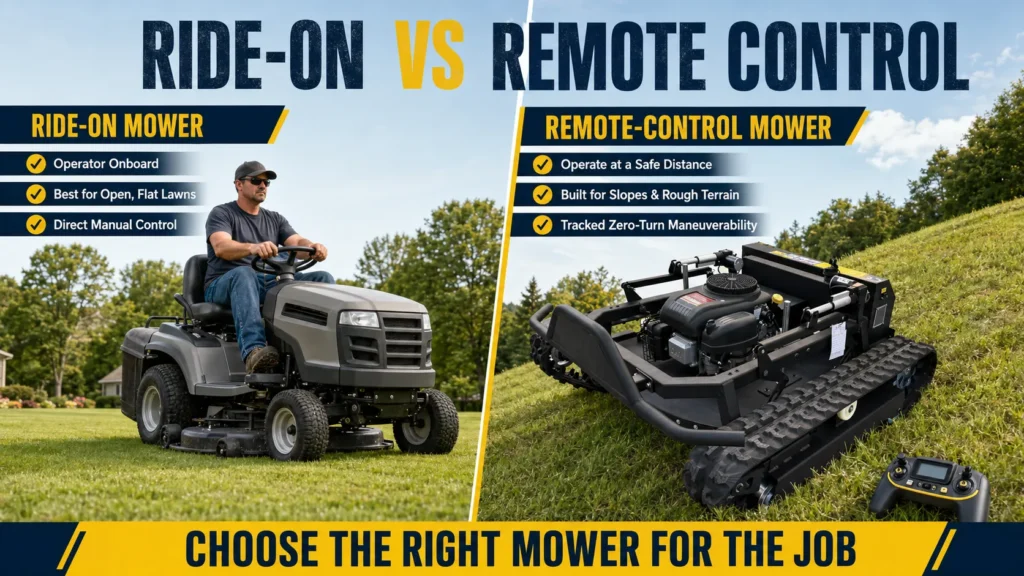
A remote control slope mower is generally the stronger choice for steep, rough, uneven, or difficult-to-access terrain because the operator controls it from a separate position. A riding lawn mower is often more comfortable and productive on broad, maintained ground that falls within the exact model’s operating limits. The best choice depends on terrain, vegetation, access, finish requirements, transport, and how much operator exposure the job creates.
Every hill is different. YITAIWEI develops tracked, flail, and wheeled remote control mower families for different ground and vegetation conditions. Compare them with a riding mower by application, not deck width or horsepower.
Table of Contents
- Quick Comparison
- Operator Position Is the Biggest Difference
- Which Mower Is Better on Slopes?
- Which Mower Handles Vegetation Better?
- Productivity Depends on the Property
- Access, Transport, and Storage
- Controls, Training, and Daily Inspection
- Cost Should Be Compared by Job Capability
- How to Choose Between Them
- Frequently Asked Questions (FAQ)
- Conclusion
Quick Comparison
| Decision factor | Remote control slope mower | Riding lawn mower | What to verify |
|---|---|---|---|
| Operator position | Operator stands separately from the machine | Operator rides on the machine | Visibility, exclusion zone, and operating procedure |
| Steep or rough terrain | Tracked versions are developed for difficult-terrain applications | Use only where the exact model permits | Slope limits, surface, travel direction, and turns |
| Maintained open turf | Can work, but may not be the simplest option | Often efficient and comfortable | Cut quality, access, and ground conditions |
| Tall and dense grass | Flail configuration can be evaluated | Normal finish deck may be unsuitable | Cutting-head capability and vegetation limits |
| Obstacles and edges | Remote viewing position may help route planning | Operator travels with the mower | Buffers, sightlines, discharge area, and stopping |
| Transport and ownership | Specialist transport, controls, and wear parts may apply | Established lawn-equipment routines may be simpler | Weight, loading, parts, training, and service support |
The table is a shortlisting guide. The manual and operating limits for the exact machine remain the controlling references.
Operator Position Is the Biggest Difference
The most important distinction is not that one mower has a remote controller and the other has a seat. It is where the operator is located when the machine works on a slope.
Remote Operation Separates Operator and Machine
With a remote control slope mower, the operator can choose a viewing position away from the machine’s direct path. This can reduce the need to ride across difficult terrain or walk immediately behind the cutting unit. The operator still needs continuous visibility, predictable control response, and a planned place to stand during every pass and turn.
A Riding Mower Carries the Operator
A riding lawn mower combines the operator and machine. On suitable open turf, that arrangement can provide comfort, direct feedback, and efficient coverage. On a steep or unstable slope, however, machine movement also moves the operator, making the manufacturer’s terrain restrictions especially important.
Remote Does Not Mean Autonomous
A remote control mower is not the same as a fully autonomous robot lawn mower. It requires an operator to steer, monitor terrain, control the cutting operation, and stop when conditions change. Buyers should evaluate the controller and operating process, not assume that the machine plans its own safe route.
Which Mower Is Better on Slopes?
For genuinely steep, irregular, rutted, or difficult ground, a tracked remote control slope mower is normally the first category to investigate. Riding equipment belongs only on slopes and under conditions expressly permitted for the exact model.
Tracked Chassis for Difficult Ground
A YITAIWEI tracked remote control mower can be evaluated where a site combines slopes with uneven ground, ruts, loose soil, or scattered loose stones. Tracks provide a different ground-contact layout from ordinary turf wheels. They do not guarantee traction, prevent sliding, or make every hill suitable.
Riding Mowers on Moderate Maintained Terrain
A riding mower may be appropriate for broad, regularly maintained hills that remain within the exact model’s instructions. Surface moisture, holes, attachments, tire condition, travel direction, and nearby edges can change the situation. Guidance from one riding mower should not be applied to another with a similar appearance.
Turns and Transitions Matter
A machine may travel predictably in a straight pass but behave differently when turning, crossing a rut, entering the slope, or moving over a crest. Measure and assess those points before selecting equipment. The best mower must complete the whole route, not merely climb one section.
Which Mower Handles Vegetation Better?
The answer depends on the cutting system rather than whether the mower is remote controlled or ridden. Maintained turf and dense overgrowth require different deck designs and working methods.
Riding Mowers for Regular Lawn Maintenance
Many riding lawn mowers are designed around routine cutting of maintained grass. On suitable terrain, they can provide a consistent finish and cover open areas efficiently. Cutting frequency matters: a finish deck should not automatically be expected to reclaim tall, dense, or woody growth.
Flail Mowers for Tall and Dense Grass
When heavy grass is the recurring problem, a remote control flail mower is the more relevant configuration to evaluate. YITAIWEI positions its flail mower family for tall and dense grass management. Confirm the supplied head, documented vegetation limits, cutting height, guarding, and replacement wear parts before ordering.
Do Not Choose by Horsepower Alone
Horsepower does not identify the cutting-head design, deck opening, guarding, or material capability. Put the vegetation description in the buying brief and ask the supplier to match it to the exact cutting system. Woody stems or mixed brush may require a specialist attachment or separate clearing method.
Productivity Depends on the Property
A riding lawn mower can be very productive on open, accessible, maintained turf. A remote slope mower can save time where conventional equipment would require extensive manual trimming, multiple machines, or difficult operator positioning. Productivity should therefore be calculated around the full job rather than travel speed alone.
Open Ground Favors Simple Coverage
On a large, clear lawn with suitable grades, the rider’s seat, deck coverage, and direct operation may support an efficient routine. Fueling, loading, blade service, and operator familiarity may also be straightforward for a landscaping team that already owns riding equipment.
Complex Ground Favors Specialized Access
Banks, roadside slopes, drainage areas, solar sites, orchard rows, rough fields, and properties with difficult edges may favor remote equipment. The operator can reposition independently of the mower, but must preserve sightlines and exclusion zones. Reduced manual trimming can be valuable when the mower reaches zones that are otherwise labor intensive.
Measure Total Workflow Time
Include transport, setup, mowing, cleaning, and loading. A machine that cannot access the terrain may create more labor elsewhere.
Access, Transport, and Storage
Specialized slope capability has little value if the mower cannot reach the work area. Measure gates, passages, row spacing, trailer dimensions, ramp capacity, turning zones, and storage space.
Riding Mower Logistics
Riding lawn mowers are widely understood by property owners and contractors, but their size and weight still need suitable transport. Attachments, rollover structures, and deck position may affect loading dimensions. Confirm approved tie-down points and trailer capacity.
Remote Mower Logistics
A remote mower may be compact in operator layout because it has no seat, but tracked chassis, cutting heads, guards, and accessories affect dimensions and weight. Ask how the machine should be loaded, secured, and recovered if disabled on a slope.
Access Can Decide the Chassis
For firmer, more even terrain with frequent turns, a wheeled remote mower may be practical. For steep and rough routes, tracks may be more relevant. Both families are available, so the access map and surface description should guide the chassis choice rather than a preference for one appearance.
Controls, Training, and Daily Inspection
Both mower types require trained operation and pre-work inspection. The controls and exposure differ, so the training should match the exact machine.
Remote Control Questions
- How are movement and cutting functions started and stopped?
- What happens when the signal is interrupted?
- Where are normal and emergency stop controls?
- How should the operator maintain visibility and position?
- Which controller functions are included in the ordered configuration?
Riding Mower Questions
- What slopes and travel directions are permitted?
- How do attachments affect operating limits?
- What restraints and protective structures are fitted?
- What are the braking and parking procedures?
- Which tire pressures and inspection points are required?
Daily Checks Are Not Optional
Inspect cutting parts, guards, fasteners, tracks or tires, fluids, batteries, controls, and accumulated vegetation according to the manual. Stop and isolate the machine before cleaning or approaching the cutting system. Record impacts, unusual vibration, leaks, or changes in control response.
Cost Should Be Compared by Job Capability
A riding lawn mower may have a lower acquisition cost or fit an existing maintenance program. A specialist remote slope mower may justify its cost where the property repeatedly demands difficult-terrain access, remote operator positioning, or heavy-vegetation cutting.
Look Beyond Purchase Price
Compare transport, training, fuel or energy, cutting wear parts, tracks or tires, filters, downtime, labor, hand finishing, storage, and service support. A machine that is inexpensive but unsuitable for a major work zone may create recurring costs elsewhere.
Specify the Ordered Configuration
The quotation should identify the exact chassis, cutting system, power configuration, controller, included accessories, spare parts, documentation, warranty, and delivery terms. Do not assume every option shown for a product family is included with every model.
How to Choose Between Them
- Map the property into steep, rough, maintained, overgrown, obstacle, and no-mower zones.
- Measure slopes, access, turns, transport routes, and nearby hazards.
- Define vegetation and the finish expected in each zone.
- Choose riding equipment only for areas within its documented limits.
- Evaluate tracked remote equipment for steep or rough recurring work.
- Evaluate a flail cutting system where tall and dense grass is central.
- Compare total workflow, support, maintenance, and ownership cost.
- Put the exact required configuration in the quotation.
A mixed property may benefit from both categories. A riding mower can maintain open turf while a remote slope mower handles the difficult banks and rough zones. The objective is not to declare one machine universally superior, but to avoid operating either type outside the job it was selected to perform.
Frequently Asked Questions (FAQ)
Is a remote control slope mower safer than a riding mower?
Remote control separates the operator from the machine, which changes direct slope exposure. It does not make operation risk-free. Safety still depends on terrain, visibility, machine limits, exclusion zones, control response, and trained operation. A rider should be used only where the exact model permits.
Which mower is better for steep hills?
A tracked remote control slope mower is usually the first type to evaluate for steep, rough, or uneven hills. A riding mower may suit moderate, maintained slopes within its documented limits. Measure the complete route, including turns and transitions, before deciding.
Which mower is better for tall grass?
The cutting system decides this more than the operator position. A remote control flail mower is relevant for tall and dense grass, while a normal riding finish deck may suit regularly maintained turf. Confirm the exact cutting head and vegetation capability.
Can a remote slope mower replace a riding mower?
It can replace a rider for some properties, especially where difficult slopes dominate. On broad, maintained, accessible turf, a riding mower may remain more comfortable and efficient. Mixed properties may use both, assigning each machine to the zones it handles best.
What should I compare before buying?
Compare measured terrain, chassis, cutting system, access dimensions, operator position, stopping behavior, transport, maintenance, parts support, training, and total workflow. Avoid choosing solely by horsepower, deck width, slope angle, or purchase price.
Conclusion
In a remote control slope mower vs riding lawn mower comparison, choose the remote mower for recurring steep, rough, uneven, or heavy-growth work and choose the rider for broad maintained terrain within its documented limits. YITAIWEI tracked, flail, and wheeled remote control mower families provide options for different ground and vegetation conditions. Match each machine to the property zones it can handle predictably, then confirm the exact configuration before ordering.