
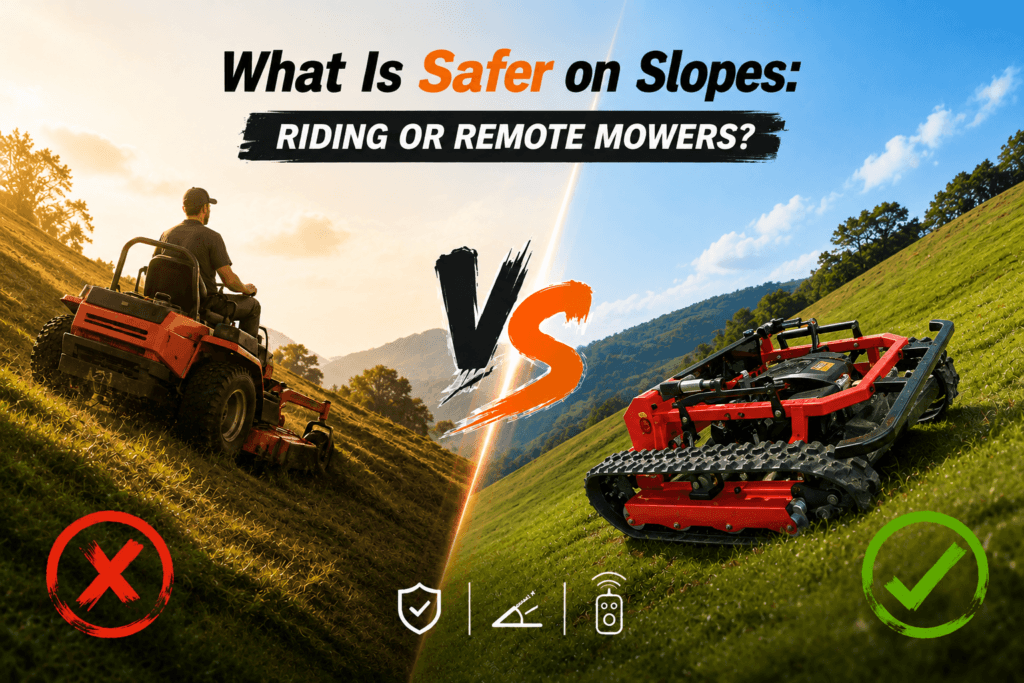
On slopes, a remote mower can reduce direct operator exposure because the operator controls the machine from a separate position. A riding mower keeps the operator on the machine, which may be practical on broad, maintained ground but creates different concerns when the surface is steep, wet, uneven, or close to an edge. Neither machine is automatically safe in every situation. The safer choice is the one that matches the measured terrain, vegetation, route, controls, and documented operating limits.
YITAIWEI develops tracked, flail, and wheeled remote control mower families for different ground and vegetation conditions. This comparison explains when remote operation may provide a meaningful advantage, when a riding mower may remain practical, and which checks should be completed before either machine enters a slope.
Table of Contents
- The Short Answer
- Why Operator Position Matters
- Compare the Terrain Before the Mower
- Cutting System Affects the Decision
- Visibility and Control
- When Remote Mowing Usually Has the Advantage
- When a Riding Mower May Remain Practical
- Safety Comparison by Work Phase
- How to Make the Final Choice
- Frequently Asked Questions (FAQ)
- Conclusion
The Short Answer
| Question | Remote mower | Riding mower | Practical conclusion |
|---|---|---|---|
| Where is the operator? | Separate from the machine | On the machine | Remote control can reduce direct exposure on difficult ground |
| Who controls the route? | Operator watches and steers remotely | Operator steers from the seat | Both require trained, attentive operation |
| What terrain is it for? | Tracked versions can be evaluated for rough slopes | Only terrain within the exact model’s instructions | Measure the whole route before choosing |
| What vegetation can it cut? | Choose rotary or flail configuration by vegetation | Use the deck only within its intended material | Cutting system matters as much as chassis |
| Does either guarantee safety? | No | No | Safety depends on conditions and operating controls |
Remote operation changes the operator’s position; it does not remove terrain hazards, thrown-material risks, sliding, visibility requirements, or the need to follow the manufacturer’s instructions.
Why Operator Position Matters
The main safety difference between riding and remote equipment is where the person is located when the mower moves across a slope.
Riding Mowers Carry the Operator
With a riding lawn mower, the operator travels with the chassis. On suitable terrain, this provides direct feedback and familiar control. On a steep slope, however, any loss of traction, unexpected rut, edge, or change in direction affects the machine and operator together. The exact manufacturer’s limits must govern the route.
Remote Mowers Separate the Person
A remote mower lets the operator choose a position with a clear view of the machine and route. This can be useful where walking behind a mower or riding across the slope would create unnecessary exposure. The operator must still remain outside the machine’s travel and discharge paths and be ready to stop immediately.
Remote Does Not Mean Autonomous
Remote control is not autonomous mowing. A person still selects the route, manages speed and cutting, watches hazards, and responds to changes. A remote mower should never be sent behind a crest, into dense vegetation that hides the chassis, or around a blind corner where the operator cannot verify conditions.
Compare the Terrain Before the Mower
Safety cannot be decided from a slope angle alone. Inspect the surface, approach, turns, transitions, and consequences of a loss of control.
Firm Maintained Turf
A riding mower may be practical on broad, firm, regularly maintained terrain when the exact model is approved for the slope and direction of travel. A wheeled remote mower may also fit accessible areas where maneuverability and remote positioning are useful. Moisture, tire condition, attachments, and nearby edges still need to be considered.
Rough or Uneven Ground
A tracked remote control mower is the first family to evaluate when a slope includes ruts, loose soil, uneven contours, or difficult access. YITAIWEI tracked configurations are developed for difficult-terrain mowing applications. Tracks do not guarantee grip or prevent sliding, so route inspection and operating limits remain essential.
Loose Stones and Debris
Stones are ground hazards, not material for the cutting system. Remove visible debris where practical, protect the work zone, and avoid intentional contact between stones and blades or flails. Stop after an unexpected impact, vibration, or control change and inspect the machine according to its instructions.
Cutting System Affects the Decision
A mower can be stable on a slope and still be unsuitable for the vegetation. Compare the cutting system separately from the chassis.
Finish Cutting on Maintained Grass
Riding mowers often work efficiently when grass is cut regularly and the terrain is accessible. A remote mower with a rotary-style deck may provide similar maintenance capability where remote positioning is more useful than a seat. Cutting height, deck protection, contour changes, and desired finish should be confirmed.
Flail Cutting for Tall and Dense Grass
When tall or dense grass is the main challenge, a remote control flail mower is the relevant configuration to evaluate. YITAIWEI positions its flail mower family for heavier vegetation management. Confirm the supplied flail head, vegetation limits, guarding, cutting height, and wear parts for the exact configuration.
Do Not Use Horsepower as a Safety Test
Horsepower does not establish stability, braking, traction, stopping response, or vegetation capability. A high-power mower may still be unsuitable for a route or cutting system. Choose by complete application requirements.
Visibility and Control
Visibility is a shared requirement, but the way it is achieved differs.
Remote Operator Sightlines
The remote operator should see the mower, route ahead, discharge area, and nearby people or property. The operator must choose a position away from the downhill path and avoid standing directly above or below the machine when the route creates exposure.
Riding Operator View
A riding operator has a close view from the seat, but the entire machine moves with them. Humps, crests, tall vegetation, and a narrow field of view can still hide hazards. Seat position does not remove the need for route inspection.
Stopping Behavior
Before work, confirm normal stop, emergency stop, cutting disengagement, and signal-loss behavior for a remote mower. For a riding mower, confirm braking, parking, reverse, and attachment procedures. The operator should test controls on stable ground before approaching the most difficult section.
When Remote Mowing Usually Has the Advantage
A remote slope mower is worth serious consideration when the recurring work includes steep banks, roadside slopes, rough fields, difficult access, or areas where the operator should not ride on the machine.
Steep Banks and Drop-Offs
Keeping the operator away from the machine can reduce direct exposure near edges, but the work zone still requires a buffer and a planned recovery method. Remote operation is an advantage only when the operator can maintain a clear view and predictable control.
Rough Vegetation
Remote equipment can be paired with a flail cutting system for tall and dense grass. The operator can observe from a more suitable position, but dense growth may conceal stones and holes. Inspect and clear the route before cutting.
Work Near Public Areas
Roadsides, parks, drainage channels, and commercial grounds require exclusion zones and traffic or pedestrian controls. A remote machine may help keep the operator out of the travel path, but it does not replace a worksite control plan.
When a Riding Mower May Remain Practical
A riding mower can still be the practical choice for large, open, maintained areas that are within the model’s documented limits and offer safe access, turning, and stopping space.
Broad Open Turf
On relatively even ground, the seat, direct steering, and established maintenance routine may support efficient coverage. The operator should not extend that routine onto steeper or wetter zones without a separate assessment.
Existing Fleet and Service
A contractor may already have trailers, parts, trained operators, and service processes for riding equipment. Those advantages matter when the site is suitable. They should not override terrain limits just because the mower is already available.
Zone-Based Equipment
A mixed property may use both categories: a riding mower for open lawn and a remote tracked or flail mower for banks and rough vegetation. Dividing the work can be safer and more efficient than forcing one machine across every zone.
Safety Comparison by Work Phase
| Work phase | Remote mower focus | Riding mower focus | Shared requirement |
|---|---|---|---|
| Before starting | Controller, emergency stop, signal behavior, route visibility | Brakes, restraints, tires, parking, attachment condition | Inspect site, weather, hazards, and machine |
| Entering the slope | Operator position and exclusion zone | Approved entry route and operator exposure | Use the documented travel direction |
| Cutting | Continuous sight and deliberate control | Stable speed, steering, and direct awareness | Stop after unexpected movement or impact |
| Turning | Plan turn away from edges and unstable ground | Use approved turning method and buffer | Do not improvise near hazards |
| Finishing | Isolate before clearing or inspection | Disengage, park, and isolate before inspection | Record damage and maintenance needs |
How to Make the Final Choice
- Map the property into firm lawn, steep slope, rough ground, dense vegetation, obstacles, and no-mower zones.
- Measure the steepest sections, access routes, turns, and buffers.
- Identify whether the dominant cutting job is maintained grass, tall grass, dense weeds, or brush.
- Choose riding equipment only for zones within its documented limits.
- Evaluate a tracked remote mower for steep or rough terrain and a flail configuration for tall or dense grass.
- Compare visibility, stopping behavior, transport, maintenance, training, and service support.
- Put the exact machine and cutting configuration in the quotation.
The safer machine is the one that gives the operator predictable control over the actual site. Sometimes that is a riding mower on open, moderate turf. For difficult slopes and rough vegetation, remote equipment may provide a better operator position and more suitable chassis options.
Frequently Asked Questions (FAQ)
Is a remote mower always safer than a riding mower on slopes?
No. Remote operation can reduce direct operator exposure, but it still requires visibility, trained control, a suitable route, and documented machine limits. A remote mower is not automatically appropriate for every slope or weather condition.
Which is safer on a steep hill, tracks or wheels?
Tracks are usually the family to evaluate first for steep, rough, uneven, or loose ground. Wheels may suit firmer and more even areas. Neither guarantees traction. Surface, moisture, travel direction, machine design, and operating instructions determine suitability.
Is a flail mower safer for tall grass?
A flail mower may be the more relevant cutting system for tall and dense grass, but the exact head and vegetation limits must be confirmed. Safety still depends on hidden obstacles, guarding, operator visibility, speed, and the terrain.
Can I use a riding mower on any slope if it has enough power?
No. Power does not establish slope approval, traction, braking, stability, or safe travel direction. Use the exact manufacturer’s instructions for the model and attachments, and stop when the route or surface falls outside those conditions.
What is the most important safety feature?
No single feature decides the result. Start with a suitable machine category, then evaluate operator position, visibility, stopping behavior, terrain, cutting system, exclusion zones, and training as one operating system.
Conclusion
For most difficult slopes, a remote control mower can provide a meaningful operator-position advantage over a riding mower, especially when paired with a tracked chassis for rough ground or a flail system for tall and dense grass. A riding mower remains practical on broad, maintained terrain within its documented limits. The safest choice comes from matching the machine to the property and operating it conservatively, not from a universal claim that one category is safe everywhere.