
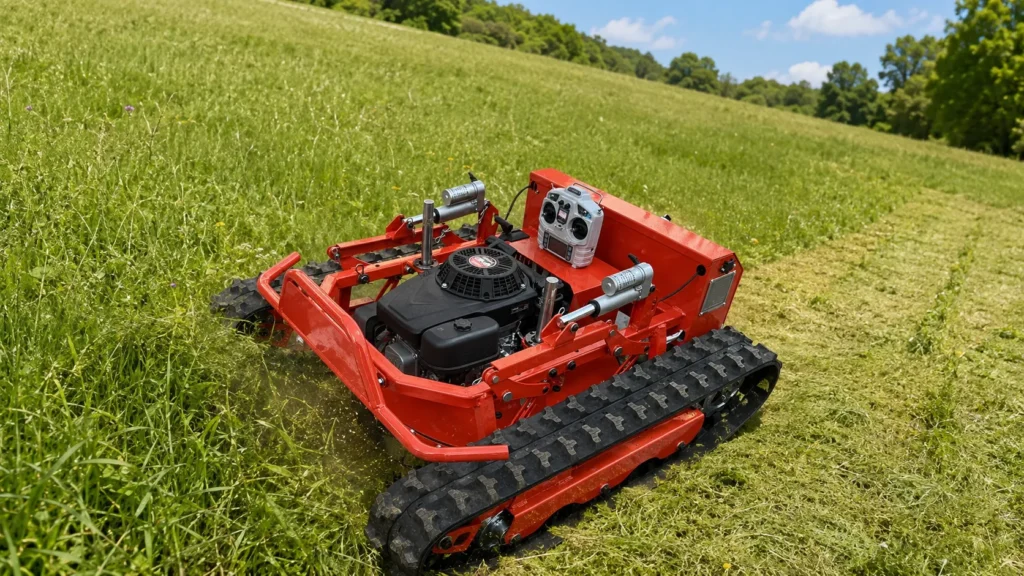
Yes, a remote control lawn mower may save time when it reduces operator walking, repeated equipment repositioning, and difficult maneuvering on slopes or irregular ground. The benefit is usually greatest where conventional mowing requires frequent turns, mounting and dismounting, or switching to handheld equipment. It may offer little advantage on a small, flat, obstacle-free lawn where a walk-behind or ride-on mower already works efficiently.
A remote-controlled mower is not an autonomous robot mower. A trained operator still directs its movement, monitors the cutting area, maintains visibility, and responds to changing conditions. Professional buyers should therefore evaluate the complete workflow—not just travel speed or cutting width—to determine whether it can reduce job time.
How a Remote Control Lawn Mower Can Save Time
The main time-saving opportunity comes from changing where the operator works. Instead of walking directly behind the cutting deck or sitting on the machine, the operator controls the mower from a separate position. This can simplify movement through areas where walking is slow, footing is uneven, or a ride-on mower would require cautious repositioning.
Less Walking Behind the Machine
With a walk-behind mower, the operator travels essentially the same route as the machine. Long banks, roadside areas, drainage features, and expansive rough-growth zones can therefore require substantial walking. Remote operation separates the operator’s route from the mower’s exact cutting path. The operator may be able to stand in a stable viewing position and direct multiple passes without following every meter of travel.
This does not eliminate operator movement. The person controlling the mower may still need to relocate to preserve a clear view, maintain an appropriate operating distance, inspect hidden areas, or approach the machine after shutdown. The practical question is whether those movements are shorter and easier than walking the entire mowing pattern.
Fewer Mounting, Dismounting, and Repositioning Steps
Ride-on mowing can be productive in broad, accessible areas, but interrupted terrain changes the workflow. Gates, tight corners, low branches, embankments, soft patches, and confined transitions may require extra turning, backing, or a change of equipment. Operators may also need to dismount to inspect uncertain ground or remove obstacles.
A remote-controlled machine can sometimes approach these areas without placing an operator on the mower. Steering from a separate vantage point may also make it easier to align the deck for the next pass. Whether this saves time depends on visibility, turning space, control response, and the amount of repositioning the site would otherwise require.
More Practical Access to Difficult Terrain
Uneven ground and slopes can slow a walking operator and complicate ride-on operation. NIOSH has reported that poor footing on slopes and wet grass contributed to falls in landscaping work. Its guidance also emphasizes inspecting worksites for steep slopes, holes, and obstructions before work begins. These findings support careful equipment and route selection rather than assuming that one mower can handle every site. Review the NIOSH landscaping hazard discussion.
Remote control may improve convenience because the operator can choose firmer footing away from the mower’s immediate path. It does not make unstable ground safe, remove rollover or sliding risks, or override the manufacturer’s operating limits. Wet vegetation, loose soil, concealed holes, drop-offs, and poor traction can still slow or stop the job.
Remote Control vs. Walk-Behind and Ride-On Workflows
| Mower type | Operator position | Typical workflow strength | Potential source of delay |
|---|---|---|---|
| Remote control mower | Operator stands apart and actively directs the machine | May reduce walking and simplify repositioning on irregular ground | Setup, visibility changes, cautious control, transport, and signal management |
| Walk-behind mower | Operator walks directly with the machine | Direct control in smaller or confined spaces | Operator must cover the full route and manage difficult footing |
| Ride-on mower | Operator sits on the machine | Efficient continuous mowing on open, accessible ground | Turning, backing, access restrictions, slope limits, and mounting or dismounting |
| Autonomous robot mower | Operator is not continuously steering during routine operation | Automated mowing within its configured operating system | Boundary setup, site compatibility, supervision requirements, and recovery from interruptions |
The comparison shows why machine speed alone cannot answer whether a remote control lawn mower saves time. Total job time includes unloading, inspection, setup, mowing, repositioning, clearing obstructions, cleaning, maintenance, and loading for transport. A mower that performs well in the cutting phase may still be inefficient if it is difficult to move between sites or repeatedly loses a usable line of sight.
When Walk-Behind Mowing May Be Faster
A walk-behind mower may remain the simpler choice for a compact, level area with narrow access, many closely spaced landscape features, or only a few minutes of actual cutting. Its direct controls and limited setup can outweigh the benefit of remote operation. It may also be easier to place precisely near edges, provided the specific machine and work procedure are appropriate for the site.
When Ride-On Mowing May Be Faster
A ride-on mower can provide a straightforward workflow across large, smooth, open areas with suitable access and generous turning space. The operator travels with the machine and maintains a consistent view from the seat. Remote control becomes more relevant when terrain, obstructions, or access patterns disrupt that continuous ride-on workflow.
OSHA advises employers to assess each mowing area, choose equipment appropriate to the terrain, survey for hazards, and follow manufacturer slope limits. Its guidance identifies wet surfaces, loading ramps, slopes, drop-offs, ditches, and bodies of water as conditions requiring particular attention. See OSHA’s riding-mower safety guidance.
Factors That Determine the Real Time Saving
Terrain, Vegetation, and Operating Conditions
Slope angle is only one part of terrain assessment. Surface firmness, side slope, holes, loose material, wet grass, erosion, and abrupt transitions can affect traction and controllability. Vegetation density and height can also change the required travel speed, number of passes, and likelihood of material buildup.
Inspecting the work area before unloading can prevent avoidable interruptions. Map drop-offs, utilities, rocks, wire, branches, drainage channels, pedestrians, vehicles, and sections with limited visibility. The U.S. Consumer Product Safety Commission advises clearing mowing areas of debris and stopping to inspect a mower after striking a foreign object. Read the CPSC riding-lawnmower safety sheet.
Cutting Width and Pass Planning
A wider cutting deck can cover more width per pass, but it does not automatically deliver a shorter job. Wider machines may need more room to turn and may be harder to position in narrow corridors. The effective result depends on pass overlap, missed strips, obstacles, vegetation load, travel direction, and the number of corrective passes.
Plan the cutting pattern before starting. Favor long, continuous passes where conditions allow, identify safe turning locations, and avoid layouts that repeatedly trap the mower behind obstacles. For commercial operations, compare the planned route with the machine’s dimensions and cutting width before assigning equipment.
Setup, Transport, and Site Transitions
Remote-controlled mowers can be substantial machines, so transport must be included in the time calculation. Check machine and package dimensions, machine weight, trailer or vehicle capacity, loading method, tie-down procedure, gate width, and unloading area. A machine that reduces walking during mowing may not save total time if loading or site access is inefficient.
Pre-start tasks can include inspecting guards and controls, checking the work zone, preparing the remote controller, confirming communication, and verifying the planned operating position. Standardized crew checklists and consistent trailer layouts can reduce repeated setup decisions without bypassing manufacturer instructions.
Visibility and Operator Position
The operator needs a clear view of the mower, its route, nearby people, and emerging hazards. Tall vegetation, terrain crests, walls, trees, structures, and dust can interrupt that view. If the operator must frequently stop and walk to a new position, expected time savings may shrink.
A brochure’s remote-control-distance value should not be treated as the distance at which mowing is always appropriate. Practical operation also depends on line of sight, interference, terrain, the specific manual, and safe control of the work zone. Position the operator for control and visibility rather than trying to maximize separation from the machine.
Maintenance and Downtime
Maintenance condition directly affects workflow. Dull or damaged cutting components, accumulated material, loose hardware, control problems, and neglected drive components can cause slow cutting, repeated passes, or unscheduled stoppages. Cleaning and inspection time should be planned between jobs, especially when moving from dense or wet vegetation to another site.
Follow the exact model’s operator manual for inspection, shutdown, cleaning, adjustment, and service procedures. Never treat remote starting or stopping as a substitute for proper shutdown and isolation before approaching cutting components or clearing material.
Using Verified Model Specifications in a Shortlist
The Yitaiwei catalog provides model-specific parameters that can help buyers compare transport requirements, coverage width, height settings, and nominal travel characteristics. The values below are kept with their exact models and should be assessed alongside the intended route and work conditions.
| Model | Cutting width | Cutting height | Machine weight | Walking speed | Remote-control distance |
|---|---|---|---|---|---|
| QL500Y | 500 mm | 20-150 mm | 140 kg | 4 km/h | 200 m |
| LB600-24V | 600 mm | 10-200 mm | 150 kg | 5 km/h | 200 m |
| QL800 | 800 mm | 20-100 mm | 255 kg | 5 km/h | 200 m |
| HS1000 | 1000 mm | 20-80 mm | 300 kg | 5 km/h | 200 m |
The catalog also lists a climbing angle of 45° for each of these four models. That value is not a recommended working slope or a safety guarantee. Operating limits and procedures must come from the applicable manufacturer instructions and a site-specific assessment. Actual performance may vary with terrain, vegetation, operating conditions and machine configuration. Confirm the final specification with the manufacturer before ordering.
For a useful shortlist, compare each exact model against measured access widths, transport capacity, required cutting-height range, desired pass layout, and the locations from which an operator can maintain visibility. Do not assume that the largest cutting width will produce the shortest overall workflow.
How to Estimate Time Savings Without Invented Percentages
A contractor or facility manager can compare workflows without relying on unsupported productivity claims. Conduct a structured site review and record the steps required by each equipment type:
- Measure access points and identify transport, unloading, and staging constraints.
- Divide the property into open ground, confined areas, slopes, irregular terrain, and exclusion zones.
- Map obstacles, turning points, visibility changes, and areas that require another tool.
- Compare the walking, riding, repositioning, and equipment-switching steps for each mower type.
- Include pre-use inspection, safe setup, cleaning, routine service, and loading in the workflow.
- Select equipment only after checking the exact model manual and site operating conditions.
This approach avoids promising a universal labor reduction. It also gives professional buyers a repeatable method for comparing jobs with different terrain and vegetation.
Frequently Asked Questions (FAQ)
Does a remote control lawn mower operate by itself?
No. A remote control lawn mower requires an operator to steer it, observe the work area, and respond to hazards and changing conditions. It should not be confused with an autonomous robot mower that follows a configured mowing system without continuous steering.
Can a remote-controlled mower save time on slopes?
It may reduce operator walking and some repositioning on suitable sloped terrain, but the result depends on traction, vegetation, visibility, access, surface conditions, and manufacturer operating limits. Remote operation does not make every slope suitable for mowing.
Is a wider remote control mower always faster?
No. Cutting width affects the number of theoretical passes, but turning space, overlap, obstacles, transport, vegetation density, and corrective passes also affect total time. A narrower machine may have a more efficient workflow in confined areas.
Does remote-control distance determine productivity?
Not by itself. The operator must maintain appropriate visibility and control. Terrain, structures, vegetation, interference, and work-zone hazards may require operation at a much shorter distance than a listed technical value.
When might a remote control lawn mower not save time?
It may not save time on small, flat, easily accessible areas; sites with many hidden corners; jobs requiring frequent equipment changes; or operations where loading, unloading, and setup exceed any reduction in walking or repositioning.
Conclusion
A remote control lawn mower can save time when its operating workflow removes substantial walking, simplifies repositioning, or provides more practical control on difficult terrain. The strongest case is site-specific, not universal. Compare the complete job—including access, cutting pattern, visibility, transport, setup, maintenance, and operating limits—with walk-behind and ride-on alternatives before choosing a machine.