
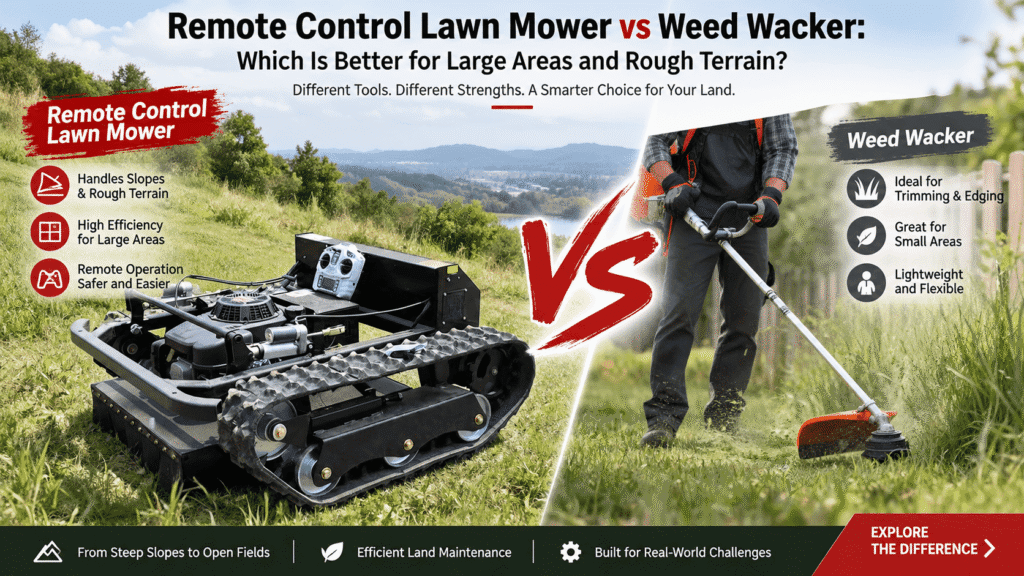
For large areas and rough terrain, a remote control lawn mower is usually the more productive primary machine, while a weed wacker remains useful for edges, narrow spaces and selective clearing. Choice depends on vegetation, ground conditions, access, finish and labor. A weed wacker gives close control, but is slow across acreage. A remote control mower covers wider paths and keeps the operator away from difficult ground, but needs a suitable cutting system.
This comparison is for contractors, land-maintenance companies, municipalities, farms, property operators and equipment buyers. It also explains where YITAIWEI tracked, flail and wheeled remote control mower families may fit into a broader equipment plan.
Table of Contents
- What Is the Difference?
- Coverage and Labor
- Rough Terrain and Slopes
- Vegetation and Cutting Systems
- Comparison for B2B Buyers
- When to Use Both
- Procurement Checklist
- Frequently Asked Questions (FAQ)
- Conclusion
What Is the Difference?
A weed wacker, also called a string trimmer or brush cutter depending on its design, is a handheld tool. The operator carries or guides the tool and uses a rotating line, blade or cutting head to remove grass and weeds. It is useful around posts, fences, drainage edges, trees and narrow corners where a larger mower cannot work.
A remote control lawn mower is a machine operated from a separate position with a wireless controller. It may use wheels or tracks and may be fitted with a rotary or flail cutting system. The operator controls movement and cutting while observing the machine from outside the immediate work area. It is not the same as a fully autonomous robot mower, which follows a programmed mowing system without continuous manual commands.
Different Tools for Different Work Patterns
The weed wacker is a precision and access tool. It can reach small or irregular sections, but the operator must carry the equipment, manage the cutting head and walk the full route. A remote control mower is a coverage and terrain-management tool. It is intended for repeated passes over a defined area and can be configured around the vegetation and chassis required for that site.
The Question Is Usually About Workflow
For a large property, the real comparison is not only mower versus trimmer. It is whether the work should be completed by one person carrying a tool, one operator controlling a machine, or a combination of machines working in zones. That choice affects daily output, fatigue, transport, service and the consistency of the finished area.
Coverage and Labor
Across large fields, roadside vegetation, solar-farm grounds or rural properties, repeated walking with a weed wacker can create a long work cycle. The operator must carry fuel or batteries, stop for breaks, avoid debris and overlap previous passes. A wider remote mower can create a more repeatable route, although actual productivity depends on cutting width, vegetation, slope, travel speed, obstacles and operator control.
| Decision factor | Weed wacker | Remote control lawn mower |
|---|---|---|
| Large open areas | Slow for continuous coverage | Designed for repeated wider passes |
| Narrow edges and corners | Strong access and close control | May need a finishing tool |
| Operator position | Walks with the cutting tool | Controls the machine from a separate position |
| Vegetation flexibility | Depends on line, blade and operator technique | Depends on deck, flail or other installed cutting system |
| Transport | Easy to carry between small work zones | Requires loading, route planning and storage |
| Commercial repeatability | Useful for detail work | Useful for planned area maintenance |
Where the Weed Wacker Still Wins
A weed wacker is often the practical choice for short jobs, small patches, delicate edges and locations where a mower cannot turn. It can also be useful after a larger machine has completed the main pass. For a contractor who maintains many small gardens rather than one large site, portability may be more valuable than machine coverage.
Where a Remote Mower Changes the Workday
A remote mower can reduce walking and carrying on large jobs when the route is predictable. Compare the complete cycle: loading, inspection, mowing, cleaning, refueling or charging and service.
Rough Terrain and Slopes
Rough terrain changes the decision. A weed wacker gives the operator direct control over each step, but the operator is also exposed to the slope, loose soil, holes, falling debris and changing footing. A remote control mower can place the operator away from the machine, but remote operation does not remove terrain hazards or guarantee stability.
Tracked Machines for Difficult Ground
For steep, uneven, rutted or loose-stone areas, a tracked remote control mower is the first category to evaluate. Tracks provide a different chassis and ground-contact arrangement from ordinary wheels, but suitability still depends on surface condition, direction, load, vegetation, machine configuration and the manufacturer’s operating instructions. YITAIWEI positions its tracked mower family for this type of difficult-terrain application.
Wheeled Machines for Firmer Routes
On relatively firm and more even ground, a wheeled remote control mower may be easier to evaluate where maneuverability and access are the priority. It should not be selected for rough slopes simply because it is remote controlled. The chassis, drive arrangement, cutting head and route conditions all need to match the job.
Debris Requires a Separate Plan
Neither a weed wacker nor a remote mower should be treated as a machine for cutting or crushing stones. Inspect for wire, branches, rocks and hidden objects before work. In areas with loose stones or construction debris, the work plan should include route preparation, exclusion zones, stopping procedures and post-impact inspection.
Vegetation and Cutting Systems
The name of the machine does not tell the whole story. The cutting system determines what type of vegetation the equipment can reasonably address. A line trimmer may be effective for grass and weeds around obstacles, while a remote mower may use a rotary deck for regular mowing or a flail head for heavier growth.
Regular Grass
For regularly maintained grass, a suitable mower deck can deliver a more consistent finish than repeated handheld trimming. The required cutting height, discharge method and route width should be defined before selecting the machine. A zero turn or wheeled remote mower may be relevant on open, firm turf, while a tracked machine may be more appropriate where the route is uneven.
Tall and Dense Grass
For tall and dense grass, the flail configuration deserves specific attention. YITAIWEI positions its flail remote control mower family for heavy vegetation-management work. Buyers should evaluate the exact flail head, cutting-height range, guarding, wear parts and vegetation conditions instead of assuming that engine power alone determines capability.
Edges and Obstacles
Even when a remote mower completes most of the area, a weed wacker may remain necessary around trees, fence posts, walls, signs and narrow drainage channels. This is not a failure of the mower; it is a normal division of labor between broad-area equipment and detail equipment.
Comparison for B2B Buyers
For B2B buyers, the purchase decision should include utilization, operator training, parts, transport and the types of contracts the equipment can support. A handheld tool may have a lower initial cost, but labor time can become the dominant expense on repeated acreage work. A remote mower requires more planning and capital, but may support a more structured service workflow.
| B2B consideration | Questions to ask | Why it matters |
|---|---|---|
| Target jobs | Are contracts mainly edges, acreage, slopes or overgrown sites? | Defines the correct primary machine |
| Operator model | Will one person walk, ride or control remotely? | Changes training and labor planning |
| Attachment strategy | Is a rotary deck, flail head or detail tool required? | Prevents buying the wrong cutting system |
| Parts and service | Are blades, flails, belts, tracks and controls available? | Reduces avoidable downtime |
| Transport | Can the machine reach every customer site? | Affects utilization and scheduling |
| Site safety | What are the stop rules, exclusion zones and visibility needs? | Supports consistent operating practice |
Cost Should Be Measured Per Work Cycle
Compare labor hours, setup time, fuel or electricity, routine service, wear parts, transport and downtime. Public prices vary by market and configuration, so a general price claim would not replace a property-specific calculation. For distributors and importers, parts availability and training materials may matter as much as the equipment price.
Remote Range Is Only One Specification
Where remote operation is relevant, applicable YITAIWEI information lists a remote-control range of up to 500m. That figure should be read with the operating environment, line of sight, interference, terrain and safe working procedures in mind. It is not a universal promise that the machine should be operated at that distance in every site condition.
Actual performance may vary with terrain, vegetation, operating conditions and machine configuration. Confirm the final specification with the manufacturer before ordering.
When to Use Both
Many professional mowing programs do not need to choose one tool for every task. A practical fleet may use a remote mower for the main area, a weed wacker for finishing edges and a separate transport or clearing tool for debris and access preparation.
For example, a tracked remote mower can address a rough bank, a flail configuration can manage tall growth, and a handheld trimmer can finish around poles and fences. On firm open ground, a wheeled remote mower may support access and maneuverability. This zoning approach can increase equipment utilization because each machine has a defined role.
Build the Route Before Buying
Map the site into open turf, rough terrain, steep sections, narrow edges, wet ground, obstacles and no-go areas. Measure gates and turning spaces. Identify which zones are maintained weekly and which are cleared only a few times each year. The result is a more useful equipment brief than a simple acreage number.
Procurement Checklist
- Define the vegetation: regular grass, tall grass, weeds, brush or mixed growth.
- Map the terrain: firm turf, uneven ground, slopes, loose stones, drainage areas and obstacles.
- Choose the cutting system before comparing engine or drive specifications.
- Measure gates, transport routes, storage and the narrowest working area.
- Compare handheld labor with the full operating cycle of a remote mower.
- Request the exact model configuration, relevant specifications, manuals and parts information.
- Plan training, visibility, exclusion zones, emergency stopping and debris inspection.
- Decide whether the purchase is for one machine, a complementary fleet or a distributor product line.
For procurement teams, the key question is which combination completes contracted work consistently with manageable service and clear machine roles.
Frequently Asked Questions (FAQ)
Is a remote control lawn mower better than a weed wacker for large areas?
Usually, a remote control mower is more efficient for repeated coverage of large areas, while a weed wacker is better for edges, corners and small inaccessible sections. The best setup may use both.
Can a weed wacker handle rough terrain?
It can reach rough and narrow ground, but the operator must walk across or beside that terrain. Slopes, loose soil, debris and fatigue should be included in the work plan.
Which is better for tall grass?
A flail remote mower is the relevant configuration to investigate for recurring tall and dense grass. A weed wacker may work for small patches, but large overgrown areas can require more labor and repeated passes.
Is a tracked remote mower suitable for loose stones?
A tracked mower may be a relevant chassis option to evaluate for rough or loose-stone terrain, but stones remain hazards. The machine does not cut or crush stones, and the route should be inspected before operation.
Is a remote control mower autonomous?
No. A remote control mower requires an operator to send commands and monitor the machine. It is different from a fully autonomous robot lawn mower.
Conclusion
For large areas and rough terrain, a remote control lawn mower is generally the better primary productivity tool, while a weed wacker remains valuable for detail work and narrow access. Choose the cutting system and chassis according to the vegetation and ground conditions. YITAIWEI tracked, flail and wheeled remote control mower families can be evaluated as complementary solutions for difficult terrain, dense grass and firmer routes. The final B2B decision should be based on the complete work cycle, not only the purchase price or a single specification.