
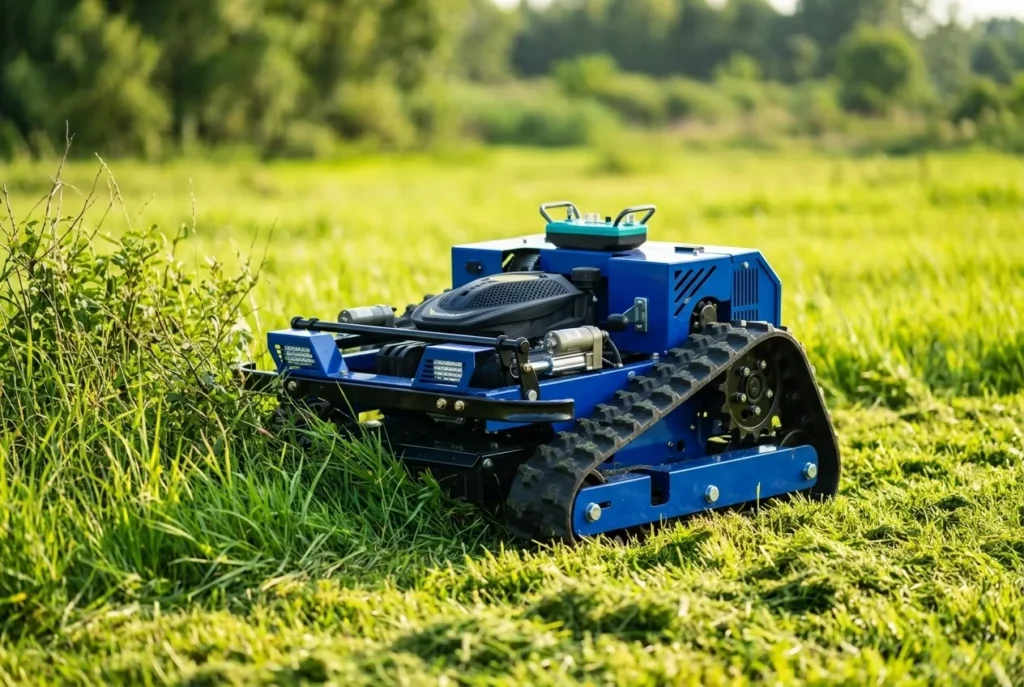
Is a remote control lawn mower worth it? It can be, especially if you regularly mow steep slopes, rough ground, large areas, or places where walking behind or riding a mower feels unsafe or exhausting. For a small, flat, uncomplicated lawn, however, the added cost, maintenance, and learning curve may be difficult to justify.
The right decision depends less on novelty and more on whether remote operation solves a real mowing problem. This guide explains where these machines offer practical value, where they fall short, and what to check before buying.
What Is a Remote Control Lawn Mower?
A remote control lawn mower is a powered cutting machine that an operator drives from a distance using a handheld controller. The operator remains responsible for steering, speed, cutting direction, stopping, and monitoring the surrounding area.
This distinguishes it from a fully autonomous robot lawn mower. A robot mower is generally designed to navigate and cut with limited direct input after setup. A remote-controlled mower still needs active attention throughout the job, even though the operator does not sit on or walk directly behind it.
Remote mowers come in different designs. Some are intended for maintained lawns, while others focus on slopes, dense vegetation, orchards, roadside areas, or rough land. Drive systems, cutting mechanisms, operating range, slope capability, and safety features vary substantially by model. Always verify the manufacturer’s official specifications for the exact machine you are considering.
When Is a Remote Control Lawn Mower Worth It?
You regularly mow slopes
Slope work is one of the strongest reasons to consider remote control. A conventional riding mower can feel unstable on an incline, while a walk-behind mower may require the operator to maintain footing near a moving blade. Remote operation lets the user stand away from the mower and choose a more stable observation point.
That does not make every remote mower suitable for every hill. Traction, center of gravity, braking behavior, ground conditions, operating direction, and the manufacturer’s permitted slope limit all matter. Wet grass, loose soil, hidden holes, and sudden changes in grade can reduce control. Treat remote operation as a way to reduce exposure, not as permission to ignore slope limits.
The terrain is tiring or difficult to walk
Uneven ground, long grass, embankments, drainage areas, and scattered obstacles can make mowing physically demanding. A remotely operated machine may reduce walking behind a heavy mower, repeated turning, vibration exposure at the controls, and the effort required to guide equipment over difficult ground.
The benefit is greatest when the machine is genuinely suited to the terrain. A mower designed primarily for smooth turf may not handle ruts, brush, soft soil, or debris well. Confirm the intended vegetation type, ground clearance, drive arrangement, cutting system, and terrain limitations in official documentation.
You need distance from specific hazards
Remote control can help keep the operator farther from low branches, thorny plants, insects, dust, unstable footing, and areas close to water or ditches. It may also improve visibility because the operator can change position instead of viewing the cutting path only from a seat.
Distance is not the same as complete protection. Mowers can throw stones, sticks, wire, and other objects. The operator must keep people and animals away, inspect the area beforehand, wear appropriate protective equipment, and follow the manufacturer’s exclusion-zone and operating instructions.
The machine will be used frequently
A specialized mower becomes easier to justify when its advantages apply to many mowing sessions rather than one awkward corner of a property. Frequent use can turn improvements in access, fatigue, and positioning into meaningful practical value.
If difficult mowing occurs only once or twice a year, hiring a suitable contractor or renting equipment may make more sense. Availability will vary by location, but comparing ownership with occasional service costs can prevent an expensive machine from spending most of its life in storage.
When It May Not Be Worth the Investment
Your lawn is small and flat
For a modest, level yard with clear edges and easy access, a standard walk-behind mower may be simpler to operate, store, clean, and maintain. Remote control adds components and procedures without necessarily improving the finished cut or saving meaningful effort.
You want unattended mowing
A remote control lawn mower is usually a poor substitute for an autonomous robot if your main goal is to let the lawn be cut while you do something else. You must remain engaged, maintain a clear view, anticipate hazards, and control the mower. If convenience means minimal supervision, compare autonomous products instead, while keeping their different installation, boundary, terrain, and safety requirements in mind.
Your property has many blind spots
Buildings, walls, dense shrubs, sharp corners, and major changes in elevation can interrupt visibility. A camera, if offered on a particular model, does not automatically eliminate blind spots or provide enough awareness for safe mowing. Remote control works best when the operator can maintain a clear view of the mower, its path, and the surrounding exclusion area.
Transport and storage would be difficult
Some remote mowers are substantial machines rather than compact lawn appliances. Before buying, consider gate width, ramps, trailers, vehicle capacity, tie-down points, storage space, ventilation, charging or fueling arrangements, and protection from weather. Dimensions, weight, and transport requirements are model-specific and should be confirmed with the manufacturer.
Remote Control vs. Other Mower Types
| Criterion | Remote control mower | Riding mower | Walk-behind mower | Autonomous robot mower |
|---|---|---|---|---|
| Operator involvement | Actively driven from a distance | Actively driven from the seat | Actively guided on foot | Designed for largely independent operation after setup |
| Best general fit | Slopes, awkward terrain, or locations where operator separation is useful | Larger, reasonably accessible areas suited to seated operation | Small to medium lawns with manageable terrain | Regular maintenance of compatible lawns with minimal direct control |
| Operator position | Away from the machine, within safe control and viewing conditions | On the machine | Directly behind or near the machine | Normally away while the mower follows its programmed system |
| Terrain considerations | Capabilities vary widely; some models focus on slopes or rough growth | Stability and rollover concerns can limit slope use | Footing and physical effort can limit difficult areas | Terrain, boundaries, passages, and navigation compatibility are important |
| Complexity | Requires controller skills, inspection, and specialized maintenance | Familiar controls but requires safe driving and maintenance | Usually the simplest ownership experience | Requires setup and ongoing management of the automated system |
| Unattended operation | No | No | No | Potentially, subject to model instructions and local conditions |
No category wins in every situation. A remote-controlled lawn mower is most compelling when it combines the active judgment of a human operator with useful physical separation from the cutting machine.
Benefits That Can Justify the Cost
Improved operator positioning
The operator can stand where footing and visibility are better rather than being tied to the mower’s seat or handles. This flexibility can be particularly useful on banks and around irregular boundaries.
Reduced physical strain
Remote steering may reduce pushing, pulling, climbing, and repeated maneuvering on foot. It does not remove all effort: the operator still needs to transport the mower, prepare the site, manage the controls, clean the equipment, and perform or arrange maintenance.
Access to awkward areas
A suitable machine may reach areas that are uncomfortable for a rider or demanding for a walk-behind mower. Actual access depends on machine width, traction, turning behavior, ground clearance, vegetation, and obstacles.
Precise human control
Unlike an autonomous mower, a remote unit responds to an operator who can adjust the route for changing grass conditions and visible obstacles. Good results still depend on controller skill, an appropriate cutting pattern, and the mower’s design.
Drawbacks and Ongoing Costs to Consider
The purchase price is only one part of ownership. Build a realistic comparison that includes:
- Delivery, transport equipment, ramps, or a suitable trailer
- Fuel or electricity, depending on the power system
- Blades, belts, filters, lubricants, tracks, tires, and other wear items
- Battery care for the mower, controller, or both
- Routine inspection and professional servicing where required
- Secure, dry storage with enough space for safe access
- Downtime and access to replacement parts or technical support
Remote systems add electronic controls, receivers, actuators, and emergency-stop functions that must remain reliable. A damaged controller, connection problem, or unavailable proprietary component could prevent use even if the cutting system itself is mechanically sound.
There is also a learning curve. Smooth steering and speed control matter on slopes and near boundaries. Buyers should understand startup, shutdown, emergency procedures, signal-loss behavior, manual recovery, and safe loading before normal use.
Safety Questions to Ask Before Buying
Remote operation changes where the operator stands, but it does not remove mower hazards. Before choosing a model, ask the seller or manufacturer:
- What happens automatically if the control signal is interrupted?
- Where are the emergency-stop controls located?
- What slope limits and operating directions are permitted?
- What minimum separation from people, animals, roads, and property is required?
- Can the mower be recovered safely if it stops on a slope?
- What inspections are required before each use?
- Which protective equipment and debris precautions are specified?
Read the official manual before purchase if possible. Do not rely only on promotional demonstrations, because controlled conditions may not resemble wet, obstructed, or uneven ground on your property.
How to Decide Whether It Is Worth It for You
Map the actual mowing problem
Walk the property with the equipment turned off and identify slopes, ditches, water, drop-offs, soft ground, gates, low branches, loose debris, public paths, animals, and blind corners. Note which areas cause difficulty with your current mower.
Define the vegetation and finish you need
Maintaining lawn grass is different from cutting tall weeds or coarse growth. Decide whether appearance, vegetation control, or access is the main objective. Verify that the mower’s cutting design is intended for that job; do not assume that a rugged-looking machine produces a fine lawn finish.
Compare the full alternatives
Compare the remote mower with keeping your current equipment, buying a different conventional mower, hiring a contractor, renting specialized machinery, or changing difficult sections to lower-maintenance landscaping. Include storage, transport, maintenance, time, physical effort, and risk exposure rather than looking only at purchase cost.
Arrange a site-relevant demonstration
If available, ask to see the exact model operate in conditions similar to yours. Focus on visibility, stopping, turning, traction, controller response, loading, noise, and access through gates. A demonstration is informative, but official limitations and instructions should still govern the decision.
Check support before committing
Ask who diagnoses faults, how parts are obtained, which maintenance tasks owners can perform, and how the machine is transported for service. Clear support arrangements matter more for specialized equipment than they do for many common lawn tools.
Frequently Asked Questions (FAQ)
Are remote control lawn mowers safer on hills?
They can reduce the need for an operator to ride or walk directly with the mower on a slope. However, the machine can still slide, roll, lose traction, or throw debris. Safe use depends on the specific model’s limits, ground conditions, operating technique, and manufacturer instructions.
Can a remote control mower cut the lawn by itself?
No, not in the usual sense. A remote mower requires an attentive person to steer and supervise it. A fully autonomous robot lawn mower is a separate type of product designed to navigate with less direct control.
Will a remote mower work on rough or overgrown land?
Some are designed for rough vegetation, while others are intended for maintained grass. Cutting capacity, ground clearance, traction, and acceptable terrain vary. Verify the official specifications and intended use of the particular model.
Is a remote control mower suitable for a small residential yard?
It may be, but it is often difficult to justify if the yard is flat, open, and easy to mow conventionally. Tight spaces, landscaping, pets, neighbors, and storage may also reduce its practicality.
How far away can the operator stand?
Control range is model-specific and should not be guessed. Even when a signal can travel farther, safe operation may require a much shorter distance so the operator maintains an unobstructed view. Follow the official operating manual.
What should I inspect before each mowing session?
Follow the model’s checklist. Common areas include the cutting components, guards, drive system, fasteners, controller, emergency stops, power or fuel condition, and the mowing area itself. Remove visible debris and keep bystanders and animals outside the required operating zone.
The Practical Verdict
A remote control lawn mower is worth it when remote operation repeatedly solves a genuine problem involving slopes, difficult footing, awkward access, physical strain, or operator positioning. It is less convincing for a small, flat lawn or for anyone expecting unattended mowing.
Evaluate the property first, compare the complete ownership cost, and verify every terrain and safety capability in the manufacturer’s official specifications. The best choice is the mower that fits the real conditions of your land without adding complexity you will rarely use.