
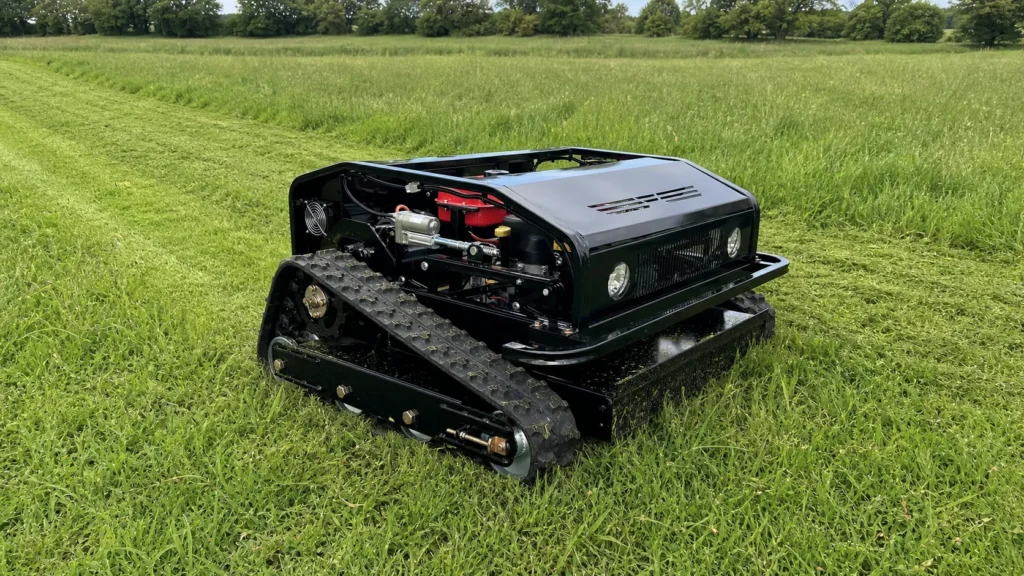
A remote control lawn mower should be inspected before every job, cleaned after mowing, and serviced according to both operating hours and calendar time. Give particular attention to the blades, tracks or wheels, engine or drive system, batteries, transmitter, receiver, emergency stop, and other safety controls. This remote control lawn mower maintenance guide explains what an operator can routinely check, when to stop using the machine, and which details must come from the exact model’s manual.
This guide concerns operator-controlled mowers that respond to a handheld radio transmitter. They are not the same as fully autonomous robot lawn mowers that navigate a lawn and return to a charging station without continuous operator control.
Start With the Manual and a Maintenance Record
Before servicing the mower, identify its exact model, power system, cutting mechanism, and drive configuration. Remote-controlled machines may use tracks or wheels, gasoline engines, electric drive motors, hydraulic components, belts, chains, or combinations of these systems. A maintenance method suitable for one configuration can damage another.
Use the manufacturer’s current manual to create a model-specific service sheet. Record the date, operating-hour reading where available, work completed, fluids or parts used, and any developing defect. Follow the manual for lubrication points, fluid grades, filter types, blade fasteners, tightening procedures, battery charging, track adjustment, and service intervals. Never infer these details from a similar-looking machine.
Remote Control Mower Maintenance Schedule
A useful schedule combines frequent visual checks with the operating-hour and calendar intervals specified by the manufacturer. For example, the Spider ILD01G operation manual separates daily work from tasks scheduled at different operating-hour intervals. Those intervals apply to that model, however, and should not be copied to another mower.
| Interval | Operator focus | Typical stop-work findings |
|---|---|---|
| Before every use | Controls, emergency stop, receiver, blades, guards, tracks or wheels, leaks, fluid levels, batteries, and loose hardware | Failed safety control, damaged blade, leaking fluid, exposed wiring, loose critical fastener, or damaged track |
| After every use | Remove grass and debris, inspect the cutting area, clean cooling openings, check for fresh damage, and recharge as directed | Entangled material that cannot be removed safely, impact damage, overheating evidence, or abnormal wear |
| By operating hours | Engine, hydraulic system, filters, belts, chains, bearings, lubrication points, and fastener checks listed in the manual | Overdue safety-critical service or a measurement outside the manufacturer’s limit |
| Monthly or periodically | Stored-battery condition, terminals, corrosion, transmitter condition, and rarely used safety functions | Swollen or damaged battery, corroded connection, unreliable signal, or control fault |
| Before seasonal storage | Thorough cleaning, drying, inspection, fuel preparation, battery care, corrosion prevention, and dry storage | Unresolved leak, damaged battery, trapped moisture, or uncertain storage procedure |
This table is a planning framework rather than a universal service specification. Where it differs from the manual, follow the instructions for the exact mower.
Pre-Use Safety and Condition Check
Make the machine inoperable before touching it
Park on stable ground, stop the cutting system, shut down the mower, apply any parking or central stop specified by the manufacturer, and wait for every moving component to stop. Remove the ignition key or use the prescribed isolation method. General guidance from the U.S. Consumer Product Safety Commission advises disconnecting electric equipment from power and disconnecting the spark-plug wire on gasoline equipment before adjustments or clearing a jam near moving parts. Your mower may require additional lockout steps.
Inspect the work area and mower
- Remove wire, stones, branches, tools, toys, and other objects that could damage the mower or become projectiles.
- Look beneath and around the machine for fuel, oil, coolant, or hydraulic-fluid leaks without reaching under an unsecured deck.
- Check guards, shields, access covers, warning labels, and fasteners for damage or looseness.
- Inspect tracks for cuts, missing components, embedded debris, abnormal sag, or uneven wear. On wheeled machines, inspect tires and wheel hardware.
- Check the cutting assembly for bent, cracked, badly worn, or loose parts. Wear heavy gloves, but remember that gloves do not make an energized blade safe.
- Confirm that cooling screens, ventilation openings, and engine or hydraulic cooling areas are unobstructed.
- Check required fluid levels only by the model-specific procedure and on the surface or at the temperature stated in the manual.
Test the remote and safety controls
Inspect the transmitter casing, switches, joysticks, antenna, battery compartment, and carrying harness. Then inspect visible receiver wiring and connectors on the mower. From the operating position specified by the manufacturer, confirm normal steering and cutting commands, emergency-stop operation, and any loss-of-signal or neutral-return behavior the manual instructs you to test.
Do not operate if a command sticks, motion is delayed or unpredictable, the mower moves without a deliberate input, the emergency stop fails, or the receiver repeatedly loses communication. A greater advertised control distance is never permission to operate without a clear view or beyond safe control.
Cleaning the Deck and Cutting System
Grass packed around a blade shaft or mowing mechanism can reduce cut quality, retain moisture, obstruct cooling, and hide damage. Clean after the machine is isolated and the blades have stopped. Use a brush, scraper, or low-risk method approved for the mower. Keep hands away from blade edges and pinch points.
Do not assume a pressure washer is permitted. Water can be forced into bearings, electrical connectors, seals, motors, or control modules. Even manufacturer guidance for autonomous mowers varies by model: Husqvarna’s seasonal Automower guidance notes that washing permission depends on the mower and advises against using a high-pressure washer on the charging station. A tracked remote-controlled mower has different components, so consult its own manual.
After cleaning, let the machine dry and check for freshly exposed cracks, loose fasteners, damaged cables, oil seepage, or polished areas indicating contact between moving parts.
Blade Inspection and Replacement
Inspect blades whenever the mower strikes an object, vibrates abnormally, or produces a suddenly poorer cut. Also follow the manual’s routine inspection interval. Look for cracks, bending, missing material, severe wear, damaged mounting points, and loose hardware. Replace broken or damaged blades rather than continuing to mow.
Blade construction and replacement rules vary. Some cutting systems require matched blades or paired components to preserve balance. Use the specified replacement part and follow the manufacturer’s orientation, bolt-reuse, locking, and tightening instructions. Do not guess a torque value. If sharpening is allowed, maintain the required profile and balance; otherwise replace the blade or send the assembly to qualified service.
Stop work if vibration persists after visible debris is removed. Continuing to run a vibrating cutting assembly can worsen damage to blade hubs, shafts, bearings, mounts, or the deck.
Tracks, Wheels, Chains, Belts, and Bearings
Clean soil and vegetation from track frames, sprockets, rollers, wheels, and protected drive areas without placing yourself beneath an unsupported machine. Examine both sides for unequal wear or alignment. A thrown, torn, or badly worn track requires correction before use.
Track, chain, and belt tension values are model-specific. Excessive looseness may permit derailment or poor drive transfer, while excessive tension can load bearings and shafts. Measure and adjust only as the manual directs. Likewise, lubricate only identified service points with the specified lubricant; indiscriminate grease or oil can attract abrasive debris or contaminate belts and brakes.
Grinding, clicking, binding, side-to-side play, or unusual heat can indicate a bearing, hub, chain, sprocket, or alignment problem. Stop and investigate rather than masking the symptom with lubricant.
Power-System Maintenance
Gasoline-engine systems
Check engine oil by the engine manufacturer’s method and keep cooling screens and fins clear. Inspect the air filter regularly and service or replace it at the stated interval, more often only if the applicable manual calls for it under dusty conditions. Use the specified fuel and oil; do not substitute based on another engine’s requirements. Inspect fuel lines and the tank area for damage or leakage, and allow hot components to cool before servicing.
Battery-electric and hybrid systems
Inspect batteries for swelling, cracks, leakage, heat damage, loose mounting, and cable abrasion. Keep terminals clean and dry, and use only the charger and charging method approved for that battery and mower. Battery chemistry affects charging limits, storage temperature, ventilation needs, and long-term maintenance, so generic monthly charging advice is unsafe unless the manual specifies it.
Treat the mower battery and transmitter battery as separate maintenance items. A charged mower cannot be controlled reliably by a transmitter with a weak, corroded, or damaged battery connection.
Hydraulic systems
Check hydraulic-fluid level and visible hoses, fittings, coolers, and cylinders according to the manual. Never search for a pressurized pinhole leak with your hand. Fluid injection injuries require urgent medical attention. A falling fluid level, damaged hose, wet fitting, loss of drive, irregular motion, or overheating is a reason to stop and arrange qualified inspection. Filter changes, pressure testing, and system opening may require authorized service.
Remote-Control Troubleshooting
If the mower does not respond, first stop the cutting system if possible and keep people away. Check whether the transmitter is switched on, its emergency stop is released as instructed, and its battery is charged and correctly installed. Check the mower’s battery state, central stop, visible receiver connections, and any status indicators described in the manual.
Move only within the manufacturer’s safe operating arrangement and restore a clear line of sight. Interference, obstacles, terrain, antenna damage, battery condition, and the surrounding environment can affect radio communication. Do not repeatedly restart a mower that behaves unpredictably.
Investigate why a fuse opened before replacing it, and use only the specified fuse type and amperage. Never bridge a fuse or install a larger one. Internal receiver faults, damaged wiring, repeated fuse failure, intermittent movement, or an unsuccessful pairing procedure should be handled using the official diagnostic process or qualified service.
Seasonal Storage Checklist
- Clean grass, soil, and plant residue from the deck, cutting area, tracks or wheels, and cooling openings.
- Dry the mower completely and inspect it so problems are repaired before the next season.
- Prepare fuel only according to the engine and mower manuals. Requirements differ between systems.
- Charge, disconnect, or remove mower and transmitter batteries only as directed for their specific chemistry and configuration.
- Clean battery terminals safely and protect them from accidental short circuits. Follow the manual’s connection and disconnection order.
- Store the mower in a dry, secure location where unauthorized users cannot start it.
- Follow the specified storage-temperature and periodic-charging instructions. Do not invent a charging interval when none is supplied.
At the start of the next season, check fluids, batteries, belts, tracks, controls, guards, and the cutting system before operation. Test the remote and every safety function in the prescribed manner.
When to Stop and Call for Service
Stop using the mower when you find a cracked or bent blade, persistent abnormal vibration, a fuel or hydraulic leak, smoke, burning odor, damaged battery, exposed wiring, repeated fuse failure, uncontrolled movement, unreliable radio response, structural cracking, or a failed emergency stop. Also seek service when a repair requires lifting without approved supports, opening a hydraulic circuit, changing internal electronics, or performing an adjustment for which the manual requires special tools or training.
Frequently Asked Questions (FAQ)
How often should a remote control lawn mower be serviced?
Inspect it before and after every use, then complete hour-based and calendar-based work at the intervals in the exact model’s manual. Engine, hydraulic, belt, chain, and filter schedules vary substantially, so there is no universal service interval.
Can I pressure-wash a remote-controlled mower?
Only if the manufacturer explicitly permits it and identifies suitable areas and procedures. High-pressure water can damage bearings, seals, electrical connectors, motors, and control equipment. Brushing and controlled wiping are safer defaults until the manual confirms otherwise.
Why does my mower vibrate after hitting an object?
A blade may be bent, cracked, loose, unbalanced, or obstructed, and related hubs or shafts may also be damaged. Isolate the machine and inspect it safely. Do not resume mowing if vibration remains after removable debris is cleared.
What should I do when the remote loses connection?
Use the prescribed stop procedure, keep away from the mower, and check transmitter and mower batteries, emergency stops, antennas, visible receiver wiring, status indicators, and line of sight. If communication remains intermittent or controls behave unpredictably, stop using the machine and obtain qualified service.
Should I remove the batteries during winter storage?
Follow the instructions for the exact mower, transmitter, charger, and battery chemistry. Some manuals call for removal and periodic charging, but storage temperatures and charging intervals differ. Store batteries dry, protected from short circuits, and away from unauthorized access.
Conclusion
Effective remote control lawn mower maintenance rests on a simple routine: inspect before mowing, clean and recheck afterward, record operating hours, and follow the exact manual for adjustments and scheduled service. Never continue through vibration, leakage, damaged blades, electrical faults, or failed safety controls. A short, consistent checklist is the most practical way to keep faults visible and the mower ready for controlled operation.