
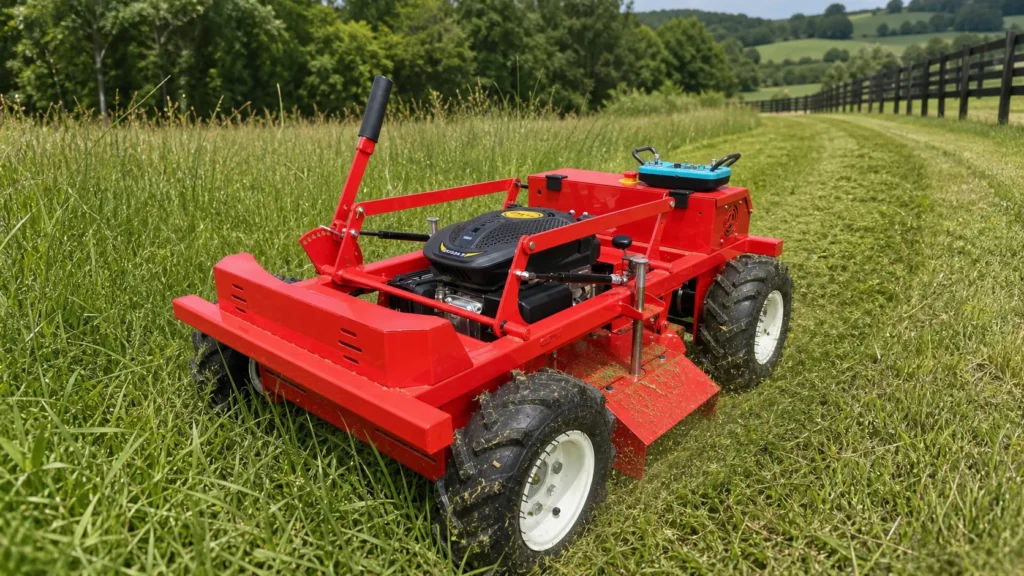
A remote control lawn mower should be operated only after the site, machine, remote link, emergency controls, weather, and exclusion area have been checked. Keep the mower continuously visible, stand outside its likely travel, slide, rollover, and debris paths, and stop immediately if a person, animal, signal problem, or terrain change creates uncertainty. This remote control lawn mower safety guide provides a practical routine, but the manual supplied for the exact model must always take priority.
Remote-Controlled Mowers Are Not Autonomous Robot Mowers
A remote control lawn mower is driven by an operator using a handheld transmitter. The operator remains responsible for steering, speed, blade engagement, hazard recognition, and stopping. It may be designed for slopes or difficult vegetation, but physical separation from the machine does not remove the risks created by blades, thrown objects, movement, crushing, fire, noise, or unstable ground.
An autonomous robot lawn mower follows a programmed work area with limited ongoing steering input. Its operating, stopping, battery, boundary, and maintenance procedures can be substantially different. Do not apply instructions for an autonomous mower to a continuously operator-driven radio-controlled machine, or vice versa.
Main Hazards to Control
- Blade contact: A cutting system can remain dangerous while moving or coasting after shutdown.
- Thrown material: Stones, wire, branches, and other objects can be ejected from the cutting area. The University of Minnesota Extension advises removing debris and keeping spectators away when mowing.
- Uncontrolled movement: Loss of traction, braking, radio communication, or operator orientation can allow the mower to travel unexpectedly.
- Sliding or rollover: Slopes, wet grass, loose soil, hidden holes, and abrupt steering can reduce stability.
- Crushing and impact: A moving mower can trap someone against a wall, tree, vehicle, or other fixed object.
- Edges and water: Ditches, banks, retaining walls, drop-offs, roads, and bodies of water can magnify the consequences of a steering or traction error.
- Unexpected startup: Blockage clearing and maintenance become especially hazardous if power has not been isolated or the machine can move.
Pre-Operation Safety Checklist
Read the Exact Manual and Learn the Controls
Identify the manual revision that applies to the mower and transmitter. Learn how to start, engage the cutting system, select speed, steer, stop propulsion, stop the blades, activate each emergency stop, and prevent restarting. Establish exactly what happens after radio-signal loss and whether deliberate reset steps are required.
Practice on a spacious, level, unobstructed area before attempting slope work. Begin with the cutting system disengaged where the manufacturer permits it. Become familiar with control direction when the mower faces toward, away from, and across the operator. A change in orientation can make an instinctive steering input send the machine the wrong way.
Inspect the Mower and Transmitter
- Check guards, shields, covers, fasteners, tires or tracks, cutting components, antennas, wiring, fluid leaks, and visible structural parts.
- Confirm that safety devices and interlocks are fitted and have not been bypassed.
- Check the transmitter condition, controls, indicators, power supply, and pairing procedure.
- Verify that propulsion and blade commands return correctly when controls are released, if that behavior is specified for the model.
- Test emergency stops and signal-loss behavior using the manufacturer-approved procedure in a controlled location.
- Do not use a machine with a damaged guard, unpredictable control, safety-system warning, or unresolved fault.
The UK Health and Safety Executive recommends confirming that machinery is complete, free from defects, and fitted with its safeguards before use. It also emphasizes suitable equipment, maintenance, inspection, training, and safety measures for mobile work equipment.
Survey the Work Area
Walk the entire site before starting. Remove loose stones, branches, wire, toys, hoses, and other debris where this can be done safely. Mark objects that cannot be removed, including stumps, irrigation hardware, utility covers, holes, and concealed edges. Inspect both the planned cutting route and the areas into which the mower or debris could travel.
Look for wet or soft soil, loose gravel, ruts, sudden changes in slope, embankments, water, traffic, buildings, windows, parked vehicles, overhead obstacles, and restricted sightlines. If vegetation hides the ground, inspect it before driving into it. Delay work when rain, fog, glare, darkness, wind, or surface conditions prevent reliable control.
Plan the Exclusion Zone and Operator Position
Keep children, bystanders, animals, and uninvolved workers out of the operating area. There is no universal exclusion distance for every remote mower. Use the distance and debris-zone instructions in the exact model manual, then expand the controlled area where terrain, vegetation, nearby property, or public access increases risk.
Choose a position that provides continuous line of sight to the complete mower and the ground ahead. Do not rely on the brochure’s maximum radio distance as a target operating distance. Stand where you can recognize a developing problem and stop before it becomes an incident.
Avoid standing directly downhill from the machine, within a likely rollover or slide path, between the mower and a fixed object, or in front of a discharge opening. Reposition before the mower, vegetation, dust, terrain, or an obstacle blocks your view. Never walk backward into traffic, an edge, or uneven ground while concentrating on the machine.
Safe Operating Routine
- Secure the work area and confirm that no person or animal is inside the exclusion zone.
- Place yourself in a stable location with a clear view of the mower and its intended route.
- Start according to the model-specific sequence, keeping the cutting system disengaged until ready to mow.
- Use smooth steering and speed inputs. Allow extra space near obstacles and terrain transitions.
- Scan repeatedly between the mower, its route, surrounding people, and your own footing.
- Stop before approaching hidden ground, a new obstacle, public access, or any condition not covered by the plan.
- At the end of work, disengage cutting, stop movement, shut down, isolate power as instructed, secure the transmitter, and wait for moving parts to stop.
Signal Loss and Emergency Stops
Do not assume all machines react alike. A model may stop propulsion, disengage blades, stop the engine, apply a brake, block restarting, or perform only some of those actions. Verify the exact result of both the remote emergency stop and any machine-mounted emergency stop.
One model-specific example shows why verification matters: the SPIDER ILD02 SG manual states that loss of radio signal generates an emergency-stop command. For that model and applicable manual revision, the stated response includes stopping the engine, blocking steering and travel, disengaging the mowing-blade clutch, blocking the starter, and switching off ignition. These functions must not be generalized to another mower. Consult the applicable SPIDER manual only for the machine and revision it covers.
If control becomes delayed, intermittent, or inconsistent, activate the appropriate stop, keep people away, and follow the manual’s recovery procedure. Do not approach until unintended movement and cutting-system operation have been prevented.
Operating on Slopes and Difficult Ground
A catalog slope figure is not automatically a safe working slope. Safe operation depends on surface grip, moisture, soil strength, vegetation, holes, machine configuration, travel direction, attachments, visibility, and the manufacturer’s procedures. Establish a lower job-specific limit when conditions warrant it, and do not operate where a slide or rollover could reach people, roads, water, or structures.
For each slope, decide where the mower could go if traction or control is lost. Keep the operator and others outside that zone. Avoid sharp turns, sudden speed changes, and driving close to an unprotected edge. Follow the manual’s model-specific instructions for travel direction, turning, stopping, braking, and any stability aid such as a winch. Never improvise an anchor or recovery method.
Yitaiwei brochure values illustrate the limitation of catalog data. For each of the catalog models QL600Y, QL500Y, HS500-24V, LB500-24V, LB600-24V, HS800, HB800, QL800, HS1000, LJ800, and LJ1000, the brochure lists a climbing angle of 45° on its corresponding model page. This is an Official brochure specification, not a recommended working slope, safe mowing slope, independently tested maximum, or all-terrain guarantee. Direction, surface, load, weather, test method, terrain effects, and safety margin are not stated. Verify the current official specifications and operating manual for the exact model before planning slope work.
Safety Features to Compare Before Buying
| Comparison criterion | What to verify | Why it matters |
|---|---|---|
| Signal-loss response | Which functions stop automatically and how restart is prevented | A vague claim such as fail-safe does not explain blade, drive, brake, engine, or restart behavior. |
| Emergency stops | Remote and machine-mounted controls, accessibility, and resulting shutdown actions | The operator needs a predictable response from each stop control. |
| Interlocks | Blade, drive, neutral-start, radio-link, guard, and restart conditions | Interlocks can reduce unintended starting or movement when correctly maintained. |
| Braking and holding | Behavior after controls are released, after emergency stop, and on a slope | Stopping propulsion does not necessarily mean the mower will remain stationary. |
| Visibility and diagnostics | Status indicators, warnings, fault reporting, and visibility aids | The operator must recognize control-link and safety-system problems promptly. |
| Guards and discharge control | Complete guarding, discharge direction, and replacement requirements | These features help manage blade-contact and projectile hazards. |
| Slope system | Permitted conditions, travel method, stability aids, and prohibited terrain | A headline climbing value does not define a safe operating method. |
| Service isolation | Documented shutdown, stored-energy, support, and lockout procedures | Maintenance requires prevention of startup, blade movement, and machine movement. |
Also compare training materials, manual clarity, parts support, inspection access, and procedures for loading, unloading, and recovery. Capabilities vary by model and revision, so verify current manufacturer documentation rather than assuming that similar-looking machines share the same safety systems.
Remote Range Is Not a Safe Working Distance
The official Yitaiwei brochure lists a remote-control distance of 200m for each of its catalog models, with the exact value appearing on the corresponding model page. This is an Official brochure specification. The catalog does not state the test environment, line-of-sight conditions, interference, or safe operating limit. Actual usable distance may be affected by line of sight, interference, environment, and safe operating requirements. The operator should remain close enough to see the mower clearly, recognize hazards, and respond in time.
Range can also be affected by terrain, vegetation, buildings, other radio equipment, transmitter condition, and power state. Never test the limit by deliberately driving toward a road, edge, waterway, person, or structure.
Blockages, Maintenance, and Transport
Clearing a Blockage
Stop the cutting system and propulsion, shut the machine down, isolate all relevant power sources, secure against movement, and wait for moving parts to stop. Follow the manual for stored energy and restart prevention. Never reach beneath a deck or into a discharge area merely because the engine or motor appears quiet. The HSE’s machinery safety guidance advises switching off and isolating machinery before removing blockages or performing cleaning, adjustment, or repair.
Inspection and Servicing
Use the prescribed support points and suitable supports before working beneath the mower. Do not rely on hydraulics, a winch, terrain, or an improvised prop to hold it. Damaged guards, cutting components, controls, braking systems, or radio equipment should be repaired by appropriately qualified personnel. After service, refit safeguards and perform the specified controlled checks before returning to work.
Loading and Transport
Use a transport method rated and configured for the exact machine. Inspect ramps, loading surfaces, tie-down points, and the destination before moving. Keep people away from the travel path and pinch zones. Shut down, isolate, restrain the mower, and secure the transmitter separately so controls cannot be operated accidentally during transport.
Frequently Asked Questions (FAQ)
Is a remote control lawn mower safer than a riding mower?
Remote operation can place the operator away from the machine, but it introduces radio-link, visibility, orientation, and remote-positioning risks. Safety depends on the machine, site, operator competence, maintenance, and operating method; the remote control alone does not make mowing safe.
Can I use the brochure’s climbing angle as my working slope limit?
No. A climbing-angle field does not necessarily establish a recommended or safe mowing slope. Use the model manual, assess actual ground and weather conditions, and maintain a safety margin appropriate to the consequences of sliding or rollover.
Where should I stand when mowing a slope?
Stand on stable ground with an unobstructed view, outside the likely downhill slide, rollover, travel, and debris-ejection paths. Do not place yourself between the mower and a wall, vehicle, tree, drop-off, or other trapping point.
What should happen if the radio signal is lost?
The correct response is model-specific. Verify whether propulsion, blades, engine, brakes, steering, and restart are affected. Test the documented behavior in a controlled setting before mowing, and do not operate if the response is unclear or defective.
Can I approach the mower after pressing the emergency stop?
Not immediately. Confirm that propulsion and cutting have stopped, shut down and isolate power as required, prevent rolling or restarting, and wait for moving parts to stop. An emergency stop is not automatically a complete maintenance isolation.
Practical Conclusion
Safe remote mowing begins with the exact manual, a careful site survey, a controlled exclusion zone, clear line of sight, tested stop functions, and an operator position outside potential movement and debris paths. Treat catalog range and climbing figures as model-specific brochure information rather than operating permission. When terrain, visibility, machine behavior, or radio control is uncertain, stop, isolate the mower if necessary, and reassess before continuing.