
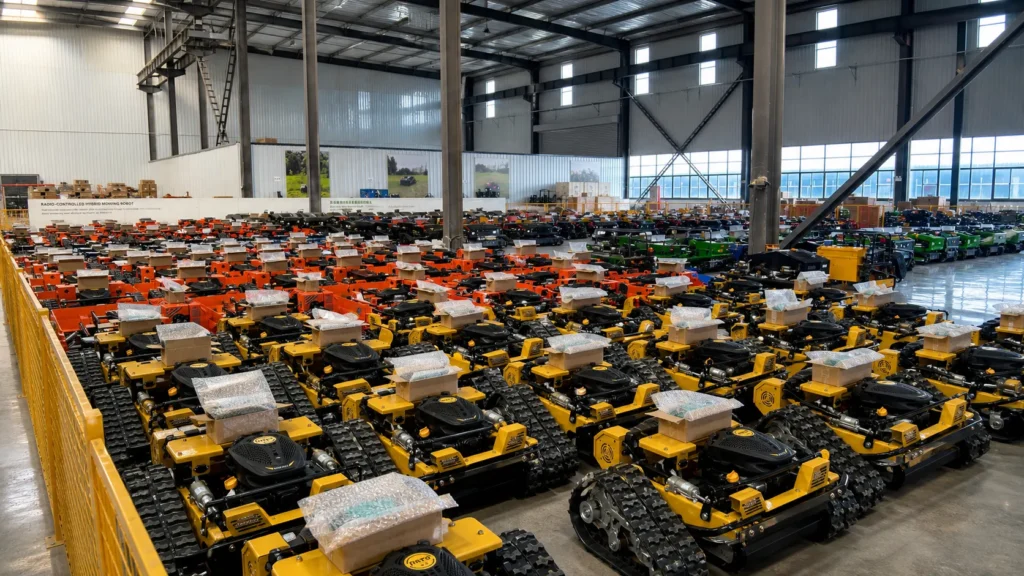
A remote control lawn mower for uneven ground can make slopes, rough grass, and awkward areas easier to cut while allowing the operator to remain at a safer distance. The right machine should combine stable traction, responsive controls, suitable cutting capability, and a design matched to the terrain. It is not the same as a fully autonomous robot mower: the operator actively steers it and remains responsible for assessing hazards throughout the job.
Choosing well requires more than checking whether a mower can move uphill. Uneven sites may include side slopes, hidden holes, wet patches, loose soil, dense vegetation, and sudden changes in gradient. This guide explains the practical features to compare, how to assess your land, and how to operate a remotely controlled mower more safely.
Why Use a Remote Control Mower on Uneven Land?
Conventional walk-behind and ride-on mowers can be difficult to control on irregular terrain. A walk-behind mower may pull the operator off balance, while a ride-on machine can expose the driver to rollover risk if it is used beyond its intended limits. A remote control mower separates the operator from the machine, but it does not remove the need for careful judgment.
Because the operator controls direction and speed remotely, it may be possible to work from a position with better footing and visibility. Remote operation can also reduce the need to walk through tall vegetation, stand directly behind a mower on a slope, or repeatedly climb rough ground.
These machines are especially relevant for embankments, orchards, solar sites, roadside verges, large gardens, drainage areas, and overgrown plots. Suitability still depends on the individual model. Always verify the official specifications for permitted slope, vegetation type, operating range, cutting system, and environmental limitations.
Assess the Ground Before Choosing a Mower
Identify gradients and side slopes
A site described as uneven may contain gentle rises, steep banks, cross-slope sections, or a mixture of all three. These conditions affect a mower differently. Climbing requires traction and power, while traveling across a slope places greater emphasis on lateral stability.
Do not estimate a difficult slope only by eye. Determine its steepest sections and compare them with the manufacturer’s stated operating limits. Check whether those limits apply to uphill travel, downhill travel, side-slope operation, or all directions. Published capabilities and operating conditions vary by model.
Inspect the surface
Traction can change substantially across the same property. Dry turf, mud, gravel, loose soil, exposed roots, and wet leaves do not offer equal grip. Look for holes, soft shoulders, erosion channels, buried debris, stones, wire, and low branches before mowing.
A machine that handles firm grass well may behave differently on saturated ground. If the surface cannot support the mower securely, postpone the work or use another approach. Remote control should never be treated as permission to ignore unstable terrain.
Consider what must be cut
Regular lawn grass places different demands on a mower than long weeds, brushy growth, or saplings. Define the normal vegetation and the heaviest material likely to be encountered. Then confirm that the cutting deck and blades are designed for it. Avoid assuming that a rugged undercarriage automatically means the cutting system can process woody growth.
Key Features for Uneven Ground
Traction and drive layout
Traction is one of the most important selection criteria. Tracked machines spread their contact area and may perform well on soft or irregular surfaces. Wheeled models can be agile and may disturb finished turf less, depending on their tires, weight, and steering method. Neither design is universally superior.
Examine tread pattern, ground contact, weight distribution, and the way the mower turns. Aggressive skid steering can mark soft grass, while insufficient tread may allow slipping. Also consider whether grass, mud, or debris can collect around the drive components and how easily those areas can be cleaned.
Low center of gravity and stability
A low, wide machine is generally better suited to uneven terrain than a tall, narrow layout, but overall stability depends on the complete design. Deck position, battery or engine placement, attachments, fuel level, and ground conditions can all affect balance.
Look for clear manufacturer guidance on slope operation and prohibited maneuvers. A claimed maximum incline should not be interpreted as a recommended working angle under every condition. Wet vegetation, abrupt steering, hidden depressions, and operating across a slope may reduce the practical safety margin.
Responsive proportional controls
Good remote controls should let the operator make gradual changes rather than forcing abrupt starts, stops, or turns. Proportional speed and steering can help maintain a predictable path on rough ground. Control layout should also be understandable when the mower is facing toward the operator, because left and right can feel reversed.
Check how the mower responds if the signal is interrupted, the controller loses power, or an emergency stop is activated. These behaviors are model-specific and should be confirmed in the official manual before use.
Adjustable cutting height and deck protection
Uneven ground increases the chance of scalping high spots or striking concealed objects. An adjustable cutting height allows a higher initial pass when the surface or vegetation is uncertain. Deck construction, blade enclosure, discharge direction, and protection around moving parts also deserve attention.
Some sites require a fine finish, while others need vegetation management rather than lawn-quality cutting. Select the cutting system for the intended result. Verify which blade type, deck configuration, and replacement parts the manufacturer approves.
Power source and runtime planning
Remote control mowers may use batteries, engines, hybrid arrangements, or other model-specific power systems. The best choice depends on site size, access, noise constraints, refueling or charging logistics, and maintenance capacity.
Do not compare machines using runtime alone. Terrain, vegetation density, travel speed, cutting load, temperature, and battery condition can affect operating duration. Use official data as a planning reference and allow enough capacity to return the mower from a difficult area without exhausting its usable energy.
Qualitative Comparison of Mower Designs
| Selection criterion | Tracked remote mower | Wheeled remote mower | What to verify |
|---|---|---|---|
| Soft or broken ground | Broad ground contact may help distribute weight | Performance depends heavily on tires and soil condition | Ground pressure guidance, tread, and permitted surfaces |
| Turning on finished turf | Pivot turns may disturb soft grass | May turn more gently if steering geometry permits | Steering method and recommended turning technique |
| Side-slope stability | Can offer a wide, low stance depending on design | Varies with track width, tire grip, and weight distribution | Official slope limits in each travel direction |
| Cleaning | Debris may collect around tracks and rollers | Mud and grass may build around wheels and axles | Safe cleaning points and maintenance access |
| Transport | Loading may require suitable ramps or lifting arrangements | Transport needs depend on dimensions and weight | Total weight, tie-down points, and loading instructions |
| Best use case | Often considered for rough, soft, or consistently sloped sites | Often considered for mixed terrain and areas needing maneuverability | Whether the exact model matches the property |
This table is a starting point rather than a rule. Design quality matters more than the simple choice between tracks and wheels. Compare actual machines using their manuals and official specifications, especially when slopes or public areas are involved.
Safety Features and Operating Practices
Emergency stopping and fail-safe behavior
The operator should be able to stop the drive and cutting system quickly. Learn the emergency procedure before moving onto a slope, and test controls in a clear, level area according to the manufacturer’s instructions. Confirm what happens after signal loss and whether restarting requires a deliberate action.
Maintain visibility and separation
Operate from a position where the entire mower and its immediate path remain visible. Do not rely on the remote-control range as a working-distance target. Long range is of little value if grass, terrain, buildings, or poor light prevent the operator from seeing hazards.
Keep people and animals away from the work area. Mowers can throw stones, metal, and other objects. The operator should avoid standing in the likely discharge path or directly downhill from the machine.
Use deliberate routes
Plan the cut before starting. Remove obvious debris and identify boundaries, drop-offs, water, retaining walls, ditches, and areas where the mower could become trapped. On slopes, use only travel patterns allowed by the manual. Avoid sudden direction changes, excessive speed, and turning close to an edge.
A higher first cut can reveal surface conditions while reducing cutting load. If the mower slips, lifts, loses steering authority, or behaves unpredictably, stop and reassess rather than trying to force it through.
How to Compare Models Before Buying
Create a short list based on the most difficult part of the property, not the easiest lawn section. Ask suppliers or manufacturers precise questions and request the relevant manual where available.
- Slope guidance: Confirm permitted gradients and whether separate limits apply to climbing, descending, and traversing.
- Vegetation capability: Match the cutting system to maintained grass, long growth, weeds, or brush.
- Machine dimensions: Check access through gates, between trees, and onto transport equipment.
- Control behavior: Review speed adjustment, steering response, emergency stopping, and signal-loss response.
- Service access: Determine how blades, tracks, wheels, filters, batteries, and other wear items are inspected or replaced.
- Parts availability: Confirm that approved consumables and replacement components are reasonably obtainable.
- Transport requirements: Verify weight, loading method, securement points, and any restrictions in the manual.
If possible, evaluate the control layout and maneuverability in conditions representative of the intended site. Do not assume that promotional footage shows the same gradient, surface, or vegetation found on your property.
Practical Mowing Workflow
- Walk the site and remove stones, wire, branches, toys, and other visible hazards.
- Mark holes, ledges, drainage channels, soft ground, and boundaries that may be difficult to see from the operating position.
- Inspect the mower, controller, cutting components, guards, drive system, and available energy or fuel according to the manual.
- Check the emergency stop and normal controls on level, open ground.
- Begin at a conservative cutting height and travel speed.
- Maintain a clear view, safe separation, and an escape route for yourself.
- Stop if traction, visibility, weather, signal quality, or machine behavior becomes unsuitable.
- After operation, isolate the machine as instructed before inspecting or cleaning it.
Never approach a mower with moving blades, and do not clear blockages until the machine has been safely shut down using the manufacturer’s procedure.
Maintenance for Reliable Terrain Handling
Uneven-ground performance depends on routine care. Worn tires, damaged tracks, loose components, blunt blades, and packed debris can affect control or cutting quality. Inspect the undercarriage frequently, particularly after operating in mud, long grass, or abrasive material.
Keep the controller in suitable condition and follow the specified charging, storage, and pairing procedures. Check fasteners, guards, emergency controls, and drive components at the intervals in the official maintenance schedule. Use approved replacement parts where the manufacturer requires them.
Cleaning methods vary. Water directed at bearings, electronics, engines, or electrical connections may cause damage on some machines. Follow the manual instead of assuming the mower can be pressure-washed.
Frequently Asked Questions (FAQ)
Are remote control lawn mowers the same as robot mowers?
No. A remote control mower is actively driven by an operator using a handheld controller. A fully autonomous robot mower typically follows programmed or sensor-based routines with less continuous steering input. Some products may combine functions, so verify the operating modes of the specific model.
Can a remote control mower work across a steep slope?
Some models are designed for slope work, but safe limits vary. Side-slope travel can create different stability demands than moving directly uphill or downhill. Check the official directional slope limits and operating instructions, then account for wet grass, loose soil, holes, and other site conditions.
Are tracks always better than wheels on uneven ground?
No. Tracks may offer broad contact and useful traction, while wheels may provide maneuverability and gentler turning on certain surfaces. The better option depends on soil, slope, vegetation, mower geometry, steering design, and maintenance needs.
Can these mowers cut brush as well as grass?
Only if the particular cutting system is designed for that vegetation. Heavy weeds, woody stems, and saplings can exceed the capability of a lawn-oriented deck. Verify the approved material and blade configuration in the manufacturer’s specifications.
What happens if the remote signal is lost?
The response depends on the model. A suitable machine should have clearly documented signal-loss behavior, but readers should not assume every mower reacts identically. Review the manual and test the prescribed safety functions in a controlled area before mowing.
How far away should the operator stand?
Stand where you can clearly see the mower, its route, and nearby hazards while remaining outside the likely path of thrown debris. The controller’s maximum range is not necessarily an appropriate operating distance. Follow the manufacturer’s separation and visibility guidance.
Conclusion
The best remote control lawn mower for uneven ground is the one matched to the site’s steepest slopes, weakest surfaces, vegetation, access, and maintenance demands. Prioritize controllability, traction, stability, cutting suitability, visibility, and documented safety behavior. Compare official specifications carefully, inspect the ground before every job, and operate conservatively when conditions change.