
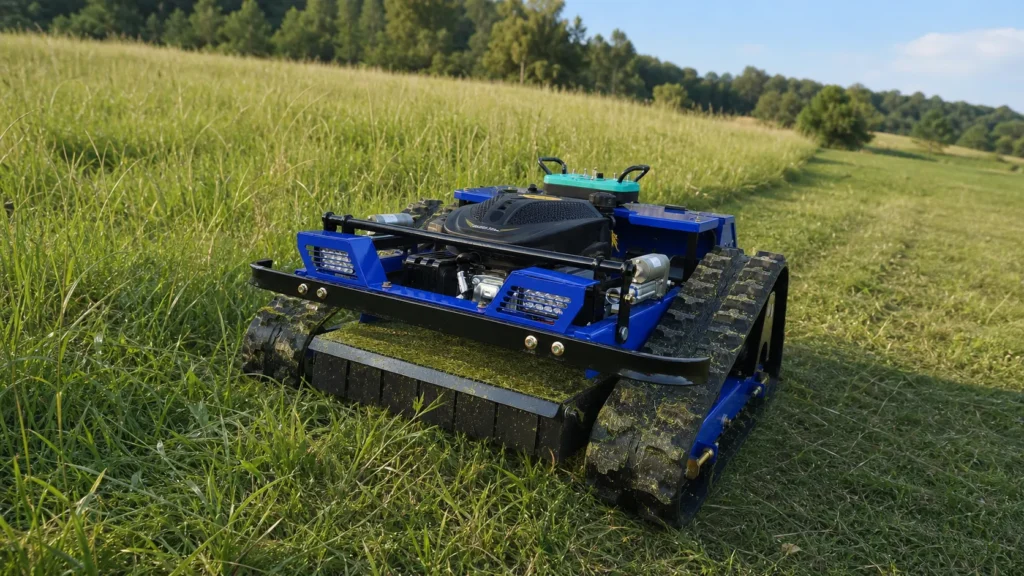
A remote control lawn mower for rough terrain is most useful when steep grades, uneven ground, dense vegetation, or nearby hazards make conventional mowing difficult. The right machine is not simply the one advertising the steepest slope capability. It must combine suitable traction, a cutting system matched to the vegetation, clearly documented working limits, dependable safety controls, practical transport, and accessible service support.
Unlike a fully autonomous robot mower, a remote-controlled mower remains under an operator’s active direction. The operator controls travel and cutting from a separate position while maintaining line of sight and an exclusion zone. This can keep the operator away from the mower itself, but it does not remove hazards from slopes, obstacles, moving blades, or thrown debris.
Where Remote-Controlled Rough-Terrain Mowers Make Sense
These machines are designed for locations where an operator would prefer not to sit on or walk directly behind mowing equipment. Potential applications include embankments, drainage areas, roadsides, solar farms, orchards, rough paddocks, utility corridors, and overgrown land with constrained access.
The practical advantage is operator separation. A person can choose a viewing position away from the machine while directing it around hazards. This is especially relevant on ground where a ride-on mower could encounter rollover risks or where manual cutting with a string trimmer would be slow and physically demanding.
A California Department of Transportation roadside evaluation found that steep or constrained areas otherwise maintained with string trimmers could be candidates for remote-control mowing. It also showed why slope angle alone is incomplete: obstacles, limited maneuvering space, surface conditions, and slipping during turns affected whether particular ground was workable.
How to Compare Rough-Terrain Mowers
| Selection factor | What to examine | Why it matters |
|---|---|---|
| Working-slope limit | Permitted limits for cross-slope and uphill or downhill travel | Operating limits may differ by direction and can be lower than a stationary tip-over figure. |
| Undercarriage | Tracks or wheels, contact area, tread design, and steering behavior | These affect traction, ground pressure, turning, turf disturbance, and performance on soft soil. |
| Cutting system | Rotary, mulching, or flail deck | The deck must suit the vegetation, desired finish, debris exposure, and maintenance capacity. |
| Remote controls | Proportional steering, emergency stop, status feedback, range, and signal-loss response | Predictable control and clear machine status are important around slopes and obstacles. |
| Power source | Petrol, diesel, hybrid, or battery | Power choice affects refueling or charging, noise, emissions, runtime planning, and servicing. |
| Physical size | Weight, width, height, tie-down points, and loading requirements | A mower must reach the site, pass through access points, and fit the available transport equipment. |
| Serviceability | Cleaning access, track tensioning, blade service, intervals, parts, and local support | Rough vegetation and dusty conditions can make routine inspection and maintenance significant. |
Understand Slope Ratings Before Buying
Working limits are not tip-over angles
One of the most important distinctions is the difference between a permitted working slope and a stationary tip-over angle. A tip-over measurement under controlled conditions is not permission to mow at that angle. Dynamic forces from turning, braking, surface changes, vegetation, holes, and attachments can reduce stability.
For example, the official AS 1000 Ovis EVO RC operator’s manual specifies different maximum working limits for travel across a slope and travel uphill or downhill. Its measured stationary tip-over angles are higher than those permitted operating limits. Those figures apply only to that model and its documented conditions; they must not be transferred to another mower.
Real terrain changes the usable limit
Wet grass, loose soil, hidden holes, ruts, stones, cut vegetation beneath the tracks, and abrupt transitions can all change grip or stability. Turning can introduce slipping even where straight travel appears controlled. A ditch also presents compound angles: its bank, bottom, and transition may each load the mower differently.
Ask the supplier for the official working-slope limits by travel direction, not just a headline maximum. Confirm whether those limits change with a particular deck, attachment, track option, or operating configuration. If the documentation does not clearly distinguish operating, warning, and shutdown angles, request clarification before choosing the machine.
Measure and inspect the site
Do not estimate a critical slope by eye. OSHA’s riding-mower safety guidance recommends using a clinometer or inclinometer when necessary, following manufacturer slope limits, surveying terrain hazards, and establishing safety zones near water and rollover hazards. Although that guidance primarily concerns riding mowers, measuring the slope and inspecting the ground are sensible planning steps for remotely operated equipment as well.
Tracks, Wheels, and Maneuverability
Tracked remote mowers are common on difficult ground because a large contact area can support traction and distribute machine weight. They may be well suited to uneven slopes, soft surfaces, and vegetation where small wheels would struggle. A low center of gravity and balanced weight distribution can also support stability, but buyers should verify the complete machine configuration rather than judging the tracks alone.
Tracks have tradeoffs. Skid steering can scuff fine turf, particularly during tight turns. Soil can pack around the undercarriage, and track tension requires inspection. Replacement tracks and undercarriage components may be costly or inconvenient if local parts support is weak.
Wheeled machines may turn with less surface disturbance and can be appropriate for firmer, milder terrain. Their effectiveness depends on tire choice, drive layout, weight distribution, and the site’s soil and vegetation. Neither format guarantees performance on wet or loose ground.
Choose the Cutting Deck for the Vegetation
Rotary decks
A rotary deck can provide an efficient general-purpose cut in grass and mixed routine growth. It may suit properties where mowing is frequent enough to prevent heavy woody material from developing. Compare blade protection, discharge behavior, deck contouring, and access for cleaning. Any limits on vegetation thickness or debris must come from the manufacturer’s documentation.
Mulching decks
Mulching systems recirculate clippings to reduce their size before returning them to the ground. They can be useful when collecting cut material is impractical and a managed appearance is desired. Performance can decline when vegetation is very wet, tall, or dense, so ask how the manufacturer defines suitable operating conditions.
Flail decks
A flail mower uses multiple hinged cutting elements and is often considered for rough grass and scrubby vegetation. It may tolerate irregular growth better than a finish-oriented deck, but it introduces more individual wear parts and inspection points. Verify the approved vegetation type, maximum material size, deck configuration, and replacement-part availability for the exact model.
Regardless of deck type, inspect the site for wire, rocks, branches, posts, irrigation equipment, and other objects. Remote operation does not prevent blade damage or thrown-object hazards.
Remote Controls and Essential Safety Functions
A useful controller should make speed and direction changes predictable. Proportional joystick control is generally more suitable for careful positioning than simple full-on commands. An accessible emergency-stop control, visible machine status, and a defined response to lost radio communication are also important comparison points.
Published radio range is not a target operating distance. Terrain, vegetation, buildings, interference, and the need to see hazards can determine a much shorter practical position. Maintain line of sight and follow the model’s manual regarding operator location and antenna use.
Ask the supplier to demonstrate normal stopping, emergency stopping, signal-loss behavior, blade shutdown, parking-brake operation, restart procedures, and any inclination alarms. Capabilities vary considerably, so verify every safety feature in the official specifications and operator’s manual.
Power Source and Operating Practicalities
Petrol and diesel machines can be convenient for long work periods when fuel handling is practical. They also bring engine servicing, exhaust, heat, and noise considerations. Battery-electric models can reduce local exhaust emissions and may be quieter, but actual working time depends on the machine, battery, vegetation load, terrain, and operating pattern. Hybrid systems add another option, with their own maintenance and charging or fueling requirements.
Do not compare power sources using a runtime claim alone. Consider how quickly the mower can return to work, whether charging is available at the site, the expected seasonal workload, storage requirements, and who can service the drive and cutting systems. Verify model-specific runtime, charge time, fuel capacity, noise output, and maintenance intervals with official documentation.
Transport, Access, and Ownership Costs
Machine weight is easy to overlook. A heavy tracked mower may require a suitable trailer, ramps, tow vehicle, tie-down arrangement, and loading procedure. Check total operating weight rather than an incomplete base-machine figure, especially when decks or attachments can change the configuration.
Measure gates, bridges, passages between trees, solar-panel clearance, and any low obstacles. Compare these dimensions with the mower’s maximum operating and transport dimensions. Ground clearance and approach geometry can matter at ditch edges or trailer ramps even when overall width is acceptable.
Purchase price is only one part of ownership. Ask about blades or flails, belts, filters, track life, track-tensioning procedures, batteries where applicable, service intervals, diagnostic support, technician availability, and parts lead times. A technically capable machine may still be a poor choice if routine parts and knowledgeable service are difficult to obtain.
A Practical Site Assessment Checklist
- Map the mowing area and identify slopes, ditches, water, drop-offs, public access, roads, fences, and overhead or ground-level obstacles.
- Measure representative slopes, including transitions and the intended directions of travel.
- Classify the surface as firm, soft, loose, wet-prone, rutted, or covered with cut material.
- Identify the vegetation, expected cutting frequency, desired finish, and possible hidden debris.
- Define an operator position with line of sight and room for a suitable exclusion zone.
- Check access dimensions and confirm that transport, loading, unloading, and secure storage are feasible.
- Compare official manuals for working limits, emergency procedures, maintenance, and approved attachments.
- Arrange model-specific training before operation and reassess conditions whenever weather or the site changes.
Frequently Asked Questions (FAQ)
Are remote control lawn mowers the same as robot lawn mowers?
No. A remote control mower is actively driven by an operator using a radio controller. A fully autonomous robot mower follows programmed boundaries, navigation instructions, or schedules with less direct control. Rough-terrain remote mowers should not be assumed to navigate or make safety decisions autonomously.
Are tracked remote mowers always better on slopes?
No. Tracks can provide a broad contact area and useful traction, but performance still depends on weight distribution, track design, surface condition, travel direction, attachments, and operator technique. They can also disturb turf during tight turns. Compare the complete machine and its documented operating limits.
Can I use the advertised maximum slope as my normal working angle?
Not without confirming what the number represents. It may describe a permitted working limit, a tested capability under specific conditions, or a stationary stability measurement. Use the lower limits and procedures in the official operator’s manual, and account for wet grass, loose soil, obstacles, transitions, and turning.
Which cutting deck is best for overgrown rough ground?
A flail deck is commonly considered for rough grass and scrubby growth, while rotary and mulching decks may suit more regularly maintained vegetation. The correct choice depends on plant density, possible debris, required finish, and maintenance resources. Verify the exact mower’s approved vegetation limits rather than relying on the deck category alone.
Does remote operation make mowing hazardous ground safe?
It can separate the operator from the machine, but it does not eliminate rollover, runaway movement, blade contact, thrown objects, fire, noise, or bystander risks. Safe use still requires site inspection, an exclusion zone, line of sight, training, protective equipment, and compliance with the manufacturer’s instructions.
What should I ask a dealer to demonstrate?
Request a demonstration of low-speed control, cross-slope and longitudinal travel within approved limits, turning behavior, normal and emergency stopping, signal-loss response, blade shutdown, track inspection, cleaning access, transport securing, and routine maintenance. Use terrain representative of your site only when the manufacturer and responsible parties consider the demonstration appropriate.
Conclusion
The best remote control lawn mower for rough terrain is the one whose documented limits, traction system, cutting deck, controls, dimensions, and service arrangements match the actual site. Measure the slopes, inspect the hazards, define the vegetation and access requirements, and compare official manuals before buying. A careful, terrain-specific selection is more valuable than choosing a machine from a single maximum-slope claim.