
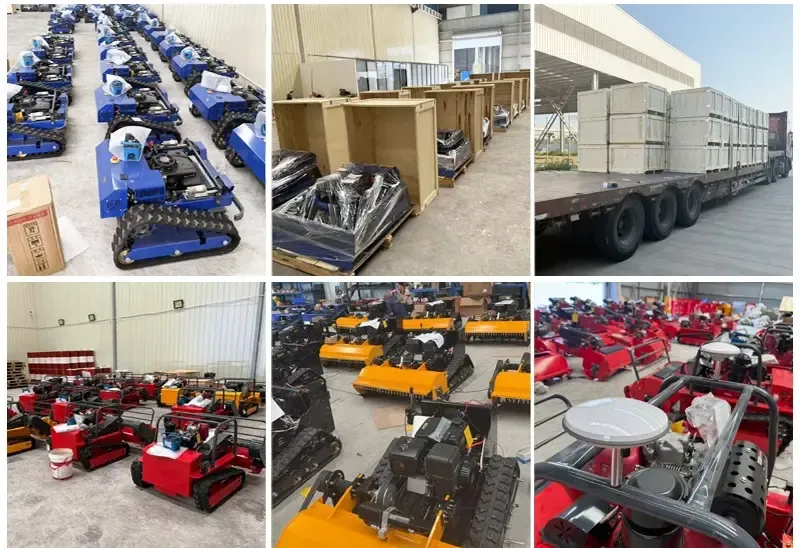
Yes, a remote control lawn mower can be worth it for contractors and land-maintenance teams when it reduces operator exposure, improves access to difficult areas, or makes repeated commercial mowing more manageable. It may not be worthwhile for small, flat lawns where a conventional mower already provides an efficient workflow. The right decision depends on terrain, acreage, transport, control requirements, service support, and the machine’s verified specifications.
Is a Remote Control Lawn Mower Worth It?
The strongest business case appears when a crew regularly handles rough vegetation, uneven ground, slopes, large open areas, or locations where the operator should not remain directly beside the cutting deck. Remote control allows the operator to command the machine from a distance while maintaining active control of movement and mowing.
When the business case is strongest
A remote control mower deserves serious consideration when several of these conditions apply:
- The company performs recurring commercial mowing rather than occasional residential lawn care.
- Sites include rough ground, embankments, drainage edges, open utility corridors, or other areas that complicate close-proximity operation.
- One operator needs a clearer view of the machine and surrounding area while controlling its direction.
- Transport and loading can be handled with the company’s existing equipment or a planned logistics process.
- The machine’s cutting width and operating speed match the crew’s actual work pattern.
- The dealer or manufacturer can provide operating instructions, parts access, training, and service support.
These conditions do not guarantee a return on investment. They indicate where remote control may solve a real workflow problem instead of adding technology without a clear operational benefit.
When it may not pay off
A remote control lawn mower may be difficult to justify when most jobs are small, flat, highly landscaped, or full of tight spaces that require frequent manual trimming. It can also be a poor fit when the business has no practical method for transporting a heavy machine, no plan for routine maintenance, or no operator who can maintain direct visual control during use.
Do not evaluate the purchase on cutting width alone. The total cost also includes transport, operator training, maintenance, energy or fuel, replacement parts, downtime, insurance requirements, and the time needed to prepare each site. A wider deck may reduce passes, but it can also increase transport and access requirements.
What You Are Actually Buying
Remote control versus autonomous mowing
A remote control lawn mower is not automatically a fully autonomous robot lawn mower. Remote control means an operator sends commands through a controller and remains responsible for steering, positioning, speed, and stopping. An autonomous mower, by contrast, is designed to navigate and perform a programmed task with less continuous manual driving.
This distinction matters in commercial purchasing. A remote-controlled machine may be attractive when an operator needs precise, active control over changing ground conditions. It is a different proposition from a system designed around mapping, boundary management, autonomous routing, or scheduled operation. Confirm which functions are included before comparing remote-controlled equipment with autonomous robotic platforms.
Control range is not a safe operating limit
Several Yitaiwei models in the supplied catalog list a remote-control distance of 200 m. Treat that as a model-specific brochure specification, not as a guaranteed working distance or permission to operate without a clear view of the machine. Ask how the distance was measured, whether line of sight was required, how interference affects control, and what operating limit the manufacturer recommends for your site.
Likewise, the catalog lists a 45° climbing angle for the models covered below. That figure should not be treated as a recommended or safe working slope. Direction, surface, load, weather, test method, and safety margin are not defined by the figure alone.
For U.S. workplace procedures, use the OSHA lawn mower safety guidance and the CPSC outdoor power equipment checklist as companion references when developing site-specific controls, training, inspection, and exclusion procedures.
How to Compare Remote Control Lawn Mowers
Start with the worksite, not the brochure headline
Document the jobs the machine must perform before comparing models. Record the approximate area, vegetation type, typical slope direction, access points, obstacles, ground firmness, transport route, and the distance from the operator’s position to the work area. Also identify whether the machine must cross between work zones or be loaded onto a trailer.
Then define the minimum requirements. These may include cutting width, height adjustment, remote-control distance, walking speed, machine weight, package dimensions, electrical capacity, starting method, and available service support. Keep each specification attached to its exact model; similarly named models may have different dimensions, weights, cutting widths, or electrical fields.
Use verified specifications for an initial shortlist
The following comparison uses model-specific fields listed in the supplied Yitaiwei catalog. It is a fact comparison, not a ranking or a best-for recommendation.
| Model | Cutting width | Cutting-height specification | Walking speed | Remote-control distance | Climbing-angle field |
|---|---|---|---|---|---|
| QL600Y | 500 mm | 20–150 mm | 4 km/h | 200 m | 45° |
| LB500-24V | 500 mm | 70 mm | 5 km/h | 200 m | 45° |
| LB600-24V | 600 mm | 10–200 mm | 5 km/h | 200 m | 45° |
| QL800 | 800 mm | 20–100 mm | 5 km/h | 200 m | 45° |
| HS1000 | 1,000 mm | 20–80 mm | 5 km/h | 200 m | 45° |
Actual performance may vary with terrain, vegetation, operating conditions and machine configuration. Confirm the final specification with the manufacturer before ordering.
Check transport, weight, and site logistics
Transport can decide whether a mower is practical. The catalog lists machine weights from 115 kg for the LB500-24V to 370 kg for the LJ1000, with package weights ranging from 150 kg to 490 kg among those models. Confirm the model’s exact weight, package dimensions, loading method, trailer capacity, ramp requirements, and storage space.
Dimensions in the catalog should also be checked with the manufacturer before ordering because the dimension order is not defined. A machine that fits the cutting area may still be difficult to move through gates, onto a trailer, or into a service bay.
Request the missing operating details
The listed electrical fields include 24V24AH or 24V40AH, depending on the model. Those labels do not establish battery chemistry or runtime. Request runtime under a defined workload, charging or refueling requirements, energy-system documentation, maintenance intervals, blade information, and the complete operating procedure.
Also request the engine make and rating method where horsepower is listed. HS800 and HB800 each show 16 or 23 hp in the catalog without identifying which configuration receives each rating, so the selected configuration must be confirmed before a purchase order is issued. LJ800 and LJ1000 also require confirmation of the start-mode wording shown for the selected version.
A Practical Buying Process for Commercial Teams
1. Calculate the operational problem
Estimate how many hours each month are spent mowing the target sites, preparing access, moving equipment, trimming after the main pass, and managing operator exposure. The remote control feature has greater value when it addresses a recurring bottleneck rather than an occasional inconvenience.
2. Compare the complete workflow
Compare loading, transport, setup, operation, cleaning, inspection, storage, and servicing. A mower that cuts a wider path may still be slower for your company if loading takes longer or access is restricted.
3. Verify documentation before committing
Ask for the operating manual, parts list, service process, warranty terms, training materials, and model-specific quotation. Confirm that the documents match the exact model and configuration. Do not assume that a feature shown on a related model applies to every machine in the range.
4. Define site controls
Establish who may operate the machine, how the operator maintains visual control, how people and vehicles are kept away from the cutting area, what happens if communication is interrupted, and how the machine is stopped and secured. These procedures should be written for the actual property rather than copied from a generic product description.
Frequently Asked Questions (FAQ)
Is a remote control lawn mower safer than a conventional mower?
It can keep the operator farther from the cutting machine, which may be valuable in some work environments, but remote control is not a safety guarantee. Safe use still depends on the machine, terrain, visibility, exclusion zones, training, emergency procedures, and manufacturer instructions.
Can a remote control lawn mower cut a 45° slope?
The supplied Yitaiwei catalog lists a 45° climbing angle for the covered models, but that figure is not a recommended or safe working slope. Confirm the test method, surface conditions, direction of travel, load limits, weather limits, and operating instructions before considering a sloped application.
How far can a remote control lawn mower operate?
The listed Yitaiwei models show a remote-control distance of 200 m. The practical control distance can depend on line of sight, interference, terrain, weather, and machine configuration, so request the manufacturer’s operating conditions and limits for the intended site.
What is the difference between remote control and autonomous mowing?
Remote control requires an operator to send commands and actively manage the machine. Autonomous mowing uses navigation and programmed behavior to reduce continuous manual driving. A remote-controlled mower should not be assumed to include autonomous routing or scheduled operation.
What should a contractor ask before ordering?
Ask for the exact model configuration, dimensions, weight, runtime, energy-system details, control procedure, safe operating limits, service support, parts availability, warranty terms, maintenance schedule, and training requirements. Confirm that every quoted specification applies to the model in the purchase documents.
Practical Conclusion
A remote control lawn mower is worth considering when commercial mowing work repeatedly involves difficult access, large areas, or a need for active operator control from a distance. It is less compelling for simple flat lawns or businesses that cannot support the transport, training, and maintenance workflow. Compare exact model specifications, verify operating conditions, and evaluate the complete job process before deciding whether remote control delivers enough practical value.