
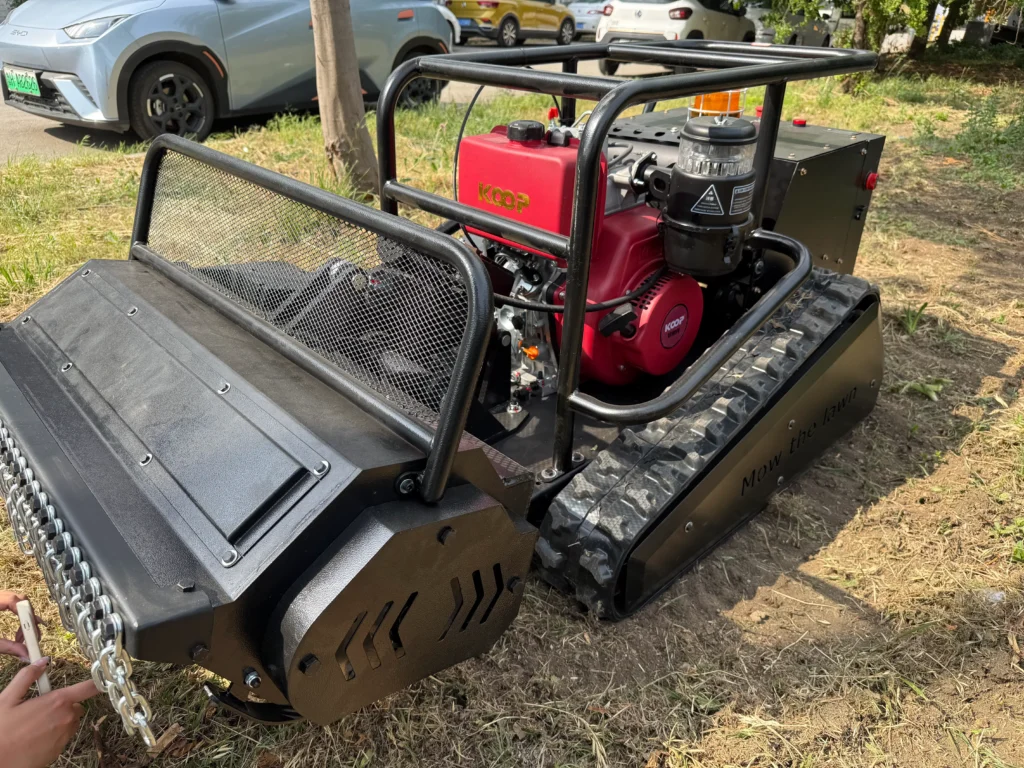
Yes, remote control lawn mowers can sometimes cut wet grass, but wet conditions should not be treated as normal operating conditions. Moisture can reduce traction, create slippery ground, clog the cutting deck, increase clumping, and leave ruts in soft turf. The right decision depends on the mower manual, grass condition, soil firmness, slope, visibility, and the operator’s ability to maintain reliable control.
A remote-controlled mower is also different from a fully autonomous robot lawn mower. The remote-controlled machine depends on an operator to direct movement, manage speed, start or stop the machine, and respond to changing ground conditions. Remote operation may keep the operator away from the cutting deck, but it does not remove the risks created by wet grass.
Why Wet Grass Changes Mowing Conditions
Wet clippings can reduce cutting and discharge quality
Grass blades carry more moisture after rain, heavy dew, or irrigation. The resulting clippings are more likely to stick together and collect under the deck or around the discharge opening. This can produce uneven rows, visible clumps, and repeated clearing stops. If the deck becomes restricted, the operator may be tempted to approach the machine while parts are still moving, which is an avoidable safety risk.
Purdue University Turfgrass Science recommends using a sharp blade, raising the mower as high as practical, removing a mulching attachment in favor of side discharge when appropriate, and directing discharge onto an already mown area when wet mowing cannot be avoided. Its wet-grass mowing guidance is useful for planning the cutting process, although the mower manufacturer’s instructions remain the controlling source for a specific machine.
Wet ground reduces traction
The more serious issue for a remote control lawn mower is often the ground rather than the grass. Wet soil can allow wheels or tracks to spin, slide sideways, or form deep ruts. A machine that is stable on firm turf may behave differently on saturated ground, especially during turns, braking, reversing, or cross-slope travel.
Mississippi State University Extension Service advises avoiding wet ground because slippery conditions increase the risk of sliding, loss of control, and rollover. This is particularly important on sloped commercial properties, drainage banks, rough land, and areas where the mower’s weight can damage the turf.
When You Should Wait to Mow
Postpone work on saturated or unstable ground
Do not schedule wet-grass mowing simply because the machine is remote controlled. Wait when the ground has standing water, visible wheel tracks from light traffic, soft areas that deform under load, or a surface that prevents predictable braking and turning. A short delay is usually preferable to repairing turf damage, recovering a stuck machine, or exposing an operator to a rollover hazard.
Slopes deserve extra caution. A brochure-listed gradient or climbing-angle value is not automatically a safe wet-working slope. Such a value does not establish the effect of surface moisture, direction of travel, load, vegetation, attachments, weather, braking distance, or safety margin. Ask the manufacturer for the operating limits that apply to the exact model and the actual site conditions.
Postpone work when control or visibility is compromised
Heavy rain, mist, glare, fog, dense vegetation, and poor lighting can make it difficult to judge the mower’s position and movement. The operator should be able to see the machine clearly, recognize people and obstacles, and stop work before the machine enters an unsafe area. Do not rely on the advertised radio range as a guarantee of safe control distance. Radio interference, obstructions, terrain, and site layout can affect the usable operating area.
Stop if control response becomes inconsistent, the machine starts drifting, the mower repeatedly loses traction, or wet clippings block the deck. Do not clear the deck, inspect the blade, or reach near moving parts until the machine has been stopped and isolated according to the manufacturer’s procedure.
How to Cut Wet Grass More Carefully
Complete a pre-job inspection
Before starting, confirm that the exact mower model is approved for the expected weather and ground conditions. Inspect the blade, deck, discharge path, wheels or tracks, guards, controller, and stopping controls. Check that people, animals, stones, wire, branches, and other objects are outside the work zone. Wet vegetation can hide debris that would be easier to see in dry conditions.
Review the route before the machine moves. Identify slopes, drainage channels, soft shoulders, retaining edges, ditches, and areas where the machine could slide toward a road, building, pond, or pedestrian route. A remote operator should also establish a clear response path and know where the machine can be stopped safely.
Use a conservative cutting setup
Raise the cutting height when the grass is wet or unusually tall. A higher first pass reduces the amount of material entering the deck and lowers the chance of bogging down. Use a sharp blade and the discharge method specified for the machine. If the mower is designed for side discharge, directing material toward an already cut area can help keep clumps from forming in the next pass.
Use a slower travel speed when the surface is slippery, the grass is dense, or the operator is working near obstacles. Make gradual turns on level ground and avoid abrupt changes in direction. Do not cross a slope simply because the mower has a published climbing-angle figure. Wet turf can change the traction available to the machine even when the underlying slope has not changed.
Set clear stop conditions
A professional mowing plan should define when work stops. Useful stop conditions include wheel or track spin, sideways movement, rutting, repeated deck blockage, loss of visual awareness, unexpected control delay, water entering a prohibited area, or any person entering the work zone.
Remote control systems may provide functions such as speed control, throttle, pause, start, and an emergency button. The supplied controller diagram shows these types of functions, but the operating procedure and safety conditions are model-specific. Operators should use the controls exactly as described for the machine in service and should never assume that one controller layout applies to every model.
What to Compare When Selecting a Remote Control Mower
Separate useful specifications from wet-condition assumptions
Cutting width helps estimate the width of each pass, but it does not prove that a mower will avoid clogging in wet vegetation. Cutting-height adjustment can help an operator make a taller first pass, but it does not establish the machine’s performance in saturated grass. Travel speed describes the listed movement range, not traction or stopping performance. Remote-control range describes a listed communication distance, not a safe operating limit.
The following specifications are transcribed from the supplied YTW parameter tables. They help compare model configurations, but they do not establish wet-grass capability, safe slope operation, runtime, or field performance.
| Model | Mowing width | Cutting height | Operation | Travel speed | RC range |
|---|---|---|---|---|---|
| YTW-550L-B | 550mm | 1-20cm | Remote control | 0-4km/h | 500m |
| YTW-550S-Z | 550mm | 30-70mm | Remote control | 0-5km/h | 500m |
| YTW-800L | 800mm | 20-100mm | Remote control | 5km/h | 500m |
| YTW-800T | 800mm | 100-200mm, electric adjustment | Remote control | 0-6km/h | 500m |
| YTW-900T | 900mm | 20-200mm, adjustable | Remote start | 0-6km/h, adjustable | 500m |
| YTW-1000T | 1000mm | 100-200mm, electric adjustment | Remote control | 0-6km/h | 500m |
Actual performance may vary with terrain, vegetation, operating conditions and machine configuration. Confirm the final specification with the manufacturer before ordering.
Ask for wet-condition information before ordering
Professional buyers should ask for model-specific guidance on wet grass, rain exposure, saturated soil, slope operation, deck cleaning, traction, braking, and control response. Request the conditions behind any advertised gradient, productivity, or control-range figure. Also confirm the exact configuration being quoted when a model has multiple engine, power, weight, or drive options.
For contractors and dealers, the most useful documentation is a current manual and a written operating procedure that defines prohibited conditions. For municipalities and commercial property operators, the purchasing review should also consider route access, pedestrian separation, drainage, recovery planning, operator training, and whether the machine can be cleaned without unsafe access to the cutting area.
A Practical Wet-Mowing Plan
Schedule around drying time
Whenever possible, schedule mowing after the surface has dried enough to support predictable movement. The grass does not need to be completely dry in every situation, but the ground should be firm and the machine should not leave damaging ruts. A short inspection after rain can be more valuable than relying on the weather forecast alone because soil types and drainage vary across the same property.
Use a controlled work sequence
Start with the safest, flattest section and keep the machine within clear view. Use a higher cutting setting and moderate speed, then monitor the cut surface, discharge pattern, traction, and turf marks. Keep people away from the route and stop before conditions deteriorate. Do not treat a successful pass on firm ground as proof that the machine is suitable for a wetter slope or softer section.
After work, follow the model’s shutdown, cleaning, and inspection instructions. Remove accumulated clippings only after the cutting system is fully stopped and made safe. Record the weather, ground condition, mower configuration, and any control or traction problems so the next operator has a useful site-specific operating history.
Frequently Asked Questions (FAQ)
Can remote control lawn mowers cut wet grass?
Sometimes. A remote control lawn mower may cut damp grass when the manufacturer permits it and the ground remains firm, level, and controllable. Wet grass should not be treated as a blanket approval for operation because clumping, deck blockage, slipping, rutting, and reduced visibility can make the job unsafe or unproductive.
Is it safe to mow immediately after heavy rain?
Not usually when the soil is saturated, slippery, or covered by standing water. Wait until the machine can brake, turn, and travel without sliding or leaving damaging ruts. Heavy rain also reduces visibility and can make it harder for the operator to maintain reliable awareness of the machine.
What cutting setting works best in wet grass?
A higher cutting setting and a sharp blade are generally more practical for a wet first pass. Use the discharge configuration specified for the mower and reduce travel speed when the grass is dense or the surface is slippery. Do not change settings beyond the exact model’s operating instructions.
Are remote-controlled mowers better than autonomous robot mowers in wet conditions?
They solve different operating problems. A remote-controlled mower gives an operator direct command over movement and cutting activity. A fully autonomous robot mower follows its own navigation and programming system. Neither category automatically becomes suitable for saturated soil or heavy rain. The relevant comparison is the manufacturer’s weather guidance, traction, control behavior, cutting system, and site restrictions.
What should buyers ask before choosing a mower for wet properties?
Ask for the exact model’s wet-weather limits, slope guidance, traction and braking information, deck-cleaning procedure, control-range test conditions, emergency-stop procedure, and configuration-specific specifications. Also ask whether the quoted cutting width, power, speed, and weight apply to the exact machine being ordered.
Practical Conclusion
Remote control lawn mowers can cut wet grass in limited, controlled situations, but remote operation does not overcome slippery ground, soft soil, blocked decks, or poor visibility. For professional mowing, wait for firm conditions whenever possible. When wet mowing is unavoidable, use a conservative cutting setup, maintain direct control and visibility, avoid unstable slopes, and stop as soon as traction or cutting quality becomes unpredictable.