
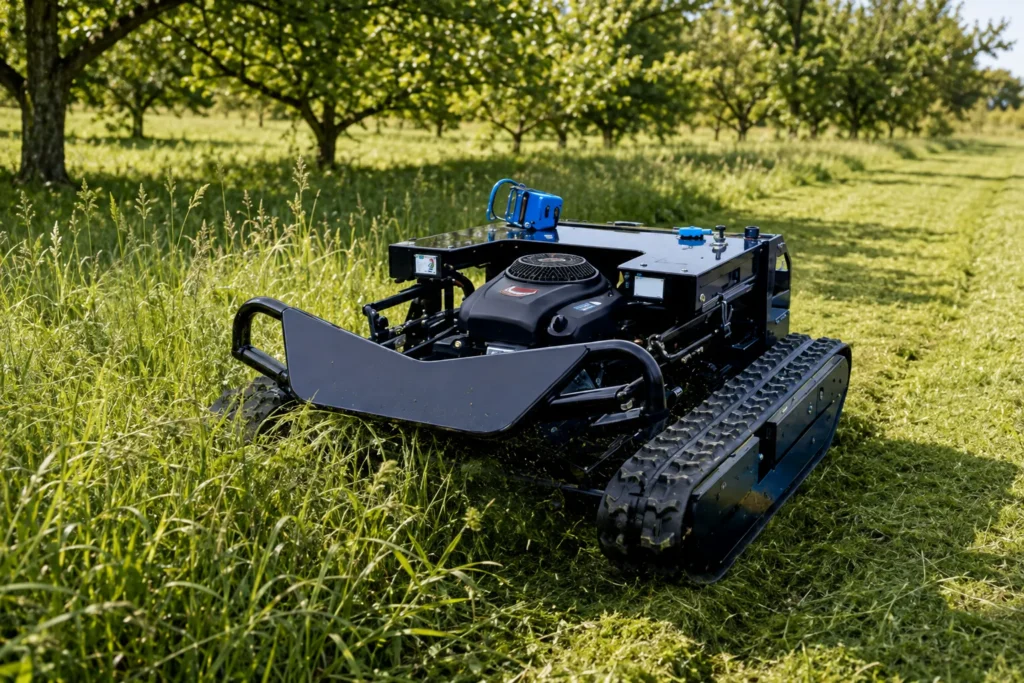
Commercial remote control lawn mower benefits include greater operator separation from the cutting area, improved access to challenging terrain, more controlled mowing workflows, and clearer equipment selection for large properties. A remote-control mower is not a fully autonomous robot: a trained operator still controls the machine, observes conditions, manages the work area, and responds to changing hazards.
For contractors, municipalities, land-maintenance companies, dealers, and commercial property operators, the right buying question is not simply whether a mower has remote control. It is whether the machine’s controls, cutting width, height range, travel speed, terrain capability, transport requirements, and support arrangements fit the work being scheduled.
What Are the Main Commercial Benefits?
More flexible operator positioning
A remote-control mower allows the operator to control the machine from a position away from the cutting deck. That can be valuable when the work area includes brush, uneven ground, steep sections, roadside edges, drainage areas, or other locations where close operator proximity makes the workflow more difficult.
Remote control does not remove the need for planning. The operator must maintain an effective view of the machine and its path, keep unauthorized people away from the work zone, and understand how the machine responds on the specific surface. The benefit is improved positioning and control flexibility, not an automatic safety guarantee.
Better access to difficult mowing areas
Commercial sites often include slopes, embankments, overgrown sections, rough grass, and narrow access routes. A remote-control format can let the operator choose a better observation point while guiding the machine through the work area. This may reduce the need to walk directly behind or beside the mower during every pass.
Terrain capability must still be assessed carefully. A brochure value described as a maximum gradient is not the same as a recommended or safe working slope. Surface condition, direction of travel, load, vegetation, moisture, visibility, and operating procedure can all affect the real work plan.
More deliberate workflow control
Remote operation can support a repeatable mowing process. An operator can set a direction, adjust travel speed, pause when the area needs inspection, and reposition the machine without repeatedly climbing on and off equipment. On large sites, this can make it easier to divide work into zones and coordinate mowing with inspection, trimming, debris removal, or access control.
The practical gain depends on the operator, site layout, machine response, and maintenance condition. Buyers should evaluate the complete workflow rather than assuming that remote control alone will increase output.
Useful control for commercial teams
Commercial mowing often involves changing operators, multiple properties, and different site rules. A clearly documented remote-control procedure can help standardize pre-start checks, exclusion zones, communication, battery or fuel checks, transport, and shutdown steps. That is especially useful for organizations that need a consistent operating method across crews.
OSHA’s landscaping and horticultural services guidance identifies hazards relevant to professional outdoor work, including noise and eye injuries. A remote-control mower should therefore be included in the company’s equipment-specific training and hazard assessment rather than treated as a self-managing machine.
How Remote Control Can Improve Commercial Mowing Operations
Match cutting width to the property
Cutting width is one of the most visible planning variables. A wider deck may reduce the number of passes across open ground, while a narrower machine may offer more flexibility around obstacles and tighter access points. The correct choice depends on gate widths, transport routes, turning space, vegetation density, and the proportion of the job that is open versus confined.
Do not judge productivity from width alone. A machine that is difficult to transport, reposition, or maintain can slow the total job even if its cutting width is large.
Use cutting-height control as a work-planning tool
Different commercial areas may require different cutting heights. Sports-adjacent grounds, roadside vegetation, rough lots, and managed property landscapes do not always use the same setting. A useful height range gives the operator more control over the job specification, but the adjustment method and actual result should be confirmed for the exact model.
For procurement teams, record the height requirement for each property and compare it with the model’s listed range. This creates a more useful specification than choosing solely by horsepower or machine size.
Plan output without treating brochure figures as guarantees
Supplied Yitaiwei tables list mowing widths, travel speeds, and other model parameters that can help organize an initial shortlist. They should be used as planning inputs alongside labor hours, access time, transport, fuel, maintenance, operator training, and the amount of hand finishing required.
Claims about area covered per hour should not be converted into a guaranteed daily production rate. Actual output depends on grass height, vegetation density, overlap, turning, obstacles, slope, weather, operator decisions, and site preparation.
Build a safer operating routine
A remote-control mower should have a documented routine covering the work boundary, bystander control, communications, visibility, inspection of the cutting area, shutdown, transport, and response to signal or mechanical problems. The U.S. Consumer Product Safety Commission also publishes lawn mower safety guidance for users and organizations planning mowing work.
Remote control changes where the operator stands; it does not change the need to inspect the ground, account for thrown objects, maintain the machine, and stop work when conditions are unsuitable.
Yitaiwei Remote-Control Mower Parameters Compared
The following comparison uses the supplied parameter tables for six Yitaiwei models. The values are presented under the original field meanings so buyers can compare the basic configuration without inferring a best-use label.
| Model | Mowing width | Cutting height | Operation | RC range | Max gradient |
|---|---|---|---|---|---|
| YTW-550L-B | 550mm | 1-20cm | Remote control | 500m | 50° |
| YTW-550S-Z | 550mm | 30-70mm | Remote control | 500m | 60° |
| YTW-800L | 800mm | 20-100mm | Remote control | 500m | 45° |
| YTW-800T | 800mm | 100-200mm, electric adjustment | Remote control | 500m | 60° |
| YTW-900T | 900mm | 20-200mm, adjustable | Remote start | 500m | 60° |
| YTW-1000T | 1000mm | 100-200mm, electric adjustment | Remote control | 500m | 60° |
The max gradient field in this table should be read as a listed model parameter, not as a safe operating limit. The tables also identify Remote start separately from Remote control, so buyers should confirm whether the former describes starting only or broader machine operation. Actual performance may vary with terrain, vegetation, operating conditions and machine configuration. Confirm the final specification with the manufacturer before ordering.
How to Select a Commercial Remote Control Lawn Mower
Start with the jobsite profile
Document the property before comparing models. Note the steepest sections, average grass height, rough vegetation, obstacles, gates, transport distance, turning areas, public access, and expected mowing frequency. A model that works well on an open parcel may be inefficient on a landscaped commercial property with many fixed obstacles.
Compare the complete specification
Check mowing width, cutting-height range, travel-speed range, operating description, remote-control range, machine weight, package weight, dimensions, and available starting system. Dimension order should be confirmed before planning gates, trailers, ramps, or storage locations. Weight should be checked against loading equipment and transport requirements.
Do not fill missing fields with assumptions. Battery chemistry, runtime, blade design, maintenance intervals, warranty, certifications, and model-specific attachment compatibility should be confirmed directly with the manufacturer or dealer when they matter to the purchase.
Evaluate service and operating readiness
A commercial mower is part of an operating system. Ask how operators are trained, how replacement parts are supplied, how faults are diagnosed, and what routine maintenance the dealer supports. Confirm the remote-control procedure, communication method, emergency response, and required site controls before assigning the machine to a crew.
For dealers and fleet buyers, create a comparison sheet that separates verified machine parameters from business assumptions. Then estimate total job cost using actual local labor, transport, fuel, maintenance, and utilization figures rather than relying on a brochure area-per-hour figure.
Frequently Asked Questions (FAQ)
What are the main commercial remote control lawn mower benefits?
The main benefits are flexible operator positioning, access to challenging mowing areas, more controlled machine movement, adjustable work settings on supported models, and a clearer way to structure repetitive commercial mowing workflows. Results depend on the property, machine configuration, operator training, and maintenance.
Are remote control lawn mowers fully autonomous?
No. A remote-control lawn mower is operated by a person using a controller. It should not be confused with a fully autonomous robot mower that navigates and performs work according to its own programmed system. Remote-control operation still requires active observation, site control, and operator decisions.
Is a listed maximum gradient the safe slope for mowing?
No. A listed maximum gradient is a model parameter, not a universal safe working slope. Buyers should confirm the test method, surface, direction, load, weather limitations, operating procedure, and final safe operating limit with the manufacturer and apply a site-specific risk assessment.
What remote-control range should a commercial buyer expect?
The supplied tables list an RC range of 500m for the six YTW models shown above. Range can be affected by line of sight, interference, terrain, and operating conditions, so the listed value should not be treated as a guaranteed working distance for every site.
How should a contractor choose between models?
Begin with access, cutting width, required height, terrain, transport, and operator workflow. Then compare weight, dimensions, speed, control description, service support, and the conditions attached to important specifications. Choose the model that fits the full job process, not simply the one with the largest number.
Practical Conclusion
Commercial remote control lawn mower benefits are strongest when remote operation solves a real site or workflow problem. Use the technology to improve operator positioning, terrain access, and process control, while treating model specifications as inputs for a careful equipment and service decision. A documented operating routine and manufacturer-confirmed configuration should come before deployment.