
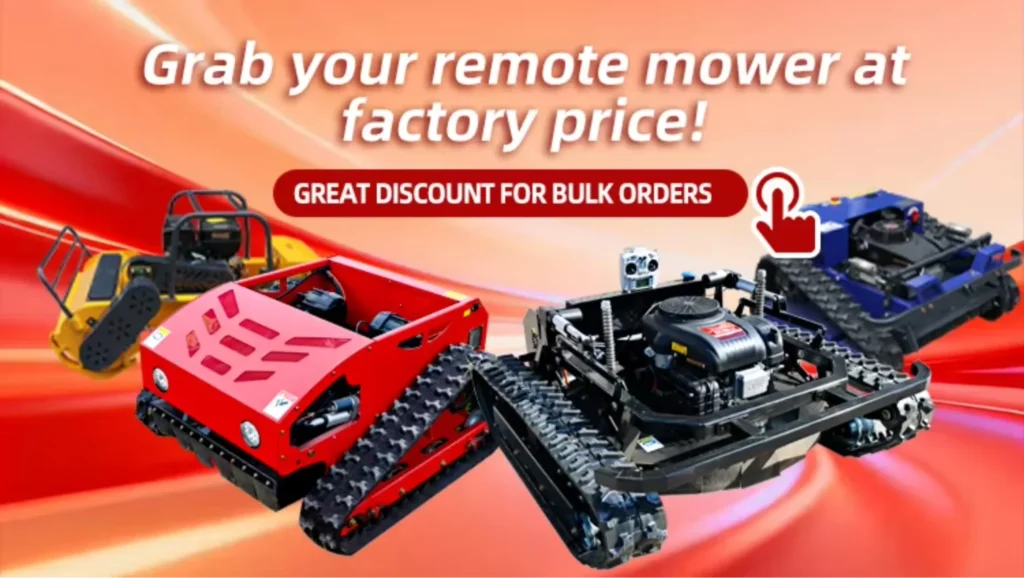
A remote control brush mower can help professional crews manage overgrown land while the operator directs the machine from a distance. For contractors, municipalities, land-maintenance companies, and commercial property operators, the right choice depends on vegetation, access, cutting width, height adjustment, transport requirements, and clearly defined operating limits. Remote control equipment should not be confused with a fully autonomous robot lawn mower: the operator remains responsible for directing the machine and managing the work area.
The Yitaiwei parameter tables supplied for six YTW models list mowing widths from 550mm to 1000mm, an RC range of 500m for each model, and different cutting-height, travel-speed, and max-gradient figures. These values provide a useful starting point for comparison, but the final specification and operating procedure should be confirmed for the exact configuration.
What a Remote Control Brush Mower Does
Remote control is different from autonomous mowing
A remote control lawn mower or brush mower receives commands from a handheld controller. The operator chooses direction, speed, stopping, and other available functions while watching the machine and the terrain. An autonomous robot mower generally follows programmed routes or navigation rules with less continuous manual steering. Those are different equipment categories and should be evaluated differently.
For overgrown land, remote operation can be relevant when the operator needs a better working position away from the machine, improved visibility of the cutting path, or more control around uneven ground and site boundaries. It does not remove the need for a site assessment, a clear work zone, or compliance with the manufacturer’s operating instructions.
Where the equipment may fit into a land-maintenance plan
Before selecting a machine, describe the job in operational terms. Is the work a first cut on neglected acreage, recurring vegetation maintenance, roadside or drainage-area management, property-edge clearing, or preparation for later finishing work? Also record the average vegetation height, density, presence of saplings or debris, soil firmness, access width, and the distance between the work area and the loading point.
Do not select a mower only because its brochure shows a larger number. Cutting width affects the path covered per pass, while cutting height affects how the machine can approach tall or uneven growth. Neither number alone proves hourly output, fuel economy, runtime, or suitability for a particular property.
How to Compare Remote Control Brush Mower Models
Published YTW model comparison
The following comparison keeps the supplied field names and values attached to the exact YTW model. It focuses on specifications that are directly useful during an initial equipment shortlist.
| Model | Mowing width | Cutting height | RC range | Max gradient | Travel speed |
|---|---|---|---|---|---|
| YTW-550L-B | 550mm | 1-20cm | 500m | 50° | 0-4km/h |
| YTW-550S-Z | 550mm | 30-70mm | 500m | 60° | 0-5km/h |
| YTW-800L | 800mm | 20-100mm | 500m | 45° | 5km/h |
| YTW-800T | 800mm | 100-200mm, electric adjustment | 500m | 60° | 0-6km/h |
| YTW-900T | 900mm | 20-200mm, adjustable | 500m | 60° | 0-6km/h, adjustable |
| YTW-1000T | 1000mm | 100-200mm, electric adjustment | 500m | 60° | 0-6km/h |
The max-gradient values in the table are listed product figures, not recommended or safe working slopes. Direction, surface, load, weather, test method, attachments, and safety margin can materially affect actual operation. The RC range is also a listed specification, not a guaranteed safe operating distance. Actual performance may vary with terrain, vegetation, operating conditions and machine configuration. Confirm the final specification with the manufacturer before ordering.
Cutting width and height
A 550mm machine may be easier to position in narrower access areas, while an 800mm, 900mm, or 1000mm machine covers more ground per pass when the site allows adequate clearance. The practical choice depends on gates, paths, obstacles, transport equipment, turning space, and the required finish.
Cutting-height figures should be matched to the work sequence. A wider range may give a contractor more flexibility between an initial reduction and later maintenance passes, but the adjustment method and conditions still matter. The supplied tables identify electric adjustment for YTW-800T and YTW-1000T, while YTW-900T is listed as adjustable. Ask the supplier to explain how the adjustment works during setup and operation.
Gradient and radio-control specifications
A listed gradient angle should be treated as a specification requiring context. A slope can behave differently depending on whether the machine travels directly up or across it, whether the surface is wet or loose, and whether the cutting attachment is under load. Buyers should request the test method, surface conditions, machine configuration, and operating limitations before using the figure in a work plan.
All six supplied YTW tables use an RC range of 500m. The table does not establish the test environment, line of sight, interference conditions, or a safe operating limit. Confirm how the controller behaves if the signal is obstructed or interrupted, and define the operator’s required visibility and exclusion zone separately from the stated range.
Plan the Work Before the First Cut
Inspect vegetation and ground conditions
Walk the work area before bringing in the machine. Mark rocks, wire, posts, drainage channels, drop-offs, stumps, buried services, soft ground, water, and other hazards that may not be visible from the operator’s normal position. Identify escape routes, public access points, nearby roads, buildings, livestock areas, and locations where debris could travel.
For employee-operated work in the United States, combine the manufacturer’s manual and site procedures with applicable workplace guidance. OSHA’s general machine-guarding requirements address hazards around machines and moving parts, while its agricultural machinery guidance provides additional planning context for agricultural work environments.
Define operator position and boundaries
Remote operation still requires disciplined control. Establish where the operator will stand, how the cutting area will be isolated, who can stop the job, and how communication will work if another person enters the site. The controller functions shown in the supplied brochure images include controls for movement, speed, throttle, start, pause, emergency stop, chassis movement, and other functions. Confirm the meaning and operating sequence of each function for the exact machine before assigning work.
The wording for operation can also matter. Several models are listed with remote control, while the YTW-900T table uses the wording “Remote start.” Do not assume that remote start means complete remote operation. Ask the manufacturer to state whether the phrase refers only to starting the engine or to directing the machine as well.
Account for transport and storage
Machine weight, gross weight, package size, and access conditions affect delivery and daily deployment. The supplied tables list net weights from 98kg for the YTW-550S-Z to 366-377kg for the YTW-900T, depending on the model. Those figures should be checked against trailer capacity, loading equipment, ramps, storage floors, and the crew’s handling procedure.
Request the exact unit dimensions and package dimensions for the quoted configuration. Dimension order is not defined in the supplied tables, so confirm length, width, and height before planning gates, trailers, containers, or service areas.
Questions to Ask Before Ordering
A professional purchase request should ask for more than a headline horsepower or gradient number. Use a written quotation that identifies the exact model, configuration, and included equipment.
- Which engine, displacement, power rating, and start system apply to the quoted model?
- How are options such as 7.5/9HP, 16 or 23HP, and 22/25/27HP mapped to a specific configuration?
- What test conditions support the listed max-gradient and 500m RC-range figures?
- What does the controller operate, and what happens when the signal is interrupted?
- What cutter or blade configuration is supplied, and which attachments are compatible?
- What are the recommended inspection, cleaning, service, and storage procedures?
- What training materials and spare parts are available for the exact model?
These questions turn a catalog comparison into a procurement decision. They also help a dealer or fleet manager compare quotations without mixing values from different configurations.
Frequently Asked Questions (FAQ)
What is a remote control brush mower?
It is a mower designed to be directed by an operator using a remote controller rather than by a person seated on the machine. The operator controls the machine from a separate position and must still manage visibility, boundaries, hazards, and the operating procedure.
Is a remote control mower the same as an autonomous robot lawn mower?
No. A remote control mower is manually directed through a controller. An autonomous robot lawn mower normally uses programmed navigation or autonomous operating logic. Buyers should compare control method, site supervision, work pattern, and safety procedures separately.
How far can the YTW remote control brush mowers operate?
The supplied parameter tables list an RC range of 500m for all six YTW models. The tables do not define line-of-sight, interference, terrain, or safe operating conditions, so the figure should not be treated as a guaranteed working distance.
Which YTW model has the widest mowing width?
The YTW-1000T has the widest listed mowing width at 1000mm. The YTW-900T is listed at 900mm, the YTW-800L and YTW-800T at 800mm, and the YTW-550L-B and YTW-550S-Z at 550mm. Width should be compared with access, turning space, transport, and the required cutting process.
Can a listed max gradient be used as a safe slope limit?
No. The supplied max-gradient figures require operating context and should not be presented as safe working slopes. Confirm the test method, surface, direction of travel, load, weather limitations, machine configuration, and operating instructions with the manufacturer before planning work on sloped ground.
A remote control brush mower is best selected by matching verified model specifications to the site, work sequence, transport method, and operator-control plan. Compare the exact configuration, clarify gradient and RC-range conditions, and confirm the manufacturer’s final specifications before ordering.