
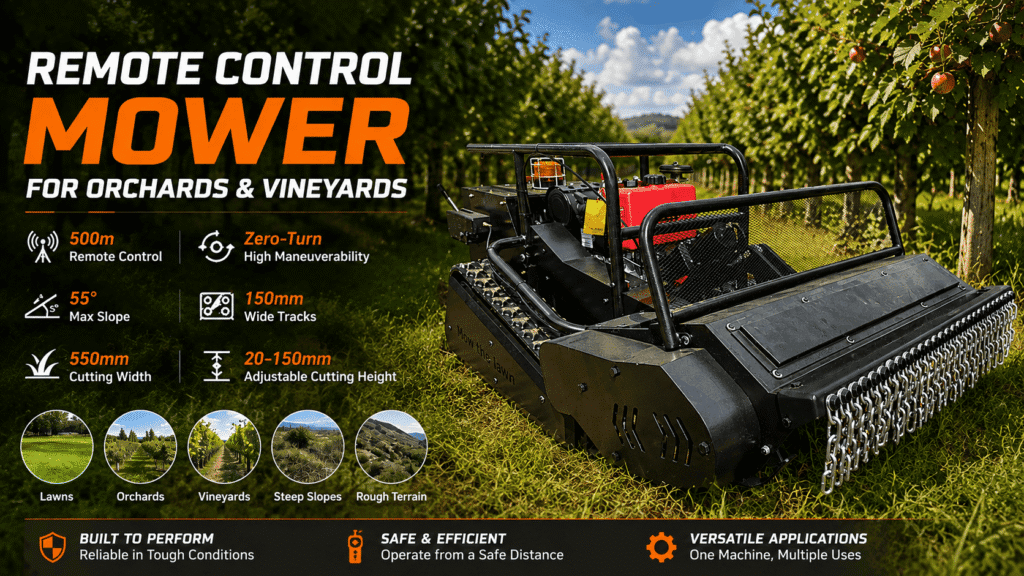
A remote control mower for orchards and vineyards can help professional crews manage vegetation while the operator stays positioned away from the cutting path. The right choice depends on row width, headland space, cutting-height needs, terrain, control range, transport requirements, and the machine’s documented configuration. Remote control lawn mowers are operator-directed machines; they should not be confused with fully autonomous robot lawn mowers that independently plan and execute mowing routes.
For contractors, land-maintenance companies, municipalities, commercial property operators, and dealers, the practical buying question is not simply which mower has the largest cutting width. It is whether the exact model can be controlled and transported effectively across the property’s rows, slopes, vegetation, and access points.
What to Look for in a Remote Control Mower
Start with orchard and vineyard access
Measure the clear working width between tree rows, vine rows, posts, irrigation equipment, and other fixed obstacles. Include the space needed to turn at row ends. A mower may fit the center of an alley but still be difficult to position if the headland is narrow or the access route includes gates and sharp turns.
Record the narrowest passage rather than the average row width. Also check whether the machine must cross service roads, grass margins, drainage channels, or uneven transitions. These measurements help buyers compare the published mowing width and the complete machine dimensions without assuming that a wider deck will automatically improve daily productivity.
Match cutting height to the vegetation plan
Cutting-height range is especially important where orchard floor vegetation, vineyard cover, weeds, and seasonal growth vary. A machine with a low setting may be useful for short maintenance cuts, while a higher setting can be relevant when the operator needs to leave more vegetation standing or manage taller growth.
Read the field exactly as published. A range such as 20-100 mm is different from a single value such as 70 mm, and an electrically adjustable range is different from a range whose adjustment method is not specified. Buyers should also ask how cutting-height adjustment is performed, whether the machine must be stopped, and which configurations include the adjustment feature.
Separate slope data from safe operating limits
Manufacturers may publish a value under a field such as Max gradient or Climbing angle. That number should remain tied to the exact model and original field name. It should not be rewritten as a recommended working slope, a guaranteed safe slope, or an all-terrain promise.
For orchard and vineyard procurement, request the operating manual and the manufacturer’s slope guidance for the actual surface, direction of travel, load, vegetation, weather, and attachment configuration. A slope that is manageable in one direction or surface condition may require a different operating procedure in another. The operator also needs a clear plan for stopping, turning, recovering control, and keeping people outside the work area.
Review remote control range as an operating parameter
Remote range is useful only when its test conditions are understood. Line of sight, interference, elevation changes, vegetation, buildings, and the position of the operator can affect how a wireless control system works in practice. Treat the published range as a model-specific specification, not as a guaranteed safe operating distance.
Ask the manufacturer to define the control range test environment and the safe operating limit. Confirm whether the listed control functions cover movement only or also include starting, throttle, cutting-height adjustment, chassis movement, and emergency stopping. A clear controller layout and a documented operating sequence matter as much as the headline distance.
YTW Remote Control Mower Specifications Compared
The following comparison uses the published values for six YTW models. It focuses on fields that directly affect initial orchard and vineyard screening: mowing width, cutting height, RC range, Max gradient, and travel speed.
| Model | Mowing width | Cutting height | RC range | Max gradient | Travel speed |
|---|---|---|---|---|---|
| YTW-550L-B | 550 mm | 1-20 cm | 500 m | 50° | 0-4 km/h |
| YTW-550S-Z | 550 mm | 30-70 mm | 500 m | 60° | 0-5 km/h |
| YTW-800L | 800 mm | 20-100 mm | 500 m | 45° | 5 km/h |
| YTW-800T | 800 mm | 100-200 mm, electric adjustment | 500 m | 60° | 0-6 km/h |
| YTW-900T | 900 mm | 20-200 mm, adjustable | 500 m | 60° | 0-6 km/h, adjustable |
| YTW-1000T | 1,000 mm | 100-200 mm, electric adjustment | 500 m | 60° | 0-6 km/h |
Use the table to narrow the documentation request, not to assign a model to a particular property without a site review. Actual performance may vary with terrain, vegetation, operating conditions and machine configuration. Confirm the final specification with the manufacturer before ordering.
How to interpret the comparison
The 550 mm models provide a narrower published mowing width than the 800 mm, 900 mm, and 1,000 mm models. Width is only one part of access planning: the complete machine dimensions, turning space, operator visibility, and obstacles in the row also affect deployment.
The cutting-height fields vary considerably. YTW-550L-B lists 1-20 cm, while YTW-550S-Z lists 30-70 mm. The larger models also use different ranges and adjustment descriptions. Keep the units consistent when comparing them, and verify the adjustment procedure for the final configuration.
All six listed models show an RC range of 500 m in the current table values. The table does not turn that figure into a safe operating limit. Buyers should request the corresponding control-system documentation and operating restrictions before placing an order.
Planning the Mowing Workflow
Map the property before choosing equipment
- Measure the narrowest row or alley, including posts, trunks, trellis wires, irrigation lines, and temporary obstructions.
- Measure headlands and identify where the machine can turn, stop, or be repositioned.
- Record slopes, cross-slopes, drainage features, soft ground, loose material, and transitions between surfaces.
- Identify loading areas, gates, storage locations, and the route used to move the machine between work zones.
- Define exclusion zones and the operator’s normal position for each work area.
Build the operator procedure around control
A remote control mower keeps the operator involved in every movement. The procedure should specify pre-start inspection, controller pairing or start sequence, movement control, cutting engagement, speed selection, emergency stopping, and post-operation shutdown. The exact functions and procedure must come from the manufacturer’s documentation for the selected model.
For general mower safety planning, review OSHA’s lawn mower safety guidance. On agricultural properties, coordinate mowing schedules with the site’s chemical-use and worker-protection procedures. The EPA Agricultural Worker Protection Standard is the relevant federal reference when pesticide applications are part of the operation.
Check transport, storage, and service requirements
Compare the exact model’s net weight, gross weight, unit dimensions, and package size with the buyer’s trailer, loading equipment, doors, ramps, and storage floor. These details can affect the total operating workflow even when the mower itself fits between rows.
Also request the engine and drive configuration for the exact model being quoted. Where a table lists multiple power, displacement, or weight options, the quotation should identify the selected configuration rather than treating the range as one fixed specification. Ask for the operating manual, parts information, maintenance requirements, and emergency procedures before committing to a fleet purchase.
Procurement Checklist for Professional Buyers
- Access: Confirm the narrowest passage, headland width, gate clearance, and complete machine dimensions.
- Vegetation: Match the published cutting-height range to the planned mowing schedule and expected growth.
- Terrain: Request model-specific operating guidance for slopes, cross-slopes, surface conditions, and turning.
- Controls: Confirm whether the model supports remote operation, remote start, or both, and obtain the exact controller procedure.
- Configuration: Tie engine, power, displacement, drive, weight, and start-system information to the quoted model configuration.
- Logistics: Verify transport weight, package size, loading method, storage space, and access for service.
- Safety: Define the exclusion zone, communication method, emergency stop process, and operator responsibilities.
Dealers and fleet buyers should standardize this checklist across every quotation. It makes model differences easier to compare and reduces the risk of selecting a machine from a headline figure that does not match the property’s actual operating conditions.
Frequently Asked Questions (FAQ)
What is a remote control mower for orchards and vineyards?
It is a mower directed by an operator through a remote controller. The operator sends movement and operating commands while observing the machine and surrounding work area. This is different from a fully autonomous robot lawn mower, which is designed to plan or repeat mowing routes with less continuous manual direction.
What mowing width should an orchard or vineyard buyer choose?
Start with the narrowest clear row or alley, then account for trunks, posts, irrigation equipment, turning space, and transport access. A wider published mowing width can reduce passes in open areas, but it may be impractical where access or headlands are limited.
Is a published Max gradient the same as a safe working slope?
No. A Max gradient value is a model-specific published parameter. It does not by itself define a recommended or safe working slope because surface, direction, load, weather, vegetation, test method, and safety margin may affect operation. Request the manufacturer’s operating limits for the final configuration.
Does a 500 m RC range guarantee operation anywhere on the property?
No. A listed RC range should be evaluated with its test environment, line-of-sight assumptions, interference conditions, terrain, and safe operating limit. The current YTW table lists 500 m for each of the six compared models, but buyers should obtain the manufacturer’s control-range conditions before relying on that figure for site planning.
What should a dealer include in a mower quotation?
The quotation should identify the exact model and configuration, published cutting and travel specifications, control functions, dimensions, weights, start system, operating manual, service information, and applicable safety procedures. It should also distinguish optional configurations from standard equipment.
Practical Conclusion
Choosing a remote control mower for orchards and vineyards starts with the property rather than the brochure headline. Measure access, define the vegetation plan, review terrain and operator workflow, then compare exact model specifications and documentation. The YTW table provides a useful starting comparison, but the final purchase decision should rest on confirmed configuration details and manufacturer operating guidance.