
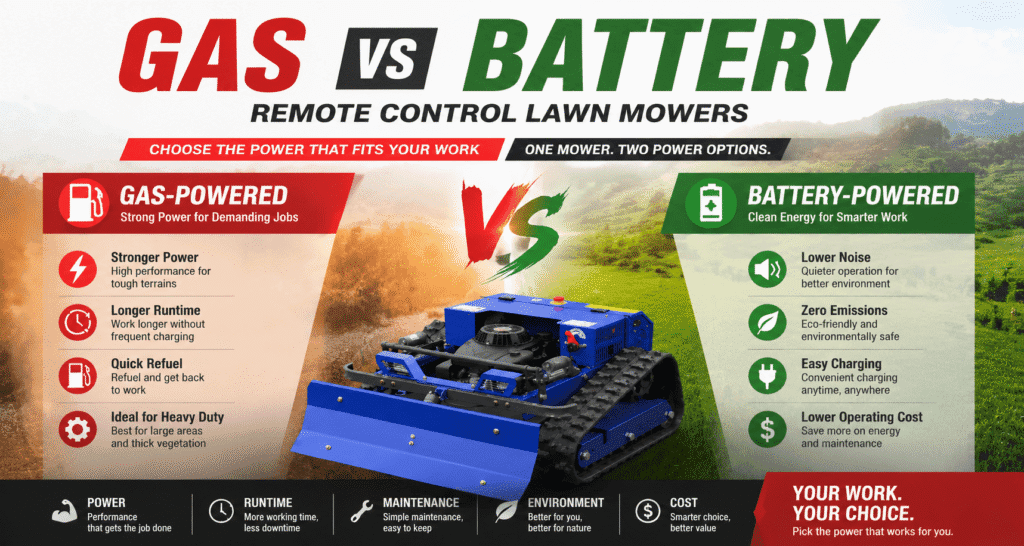
Choosing between a gasoline and battery-powered remote control lawn mower in 2026 depends less on which power source is universally better and more on where, how long, and how intensively the machine will work. Gasoline models generally suit long sessions, remote sites, and demanding vegetation when quick refueling matters. Battery-powered models can be a better fit where lower operating noise, simpler routine maintenance, and access to reliable charging are priorities.
The right choice should start with the property, not the power label. Consider mowing duration, terrain, vegetation density, transport, charging or fuel access, service capability, and the exact specifications of the model under review. Remote control range, cutting width, gradient figures, runtime, and power ratings must always be checked for the specific machine and its documented operating conditions.
Gas vs Battery-Powered Remote Control Lawn Mowers: Quick Comparison
| Decision factor | Gasoline remote control mower | Battery-powered remote control mower |
|---|---|---|
| Energy replenishment | Refuel when approved fuel is available | Recharge or exchange compatible battery packs |
| Long work sessions | Often practical where repeated refueling is possible | Depends on battery capacity, charging time, and spare-battery planning |
| Routine maintenance | Includes engine-related service requirements | Eliminates many gasoline-engine service items but still requires mower, drive, battery, and electrical inspection |
| Noise at the power source | Gasoline engine operation is generally more noticeable | Electric drive can reduce power-system noise, although blades and moving components still create noise |
| Remote locations | Useful when fuel can be transported safely but charging is unavailable | Useful when charging infrastructure or sufficient spare batteries are available |
| Storage planning | Requires appropriate fuel and engine-storage procedures | Requires correct battery charge, temperature, inspection, and storage procedures |
| Best fit | Long, demanding, or infrastructure-limited jobs | Noise-sensitive, maintenance-conscious, or charging-supported operations |
How the Two Power Systems Differ
Gasoline Remote Control Lawn Mowers
A gasoline remote control mower uses an internal-combustion engine as its main power source. Depending on the model, the engine may power the cutting system, generate electricity for drive components, or work within a combined mechanical and electrical system. These configurations are not interchangeable, so buyers should verify the actual power path rather than assuming every gasoline remote mower operates in the same way.
The practical advantage is energy density and fast replenishment. When an operator has approved fuel and follows safe refueling procedures, a machine can often return to work without waiting for a battery to recharge. This can matter on large properties, roadside projects, overgrown land, orchards, and remote sites where the workday is longer than a single battery cycle.
The tradeoff is engine care. Oil, filters, fuel condition, cooling, starting components, and manufacturer-specified service intervals become part of ownership. Gasoline storage and transport also require more planning than simply carrying a charged electrical pack.
Battery-Powered Remote Control Lawn Mowers
A battery-powered remote control mower uses stored electrical energy for propulsion, cutting, controls, or a combination of these functions. Some machines use a single integrated battery system, while others use removable packs. Buyers should confirm battery chemistry, voltage, capacity, pack quantity, charger requirements, replacement availability, and whether published runtime conditions match the intended job.
Battery models can simplify routine power-system maintenance because there is no gasoline engine oil, fuel system, or exhaust system to service. They may also be attractive near residences, schools, parks, solar installations, and other locations where reducing engine noise or on-site fuel handling is valuable.
However, battery operation is not automatically maintenance-free. Cutting systems, tracks or wheels, motors, controllers, connectors, cooling passages, remote-control components, and safety devices still need inspection. Battery condition and temperature can also affect usable work time, charging, and storage.
Six Factors That Should Decide Your 2026 Purchase
1. Daily Mowing Time
Estimate the actual cutting time required, including turning, overlap, obstacle avoidance, repositioning, and travel between sections. A brochure runtime figure may not represent tall grass, slopes, soft ground, heavy cutting, or frequent maneuvering. For battery equipment, compare the expected work cycle with charging time and the number of available packs. For gasoline equipment, calculate safe fuel access and planned service breaks.
2. Terrain and Vegetation
Power source alone does not determine whether a mower can handle slopes, rough terrain, brush, or wet vegetation. Traction design, center of gravity, cutting system, machine weight, ground pressure, speed control, and operating guidance all matter. A higher power rating does not automatically make a machine safer on a slope or more suitable for every type of growth.
When a brochure lists a maximum gradient, treat it as a model-specific statement rather than a universal safe-working angle. Ask what surface, direction, load, weather, attachment, and test method were used. The operator manual and site risk assessment should control the final decision.
3. Access to Fuel or Charging
A remote property without grid power may favor gasoline if approved fuel transport and storage are practical. A facility with dependable charging, planned overnight downtime, or an existing battery-management process may favor electric equipment. Mobile charging can change the calculation, but charger input, generator compatibility, charging environment, and electrical safety must be verified before purchase.
4. Noise and Work Location
Battery power can reduce the noise associated with an internal-combustion engine, but no mower is silent. Blades, impact with vegetation, tracks, motors, and debris still produce sound. If the machine will operate near homes, hospitality venues, campuses, hospitals, or public spaces, compare the manufacturer’s model-specific sound information and local operating restrictions rather than relying on broad marketing labels.
5. Maintenance Capability
Choose a system your team can support. A gasoline mower may be practical where small-engine parts, technicians, and fuel procedures are already established. A battery model may fit organizations that prefer electrical diagnostics, modular replacement, and fewer engine service tasks. In both cases, confirm local parts availability, remote-control support, controller diagnostics, blade service, track or wheel parts, and warranty procedures.
6. Total Cost of Ownership
Purchase price is only one part of cost. Compare fuel or electricity, batteries, chargers, engine service, wear parts, transport, downtime, storage, technician access, and expected replacement cycles. Battery packs are consumable assets, while gasoline engines carry recurring service needs. The better financial choice depends on utilization and local support, not a single headline price.
When a Gasoline Remote Control Mower Is the Better Choice
A gasoline model may be the stronger option when the work involves long shifts, dense or overgrown vegetation, large remote properties, or limited charging access. It can also suit operators who already maintain gasoline equipment and have established procedures for fuel, engine service, and spare parts.
- The site is far from dependable electrical power.
- Quick refueling is more practical than waiting for charging.
- The mower will operate for extended periods with planned fuel stops.
- Local technicians and engine parts are readily available.
- The selected model’s cutting and traction system matches the terrain.
Do not choose gasoline only because a horsepower figure appears larger. Verify how power reaches the cutting and drive systems, and compare machines under the same type of operating conditions.
When a Battery-Powered Remote Control Mower Is the Better Choice
A battery-powered model may be preferable where charging is reliable, operating windows are predictable, and reduced engine-related maintenance is important. It can also suit locations where on-site fuel handling is undesirable or where lower power-system noise supports the work environment.
- The property has dependable charging access.
- Work can be divided into planned battery cycles.
- Spare packs or charging downtime fit the operating schedule.
- The organization wants to reduce gasoline-engine service tasks.
- The manufacturer provides clear battery, charger, replacement, and storage documentation.
Do not purchase on voltage or amp-hour figures alone. Ask for model-specific runtime conditions, charging time, usable battery configuration, expected battery service life guidance, replacement cost, and availability.
What to Verify Before Buying in 2026
Product ranges are changing quickly, so use current model documentation rather than an old comparison page or a specification from another machine. Before requesting a quotation, ask the supplier to confirm the following in writing:
- Exact model and configuration
- Gasoline, battery, or hybrid power architecture
- Cutting width and cutting-height adjustment
- Documented operating or runtime conditions
- Charging time, charger input, and spare-battery options
- Fuel type, engine model, and required service schedule
- Remote-control range and its test conditions
- Terrain and gradient limitations
- Machine weight, dimensions, and transport requirements
- Safety functions, emergency stopping, manuals, and training
- Parts, technical support, and warranty terms for your market
Keep every specification attached to its exact model. Similar-looking machines can have different engines, batteries, cutting systems, weights, controls, and operating limits.
Frequently Asked Questions (FAQ)
Are gasoline remote control lawn mowers more powerful?
Not automatically. Gasoline machines often list engine horsepower, while battery machines may list electrical ratings that cannot be compared directly without system details. Cutting performance also depends on blade design, torque delivery, cutting width, travel speed, vegetation, and terrain. Compare model-specific operating information rather than one power number.
How long does a battery remote control mower run?
Runtime varies by battery configuration, cutting load, terrain, speed, temperature, battery condition, and machine design. Use only a model-specific figure with stated test conditions. If conditions are missing, ask the manufacturer how the estimate changes in tall grass, on slopes, or during continuous cutting.
Can a battery mower handle rough terrain?
It may, but the battery is only one part of the machine. Tracks or tires, ground clearance, weight distribution, traction control, cutting system, weather protection, and manufacturer operating limits determine suitability. Review the exact model and arrange a relevant demonstration where practical.
Which type is easier to maintain?
Battery models usually remove several gasoline-engine service items, but they still require blade, drive, electrical, remote-control, battery, and chassis maintenance. Gasoline models add engine and fuel-system care. The easier option is the one supported by clear documentation, available parts, and technicians familiar with the system.
Is a battery remote control mower cheaper to operate?
It can be, but there is no universal answer. Electricity cost, battery replacement, charger investment, utilization, downtime, fuel price, engine service, and local labor all affect ownership cost. Build a comparison using the expected annual operating hours and actual supplier quotations.
Which remote control mower should I choose in 2026?
Choose gasoline for long, demanding work where fast refueling and engine support are available. Choose battery power for planned duty cycles where charging, lower engine-related maintenance, and reduced fuel handling are priorities. In either case, verify the exact model against your terrain, vegetation, schedule, and safety requirements.
Conclusion
For 2026, the choice between a gasoline and battery-powered remote control lawn mower comes down to duty cycle and infrastructure. Gasoline remains practical for long sessions and remote work with reliable fuel support. Battery power is compelling for scheduled work, dependable charging, and organizations seeking simpler power-system maintenance.
Start with the job site, calculate realistic operating time, and verify every specification for the exact model. A well-matched mower will deliver more value than choosing by fuel type, horsepower, battery voltage, or brochure claims alone.