
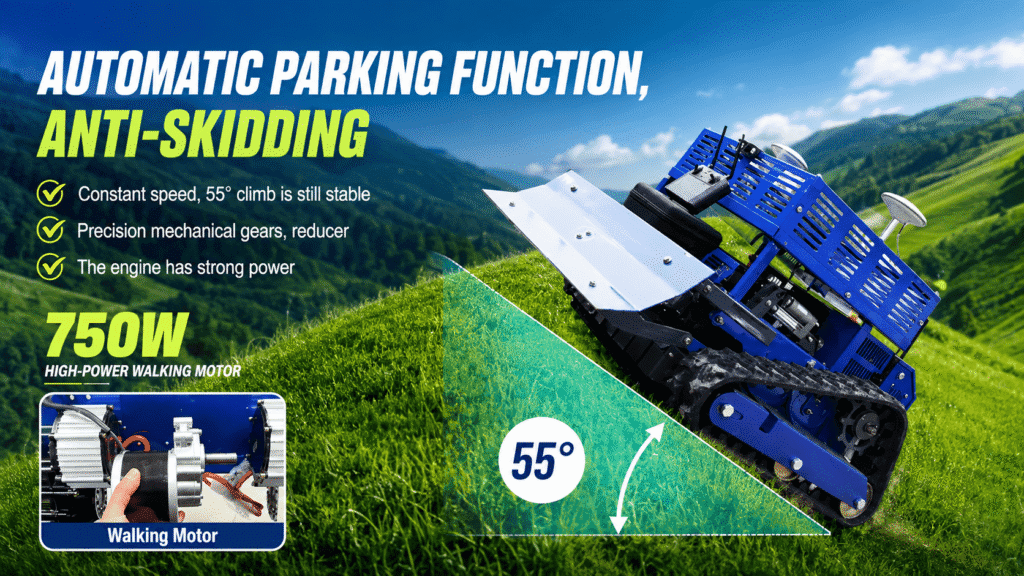
The best mower for steep hills is usually a machine that keeps the operator off the slope, maintains controlled movement, and matches the vegetation rather than simply offering the most horsepower. For many difficult hillsides, a tracked remote control mower is the strongest type to consider because the operator can work from a separate position. However, the right choice still depends on slope direction, surface condition, obstacles, grass density, access width, and the machine manufacturer’s operating limits.
YITAIWEI develops remote control mowing solutions around three practical machine families: tracked mowers for demanding terrain, flail mowers for heavier vegetation, and wheeled mowers for firmer, more even areas. The useful question is not which family sounds most powerful, but which chassis and cutting system fit the actual hillside.
Quick Comparison: Which Mower Type Fits a Steep Hill?
| Mower type | Main advantage | Main limitation | Where to investigate it |
|---|---|---|---|
| Tracked remote control mower | Allows the operator to control the machine from a separate position | Requires training, clear sightlines, and careful route planning | Steep, uneven, rough, or loose-stone terrain |
| Remote control flail mower | Cutting concept aimed at tall and dense grass management | The exact vegetation limit must match the supplied cutting head | Overgrown banks and heavy grass |
| Wheeled remote control mower | Maneuverable layout for accessible ground | Ground contact depends on surface firmness and wheel design | Firmer, more even slopes within manufacturer limits |
| Walk-behind slope mower | Direct control and relatively compact access | The operator still walks near or on the incline | Smaller slopes with secure footing |
| Riding mower | Productive on broad, moderate ground within its limits | Operator exposure and rollover risk become central concerns | Only slopes expressly permitted by the manufacturer |
This table is a screening tool, not permission to operate a mower on a particular slope. The owner’s manual and manufacturer instructions for the exact machine remain the controlling references.
Measure the Hill Before Choosing a Mower
A hillside that looks manageable from the bottom can contain short sections that are much steeper than its average. Measure multiple points, including approaches, turns, drainage channels, and transitions near the top and bottom. Note whether the proposed travel path runs across the slope or up and down it, because direction can change traction and stability.
Slope Angle Is Only One Part of the Assessment
Record soil firmness, moisture, loose gravel, exposed roots, holes, retaining edges, and drop-offs. A dry grass slope and the same slope after rain are not equivalent operating surfaces. Tall vegetation can also hide obstacles and reduce the operator’s ability to judge wheel or track contact.
Plan Access and Turning Areas
Measure gates, row spacing, transport access, and the room available to turn without approaching an edge. Cutting width matters only when the machine can reach the work area and complete a controlled route. A wider deck can reduce passes on open ground, while a compact machine may be easier to position around trees, posts, and narrow entrances.
Why Remote Control Mowers Deserve Consideration
A remote control mower separates the operator from the machine, which changes the exposure compared with riding directly on the slope. The operator can choose a viewing position and avoid carrying body weight on the mower. That does not make operation risk-free: the machine still needs a planned exclusion zone, reliable visual contact, deliberate speed control, and a route that avoids people, traffic, structures, and drop-offs.
Tracked Mowers for Difficult Ground
The tracked remote control mower range is developed for slope and difficult-terrain mowing applications. A tracked chassis is the family to evaluate when a hillside combines uneven contours, ruts, rough ground, or loose stones. The tracks are intended to manage ground contact; the mower is not designed to cut or strike stones. Visible rocks and debris should be identified and removed where possible before mowing.
Actual grip still depends on track design, surface, vegetation, moisture, travel direction, and machine configuration. Buyers should ask how the machine steers, how quickly it stops, what happens if the signal is interrupted, and how emergency stopping is performed.
Operator Position Matters
The operator should select a position that provides a clear view without standing in the machine’s downhill path or discharge area. The product data lists a 500m remote-control range, but this is not the intended operator-to-machine working distance. A listed signal range cannot replace sightlines, control response, site exclusion, or the manufacturer’s operating procedure.
Match the Cutting System to the Vegetation
Steep hills may carry maintained lawn grass, seasonal weeds, dense rough grass, saplings, or mixed brush. A machine that leaves a clean lawn finish may not be the best tool for an overgrown bank. Before comparing engines or deck sizes, define the material to be cut and the finish required after mowing.
Flail Mowers for Tall and Dense Grass
Where a slope has tall grass, dense grass, or repeated heavy regrowth, YITAIWEI’s remote control flail mower family is the more relevant solution to investigate. The flail concept is intended for heavier vegetation management than ordinary lawn finishing. The exact cutting capacity still depends on the supplied flail head and model configuration, so stem size and vegetation limits should be confirmed before ordering.
Wheeled Mowers for Firmer Ground
Not every hill requires tracks. For relatively firm, more even ground with clear access and turning space, a wheeled remote control mower may provide a simpler, maneuverable solution. Wheel layout does not establish a universal slope rating, so the surface, travel direction, and exact manufacturer limits still need to be checked.
Cutting Height and Ground Clearance
A useful cutting-height range helps an operator avoid scalping uneven crests and begin high when reclaiming overgrown ground. Ground clearance, deck shape, and obstacle protection also affect whether a mower can cross ruts and transitions. These details should be evaluated together rather than treating cutting height as an isolated number.
Choose the Product Family by Job
| Job condition | Product family to evaluate | Reason for the match | Confirm before ordering |
|---|---|---|---|
| Steep or irregular ground | Tracked remote control mower | Chassis developed for difficult-terrain mowing | Slope limits, travel direction, track type, and stopping behavior |
| Loose-stone or rough surface | Tracked remote control mower | Tracked layout is the relevant ground-contact option | Obstacle removal, surface condition, guarding, and route |
| Tall and dense grass | Remote control flail mower | Cutting concept developed for heavier vegetation | Flail head, vegetation limit, cutting height, and guarding |
| Firm and relatively even ground | Wheeled remote control mower | Maneuverable layout for accessible areas | Surface grip, slope limit, access width, and turning space |
This is a product-family guide rather than a complete specification table. Final model selection should be based on the measured site and the confirmed configuration supplied by the manufacturer.
Questions to Ask Before Buying
- What is the manufacturer’s permitted operating slope for the exact configuration?
- Does the limit change for cross-slope and up-and-down travel?
- Should this site use a tracked, flail, or wheeled configuration?
- What vegetation is the supplied cutting system designed to handle?
- How does the machine stop after loss of signal or an emergency command?
- Can the machine pass through every gate and reach the planned turning area?
- Which cutting parts, tracks or wheels, filters, and service support are available?
- What transport method and loading procedure are required?
A supplier should identify the exact chassis, cutting assembly, engine, controller, and safety documentation included in the quoted configuration. If a feature is important to the job, place it in the purchase agreement rather than relying on a general product-family description.
A Practical Site-to-Machine Selection Process
- Map the property and separate moderate lawn, steep hillside, loose-stone ground, heavy grass, and obstacle zones.
- Measure the steepest sections and record surface conditions and travel direction.
- Define vegetation height, density, stem size, and desired finish.
- Set access limits for width, transport, gates, turns, and storage.
- Choose tracked, flail, or wheeled equipment according to the dominant job condition.
- Verify operating limits, controls, stopping behavior, and maintenance requirements.
- Create an operating plan that includes sightlines, exclusion zones, weather limits, and emergency procedures.
One machine may not be the best answer for every part of a mixed property. A tracked mower may handle the difficult hillside, a flail mower may address dense regrowth, and a wheeled mower may maintain firmer accessible areas. Choosing the appropriate product family for each zone can be more effective than forcing one configuration into every task.
Frequently Asked Questions (FAQ)
Is a tracked mower always best for steep hills?
No. Tracks and remote control can be valuable on difficult terrain, but the correct machine depends on measured slope, surface, vegetation, access, travel direction, and manufacturer limits. A tracked mower is a strong family to evaluate, not a guarantee for every slope.
Can a flail mower cut tall and dense grass?
The remote control flail mower family is positioned for tall and dense grass management. The exact vegetation capacity depends on the supplied cutting head and model configuration. Confirm cutting height, material limits, guarding, and maintenance requirements for the machine being ordered.
Can a tracked mower work where there are stones?
A tracked chassis can be evaluated for rough or loose-stone ground, but the mower should not be used to cut or intentionally strike stones. Inspect the route, remove visible debris where possible, and confirm guarding and operating instructions for the exact configuration.
Can I use a riding mower on a steep hill?
Use a riding mower only on terrain and in conditions expressly permitted by the manufacturer for that exact model. Never treat a general angle found online as approval. Wet grass, holes, edges, loose soil, attachments, and travel direction can materially change the situation.
What is the most important feature in a steep-hill mower?
No single feature decides the choice. Start with verified operating limits and a site assessment, then evaluate chassis type, cutting system, controlled stopping, operator position, visibility, and service support. The best mower is the one whose documented capabilities match the complete job.
Final Recommendation
For steep, rough, or hard-to-reach hills, start by evaluating the YITAIWEI remote control mower range: tracked machines for demanding terrain, flail configurations for tall and dense grass, and wheeled machines for firmer, more even ground. Select by terrain and vegetation first, confirm the exact configuration and operating limits, and treat remote control as a way to improve operator positioning rather than a substitute for safe planning.