
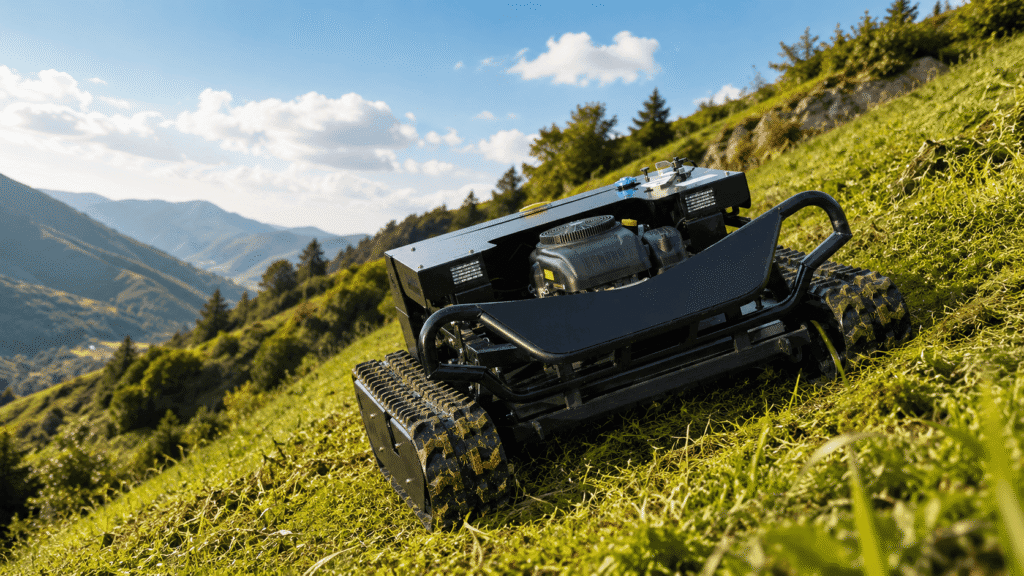
A remote control mower for steep hills allows the operator to control the machine from a separate position instead of riding on it or walking directly behind it. That distinction can be valuable on slopes where footing, rollover exposure, rough ground, or dense vegetation make conventional mowing difficult. The machine still has to match the measured slope, surface, vegetation, access, and manufacturer’s operating limits.
YITAIWEI develops tracked, flail, and wheeled remote control mower solutions for different terrain and vegetation conditions. On a steep hill, the best configuration is not automatically the largest or most powerful machine. It is the one whose chassis, cutting system, controls, and dimensions fit the actual work route.
How a Remote Control Mower Changes Hill Work
Traditional riding equipment places the operator on the machine, while a walk-behind mower keeps the operator close to the cutting unit. Remote operation separates those positions. The operator can choose a viewing point that provides clear sight of the mower, the ground ahead, and nearby hazards without occupying the mower itself.
Operator Position Is the Main Difference
The operator should remain outside the mower’s downhill path and discharge area while keeping continuous visual contact. A remote controller does not make blind operation acceptable. Crests, tall vegetation, trees, retaining walls, and structures can hide the machine or its route, so the work plan must establish where the operator will stand during every pass and turn.
Remote Range Is Not Working Distance
The product data lists a 500m remote-control range. This is a signal specification, not a recommendation to operate from 500 meters away. Effective hill work depends on visibility, response, interference, exclusion zones, and the operating instructions for the exact machine. The operator should stay close enough to judge ground contact and stop work when the view is obstructed.
Choose the Chassis for the Ground
A slope should be assessed as a surface, not only as an angle. Firm turf, wet clay, loose soil, gravel, ruts, exposed roots, and drainage channels create different demands. Inspect the complete route, including entry points, turns, transitions, and the area at the bottom of the hill.
Tracked Mowers for Steep and Rough Terrain
A tracked remote control mower is the first YITAIWEI family to evaluate for steep, uneven, rutted, or loose-stone ground. The tracked layout is intended to provide a different ground-contact pattern from ordinary turf wheels and can suit difficult-terrain mowing applications. Actual traction still varies with track design, moisture, vegetation, travel direction, speed, and machine configuration.
Loose stones should be treated as ground hazards, not material to be cut. Inspect the site, remove visible rocks and debris where practical, and plan a route that avoids intentional blade contact. Tracks can help the chassis travel over rough ground, but they do not make stones harmless or guarantee that a mower cannot slide.
Wheeled Mowers for Firmer, More Even Areas
A wheeled remote control mower may be the more practical choice when the surface is firm, reasonably even, and accessible, especially where maneuverability and frequent direction changes matter. Wheel layout alone does not establish slope capability. Confirm the exact model’s permitted gradient, travel direction, tire arrangement, and restrictions before placing it on a hill.
Choose the Cutting System for the Vegetation
The chassis handles movement while the cutting system handles vegetation. These decisions should be made separately. Short maintained grass, tall seasonal growth, dense grass, weeds, and woody material do not place the same load on a mower.
Flail Mowers for Tall and Dense Grass
For hillsides covered with tall or dense grass, the YITAIWEI remote control flail mower family is the relevant solution to investigate. A flail configuration is developed for heavier vegetation management than ordinary lawn finishing. The exact cutting limit depends on the supplied flail head and model configuration, so buyers should confirm acceptable vegetation, cutting height, guarding, and wear-part requirements.
Rotary Cutting for Maintained Areas
Where grass is regularly maintained and the required result is closer to a lawn finish, a rotary-style mower may be sufficient. Cutting width, height adjustment, deck protection, and contour following can matter more than maximum engine output. On uneven crests and dips, starting with an appropriate cutting height can reduce scalping and unnecessary blade contact.
Do Not Judge Cutting Ability by Horsepower Alone
Horsepower does not identify the blade system, deck opening, guarding, or the material a mower is designed to process. Ask what cutting assembly is included in the quotation and what vegetation it is documented to handle. For mixed brush or woody stems, a separate clearing step or specialist attachment may be necessary.
Remote Hill Mower Configuration Guide
| Work condition | Configuration to evaluate | Why it may fit | Key point to confirm |
|---|---|---|---|
| Steep, uneven hill | Tracked remote control mower | Chassis designed for difficult-terrain movement | Permitted slope, direction, stopping, and track condition |
| Rough ground with loose stones | Tracked remote control mower | Ground-contact layout suited to rough routes | Obstacle removal, guarding, visibility, and travel path |
| Tall or dense grass | Remote control flail mower | Cutting concept intended for heavier vegetation | Flail head, vegetation limit, cutting height, and wear parts |
| Firm, relatively even slope | Wheeled remote control mower | Maneuverable layout for accessible ground | Model slope limit, tire grip, turns, and surface condition |
| Mixed property | More than one configuration | Different zones may need different chassis or cutting systems | Zone map, transport, storage, and maintenance plan |
The table identifies product families, not universal approvals. Final selection requires the exact machine documentation and a site-specific assessment.
Plan the Work Before Starting
A remote mower should enter the slope only after the route and work zone are prepared. A few minutes of inspection can reveal hazards that were hidden by grass or difficult to see from the property boundary.
Inspect and Mark the Route
- Measure the steepest sections instead of relying on the average hill angle.
- Mark holes, drop-offs, roots, wire, stumps, drains, and retaining edges.
- Remove loose objects that could contact the cutting system.
- Identify safe entry, exit, turning, refueling or charging, and recovery areas.
- Check whether rain, dew, cut grass, or loose soil has changed the surface.
Create an Exclusion Zone
Keep people, animals, vehicles, and other workers away from the mower’s travel and discharge areas. Roadside or public-facing work may need additional traffic controls and spotters. The operator should know where the mower will stop if a pass cannot be completed and should never improvise a turn close to a drop-off.
Inspect the Machine
Before operation, follow the manufacturer checklist for tracks or tires, cutting parts, guards, fasteners, fluids, battery condition, controller, emergency stop, and signal behavior. Clear accumulated vegetation only after the machine is fully stopped and disabled according to its instructions. Do not approach a running cutting system because the mower is remotely controlled.
Operate With a Deliberate Pattern
The work pattern should minimize difficult turns and preserve a clear view. There is no universal instruction to mow only across a slope or only up and down it. The appropriate direction depends on the machine design, the exact manual, the surface, and the planned route.
Start Conservatively
Begin in a less demanding section to confirm control response, surface grip, cutting load, and stopping behavior. Use a deliberate travel speed and avoid sudden steering inputs. If the machine begins to slide, loses predictable response, throws unexpected debris, or becomes difficult to see, stop and reassess rather than trying to finish the pass.
Manage Heavy Vegetation in Stages
Tall grass can hide holes and debris while increasing cutting load. A staged approach may be appropriate when permitted by the equipment instructions: inspect as much of the route as possible, begin at a suitable cutting height, and reduce the remaining material in a later pass if needed. Do not force the mower into vegetation beyond the documented capacity of the cutting head.
Keep Turns Away From Hazards
Plan turns on the most stable available ground and leave a buffer from roads, water, walls, and drop-offs. Turning can change the way tracks or tires interact with the surface. A machine that travels predictably in a straight line may behave differently when steering on loose or wet ground.
What Buyers Should Confirm Before Ordering
- The exact chassis: tracked or wheeled.
- The exact cutting system: flail, rotary, or another supplied configuration.
- The permitted slope and any difference between travel directions.
- The method for normal stopping, emergency stopping, and signal interruption.
- The machine width, cutting width, and access requirements.
- The vegetation limits and recommended cutting-height procedure.
- The required transport, loading, daily inspection, and maintenance equipment.
- The included parts support, manuals, training information, and warranty terms.
Put job-critical features in the quotation and purchase agreement. Product-family images are useful for understanding the range, but the ordered configuration should identify the chassis, cutting head, engine, controller, and included accessories.
Frequently Asked Questions (FAQ)
Is a remote control mower safe for every steep hill?
No. Remote control changes the operator’s position but does not make every slope suitable. The measured grade, surface, route, vegetation, visibility, weather, and machine limits still determine whether work should proceed. Follow the exact manufacturer’s instructions and stop when conditions become unpredictable.
Are tracks better than wheels on a steep hill?
Tracks are often the product family to evaluate for steep, rough, uneven, or loose ground, while wheels may suit firmer and more even areas. Neither layout guarantees traction. Compare the actual route, ground conditions, machine design, and documented operating limits.
Can a remote control flail mower cut dense grass?
A flail mower is developed for heavier vegetation management and is the relevant configuration to investigate for tall and dense grass. Exact capability depends on the supplied flail head and machine configuration. Confirm vegetation limits, cutting height, guarding, and wear-part needs before ordering.
Can a tracked mower cut over stones?
The tracks may help the chassis move over rough or loose-stone ground, but stones are not cutting material. Inspect the route, remove visible debris where practical, avoid intentional blade contact, and confirm the cutting-system guards and site procedure for the exact mower.
How far away should the operator stand?
Use a position that preserves continuous visibility, predictable control, and separation from the machine’s path and discharge area. The listed remote range is not the recommended working distance. Site layout, interference, obstacles, and manufacturer instructions should determine the operator position.
Conclusion
A remote control mower for steep hills is most useful when it combines the right operator position with a chassis and cutting system selected for the site. Evaluate a tracked mower for steep or rough ground, a flail configuration for tall and dense grass, and a wheeled mower for firmer, more even areas. YITAIWEI offers these three product families, allowing buyers to match the machine to the dominant terrain and vegetation instead of relying on one specification. Confirm the exact configuration, prepare the route, and operate within documented limits.