
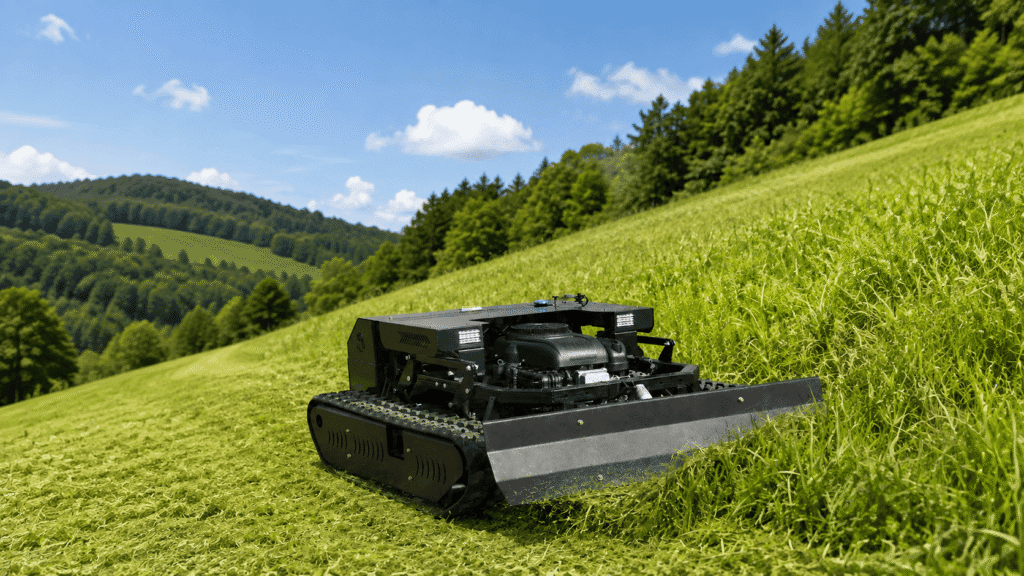
To mow a steep hill safely, first measure and inspect the slope, choose equipment approved for the conditions, remove or mark hazards, establish an exclusion zone, and plan every pass and turn before the cutting system starts. Do not mow simply because a machine can climb the hill. Surface grip, travel direction, vegetation, visibility, obstacles, weather, and the manufacturer’s operating limits all affect the decision.
A remote control mower can improve operator positioning because the operator does not ride on the machine or walk immediately behind it. YITAIWEI offers tracked, flail, and wheeled remote control mower configurations for different terrain and vegetation. The correct configuration should be selected before the work method is planned.
Table of Contents
- Steep-Hill Mowing Safety Checklist
- Step 1: Inspect the Hill Before Selecting Equipment
- Step 2: Choose the Right Mower Configuration
- Step 3: Prepare the Machine and Work Zone
- Step 4: Plan Passes, Turns, and Operator Position
- Step 5: Operate Conservatively
- Step 6: Shut Down and Inspect After Mowing
- Frequently Asked Questions (FAQ)
- Conclusion
Steep-Hill Mowing Safety Checklist
| Stage | Required check | Reason | Stop if |
|---|---|---|---|
| Site assessment | Measure slope and inspect the complete route | Average angle can hide steeper sections and hazards | The route exceeds documented machine limits |
| Equipment choice | Match chassis and cutting system to ground and vegetation | Movement and cutting place different demands on the machine | The configuration is not documented for the job |
| Work-zone setup | Remove debris and establish an exclusion area | Reduces contact with objects and nearby people | People, traffic, or animals cannot be controlled |
| Operation | Maintain visibility and deliberate control | The operator must judge route and machine response | The mower slides, disappears from view, or responds unpredictably |
| Post-work | Stop, isolate, inspect, and clean safely | Damage and buildup can affect the next operation | Cutting parts, tracks, tires, or controls need repair |
Step 1: Inspect the Hill Before Selecting Equipment
Walk the site only where footing is secure, or inspect it from stable access points. Measure several locations rather than relying on the appearance of the hill from below. Include the entry, exit, turns, crests, drainage channels, and transitions to level ground.
Identify Surface Conditions
Record whether the surface is firm turf, wet clay, loose soil, gravel, exposed rock, or a mixture. Dew, rain, cut grass, and dry loose soil can change grip. A route that was manageable during an earlier visit may not be suitable under today’s conditions.
Locate Hidden Hazards
Tall vegetation can conceal wire, stones, holes, roots, stumps, drains, and sharp changes in grade. Mark hazards that cannot be removed. Pay special attention to roads, ponds, retaining walls, fences, solar equipment, buildings, and drop-offs where loss of control would have serious consequences.
Set Weather and Surface Limits
Decide in advance which conditions require postponing the job. Do not wait until a mower slides before concluding that the ground is too wet or loose. The operator or supervisor should have authority to stop the work when visibility, grip, or weather changes.
Step 2: Choose the Right Mower Configuration
The mower must match both the ground and the vegetation. A suitable chassis does not automatically provide a suitable cutting system, and a powerful cutting head does not make an unsuitable chassis safe on a hill.
Tracked Mowers for Demanding Terrain
A YITAIWEI tracked remote control mower is the first family to evaluate for steep, uneven, rutted, or loose-stone terrain. Tracks provide a different ground-contact layout from ordinary wheels, but they do not guarantee grip or prevent sliding. Confirm the exact machine’s permitted slope, travel direction, stopping behavior, and track requirements.
Tracks may help the chassis travel over rough ground; they do not make stones cutting material. Remove visible rocks and loose debris where possible and avoid intentional blade contact. If the route cannot be cleared or guarded appropriately, use another method.
Flail Mowers for Tall and Dense Grass
Where heavy vegetation is the main challenge, evaluate a remote control flail mower. YITAIWEI positions its flail family for tall and dense grass management. Confirm the supplied cutting head, vegetation limits, cutting height, guarding, and wear parts rather than assuming every flail configuration handles the same material.
Wheeled Mowers for Firmer Ground
A wheeled remote control mower can be practical on relatively firm, more even ground with clear access and turning space. Do not choose it from maneuverability alone. Tire condition, surface grip, slope limit, travel direction, and nearby edges must fit the exact operating instructions.
Step 3: Prepare the Machine and Work Zone
Complete the manufacturer inspection before moving onto the hill. Check tracks or tires, cutting parts, guards, fasteners, fluids, controller condition, battery state, emergency stop, and normal stopping response. Do not use a machine with damaged guards, worn movement components, fluid leaks, loose cutting parts, or unreliable controls.
Test Controls on Stable Ground
Confirm forward, reverse, steering, cutting engagement, normal stop, and emergency stop on a stable open area. The operator should understand what happens after signal interruption. A controller should not be learned for the first time while the mower is already on a steep section.
Create an Exclusion Zone
Keep people, animals, vehicles, and other workers away from the travel and discharge areas. Roadside and public-facing work may require traffic controls or a spotter. Define a safe place for the operator and a separate recovery route before beginning.
Plan Refueling, Charging, and Recovery
Choose a stable service area away from ignition sources and moving traffic. Determine how the mower will be recovered if it stops on the slope. Do not rely on a person walking downhill to pull, push, or restart a disabled machine without an approved recovery procedure.
Step 4: Plan Passes, Turns, and Operator Position
There is no universal rule that every mower should travel across a slope or always move up and down. The correct direction depends on machine design and manufacturer instructions. Plan straight sections, turns, entry points, exit points, and buffers as one route.
Maintain Continuous Sight
The operator should see the mower, the path immediately ahead, and nearby hazards throughout the pass. The product data lists a 500m remote-control range, but that value is not the recommended working distance. Stay close enough to judge machine response and ground contact, and stop if vegetation or terrain blocks the view.
Stand Outside the Downhill Path
Do not position the operator where a sliding or uncontrolled mower could travel. Stay outside the discharge area and avoid standing directly above or below the machine when the planned route creates exposure. Relocate between passes instead of stretching the working angle from one poor viewing point.
Keep Turns on the Best Available Ground
Turning changes how tracks or tires load the surface. Where possible, plan turns on firmer, less steep ground and leave generous buffers around edges. Avoid abrupt steering, sudden speed changes, and improvised turns near roads, water, retaining walls, or drop-offs.
Step 5: Operate Conservatively
Begin in a less demanding area and confirm cutting load, traction, control response, and stopping behavior. Use deliberate inputs and a pace appropriate for vegetation and surface conditions. Productivity is secondary to predictable machine behavior.
Use Staged Cutting for Heavy Growth
Dense grass may hide hazards and increase cutting load. When permitted by the equipment instructions, begin at a suitable cutting height and use another pass for the final result. Never force the mower into vegetation beyond the documented capacity of the cutting head.
Watch for Changing Conditions
Cut material can accumulate under tracks or tires, and exposed soil may become looser after repeated turns. Weather can also change during the job. Reassess the route periodically rather than assuming the first successful pass proves every later pass is acceptable.
Use Clear Stop-Work Rules
- Stop if the mower slides or no longer follows commands predictably.
- Stop if the operator loses clear sight of the machine or route.
- Stop if a person, animal, or vehicle enters the exclusion zone.
- Stop after unexpected impact, vibration, noise, smoke, or leakage.
- Stop when rain, dew, loose soil, or cut vegetation changes grip.
- Stop if the next turn or pass cannot be completed within the planned buffer.
Step 6: Shut Down and Inspect After Mowing
Move the mower to a stable service area, stop the cutting system, shut down the machine, and isolate starting controls according to the manual. Allow hot and moving parts to reach a safe condition before inspection. Never clear wrapped grass or inspect blades while the cutting system can start.
Check Cutting and Drive Components
Inspect flails or blades, guards, fasteners, tracks or tires, and areas where vegetation collects. Look for damage caused by hidden debris or ground contact. Replace worn or damaged parts before the next job instead of treating continued operation as a test.
Record Conditions and Maintenance
Log the site, weather, operating hours, observed grip, cutting performance, impacts, maintenance, and parts replaced. These records help the next operator understand the property and can show when a route or configuration needs to change.
Frequently Asked Questions (FAQ)
What is the safest type of mower for a steep hill?
No mower is safest in every condition. A remote control tracked mower is often worth evaluating because it separates the operator from the machine and is designed for difficult terrain. Suitability still depends on the exact slope, surface, vegetation, route, visibility, and manufacturer limits.
Should I mow across a steep hill or up and down?
Follow the instructions for the exact mower. Travel direction affects machines differently, so there is no universal rule covering riders, walk-behind equipment, and remote tracked mowers. Plan entry, straight passes, turns, and exits together, then stop if the route becomes unpredictable.
Can I mow a steep hill when the grass is wet?
Wet grass and soil can reduce grip and make machine response less predictable. Postpone work when conditions fall outside the manufacturer’s instructions or the planned surface limits. Remote control does not eliminate sliding, poor visibility, or thrown-material hazards.
Can a tracked mower operate on gravel or stones?
A tracked chassis can be evaluated for rough or loose-stone terrain, but stones are not cutting material. Remove visible debris where practical, avoid intentional blade contact, and confirm guarding and route requirements. Stop after any unexpected impact and inspect the machine before continuing.
Does remote control make hill mowing completely safe?
No. Remote control can improve operator position, but safety still requires suitable equipment, continuous visibility, an exclusion zone, predictable machine response, and operation within documented limits. A long signal range cannot replace close observation and a prepared route.
Conclusion
To mow a steep hill safely, assess the complete site, match the chassis and cutting system to the terrain and vegetation, prepare the machine, establish an exclusion zone, and define stop-work rules before starting. YITAIWEI tracked, flail, and wheeled remote control mower families provide different options for difficult terrain, heavy grass, and firmer ground. The safest result comes from choosing the correct configuration and operating it conservatively within the manufacturer’s instructions.