
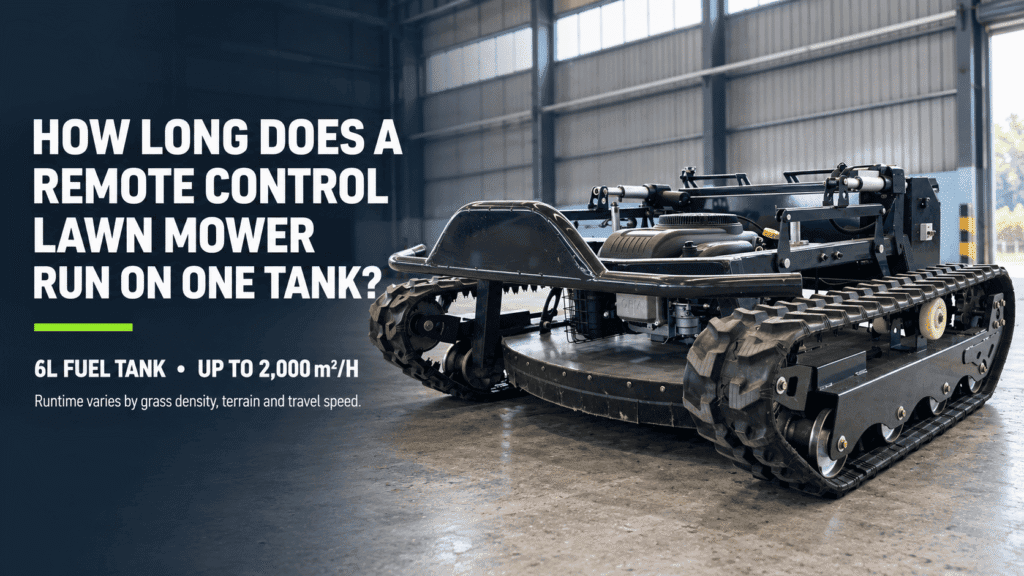
How long a remote control lawn mower runs on one tank depends on fuel consumption, grass conditions, terrain, cutting height, travel speed and operator control. A larger fuel tank does not automatically equal a fixed number of working hours. For the YITAIWEI YTW-900T tracked remote control mower, the confirmed fuel tank capacity is 6L. The exact runtime still depends on the working load and operating conditions, so buyers should use the tank capacity for planning rather than treat it as a guaranteed runtime figure.
The YTW-900T is a tank-style remote control mower designed for active operator control. Its listed configuration includes a 900mm cutting width, 20–200mm adjustable cutting height, 0–6km/h adjustable travel speed, 1500W power, and up to 500m remote-control range. These specifications help explain the work cycle, but they do not establish fuel consumption per hour.
Table of Contents
- What Determines Runtime?
- YTW-900T Parameters Related to Mowing Time
- How Terrain Affects Fuel Use
- How Grass and Cutting Height Affect Runtime
- How to Plan a Mowing Cycle
- B2B Purchasing Considerations
- Frequently Asked Questions (FAQ)
- Conclusion
What Determines Runtime?
The simplest planning formula is fuel available divided by fuel consumption. In practice, fuel consumption changes during the job. A mower working on short, dry grass over firm ground may use fuel differently from the same mower cutting tall vegetation on a slope. Travel speed, repeated turns, stopping, reversing and attachment load also influence the work cycle.
| Factor | How it can affect runtime | Planning question |
|---|---|---|
| Vegetation height | Taller grass can increase cutting demand | Is the site maintained or overgrown? |
| Grass density | Dense growth may require slower or repeated passes | Will one pass produce the required result? |
| Slope | Climbing and maneuvering can change the load | How much of the route is sloped? |
| Travel speed | Higher speed does not always improve cutting productivity | What speed matches the vegetation and surface? |
| Turning and stopping | Frequent control changes add non-cutting time | Are there many trees, posts or narrow sections? |
| Maintenance | Incorrect adjustment can reduce operating efficiency | Are the cutting and drive systems serviced? |
Why Tank Capacity Is Not Runtime
A 6L tank tells the buyer how much fuel the listed configuration can hold. It does not provide a verified hourly consumption rate. Without a confirmed fuel-use figure and test conditions, it would be inaccurate to promise that the machine runs for a particular number of hours on one tank.
Working Time Versus Engine Time
A mowing shift includes more than continuous cutting. The operator may spend time inspecting the route, repositioning the machine, clearing safe areas, adjusting the cutting height, refueling, checking the controller and moving between work zones. For commercial planning, estimate both engine time and productive cutting time.
YTW-900T Parameters Related to Mowing Time
The YTW-900T specification table provides several parameters that are useful when planning a mowing route.
| YTW-900T parameter | Confirmed value | Why it matters |
|---|---|---|
| Fuel tank capacity | 6L | Defines the listed fuel capacity for a work cycle |
| Cutting width | 900mm | Helps estimate the number of passes across an area |
| Cutting height | 20–200mm adjustable | Allows the setup to match different grass conditions |
| Travel speed | 0–6km/h adjustable | Supports route planning and controlled movement |
| Power | 1500W | Identifies the listed power value of the configuration |
| Remote-control range | 500m | Supports remote route planning where visibility is maintained |
The 500m remote-control range should not be treated as a recommended operating distance or a guarantee for every site. Line of sight, interference, terrain and safe working procedures remain important. Actual performance may vary with terrain, vegetation, operating conditions and machine configuration. Confirm the final specification with the manufacturer before ordering.
How the 900mm Cutting Width Helps Planning
A 900mm cutting width can help buyers estimate the number of passes required on an open area. It does not equal actual hourly coverage because overlap, turns, slope changes, obstacles and vegetation density reduce effective productivity. Use the width as a route-planning input, not as a promise of area-per-hour performance.
How the Cutting Height Range Supports Different Jobs
The listed 20–200mm adjustable cutting height allows the operator to select a setting for the grass condition and desired result. A higher setting may be appropriate when vegetation is tall, while a lower setting may be used for a maintained finish when the site permits. The correct setting affects cutting resistance and therefore belongs in the runtime plan.
How Terrain Affects Fuel Use
Terrain is one of the most important variables in a remote control mower’s work cycle. A flat, firm lawn allows a predictable route. A tracked mower working across a slope, uneven ground or changing surface may spend more time climbing, correcting direction and navigating around hazards.
Slopes and Transitions
On slopes, the operator may use a controlled speed and shorter passes to maintain visibility and machine response. Transitions at the top and bottom of a slope can also create additional maneuvering. The YTW-900T specification table lists a 60° maximum gradient, but this figure must not be presented as a guaranteed safe working slope. Test conditions, surface, load, direction, weather and safety margin are not established by the listed value.
Rough or Uneven Ground
Rough ground can increase non-cutting time because the operator must avoid holes, debris and unstable areas. The tracked chassis is relevant when evaluating difficult terrain, but tracks do not remove the need for route inspection or safe operating procedures. Do not assume that a rough route will deliver the same runtime as maintained turf.
Loose Stones and Debris
Loose stones, wire and branches should be removed or marked where practical. The mower should not be treated as a machine for cutting or crushing stones. An impact may require stopping and inspection, which affects the work cycle and can create unplanned downtime.
How Grass and Cutting Height Affect Runtime
Vegetation changes the load placed on the cutting system. Short, regularly maintained grass generally creates a different work pattern from tall, dense or wet grass. If the machine is used as a flail mower for heavy vegetation, the cutting attachment and material density should be included in the planning discussion.
Regular Grass
For maintained grass, use a consistent route and avoid removing excessive material in a single pass. Keep the cutting height appropriate for the site and monitor the quality of the cut. A stable mowing schedule can make fuel planning more predictable over time.
Tall and Dense Grass
YITAIWEI positions its flail remote control mower family for tall and dense grass. When the YTW-900T or another tracked mower is configured for demanding vegetation, the buyer should consider slower passes, repeated cutting and more frequent inspection. Do not calculate runtime from tank capacity alone.
Wet Grass
Wet grass can be heavier and more difficult to cut cleanly. It may also create slippery ground and additional cleaning requirements. If the surface or vegetation is outside the documented operating conditions, postpone work and reassess the route.
How to Plan a Mowing Cycle
For a professional mowing job, treat one tank as a planning interval rather than an exact time promise. Start by mapping the area into open ground, slopes, obstacles, dense vegetation and restricted sections.
- Measure the area and identify the longest continuous mowing route.
- Record grass height, density, moisture and expected seasonal changes.
- Mark slopes, transitions, loose stones, trees, fences and drainage areas.
- Estimate passes using the 900mm cutting width, allowing for overlap and turning.
- Choose a conservative operating speed within the listed 0–6km/h range.
- Schedule pre-start inspection, safe refueling, cleaning and post-job checks.
- Track fuel added and actual mowing time across several comparable jobs.
Recording real fuel use from the same machine and similar conditions will produce a more useful internal estimate than applying a generic industry number. Keep separate records for regular grass, tall grass, slopes and rough terrain because the results may differ significantly.
B2B Purchasing Considerations
For contractors, distributors and property-maintenance companies, runtime affects scheduling, transport and customer commitments. The right question is not only “How many hours can it run?” but also “How much usable work can one tank support on the sites we serve?”
For Contractors
Contractors should compare tank capacity, route length, refueling access, transport time, cutting width and service support. The YTW-900T’s 900mm width and tracked configuration may be relevant for jobs where terrain is more important than maximum road speed. Actual productivity still depends on the site.
For Distributors
Distributors should present the 6L tank as a confirmed capacity and avoid publishing an unsupported runtime promise. A useful product brief should include the conditions that affect fuel use, available attachments, parts, operator training and the information needed for customers to plan refueling.
For Large Properties
Large properties may benefit from a route plan that divides open grass, slopes and dense vegetation into separate work zones. YITAIWEI tracked, flail and wheeled remote control mower families can be evaluated according to the terrain and cutting task. Matching the machine to each zone can improve planning more than choosing only by tank size.
Frequently Asked Questions (FAQ)
How long does a remote control lawn mower run on one tank?
The exact runtime depends on fuel consumption and operating conditions. The YTW-900T has a confirmed 6L fuel tank, but no verified hourly fuel-consumption figure is available, so a precise number of hours should not be promised.
What is the fuel tank capacity of the YTW-900T?
The listed fuel tank capacity of the YTW-900T is 6L.
Does tall grass reduce remote control mower runtime?
It can increase cutting demand and may require slower or repeated passes. Grass height, density, moisture and the installed cutting system should be included in the work estimate.
Does slope mowing use more fuel?
It may change fuel use because climbing, maneuvering and route control can increase the working load. The actual effect depends on the surface, direction, grade, vegetation and machine configuration.
What is the cutting width of the YTW-900T?
The confirmed cutting width is 900mm. Effective coverage will be lower than a simple width calculation when the route includes overlap, obstacles, turns or difficult terrain.
Conclusion
The YTW-900T has a listed 6L fuel tank, but tank capacity alone cannot establish how many hours a remote control lawn mower will run. Fuel use changes with grass, cutting height, slope, speed, surface, turns and operating practice. Use the YTW-900T’s 900mm cutting width, 20–200mm cutting-height range, 0–6km/h travel speed, 1500W power and 500m remote-control range to build a site-specific work plan, then record actual fuel use over comparable jobs. This gives buyers a more reliable basis for scheduling and equipment selection.