
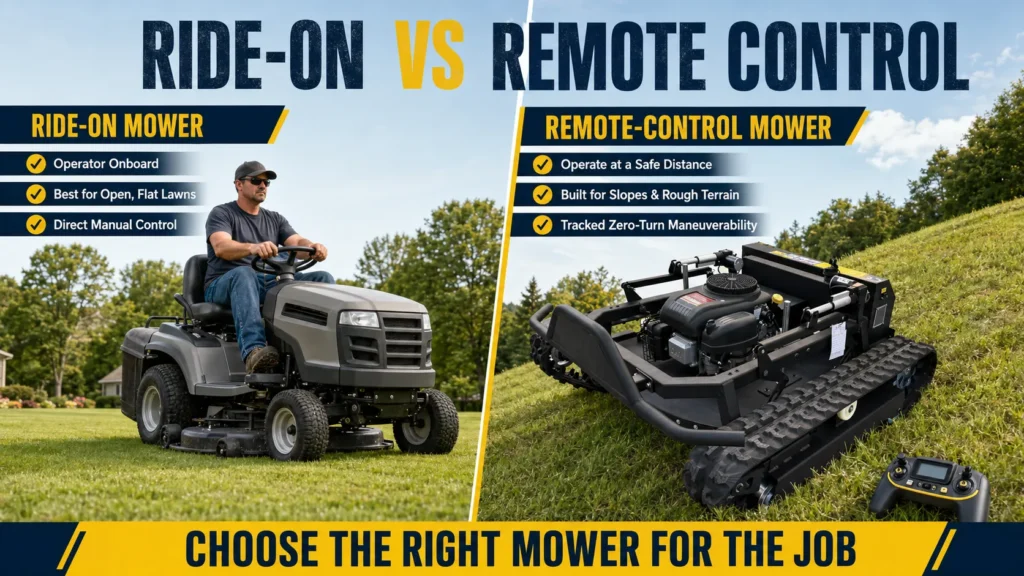
For most professional buyers, the choice between a riding lawn mower and a zero-turn mower comes down to property layout and job scope. Choose a conventional riding mower when you need familiar steering, broad attachment support and year-round utility. Choose a zero-turn mower when maneuverability and efficient trimming around frequent obstacles matter more. For difficult sites where an onboard seat is undesirable, a remote-control zero-turn mower adds a third operating configuration.
The important distinction is that zero-turn describes how a mower turns, not where its operator sits. Many zero-turn mowers are ride-on machines, but the category can also include machines controlled remotely from the ground. Actual capability varies by model, terrain and operating conditions, so compare the complete machine rather than buying from the category name alone.
Riding Lawn Mower vs. Zero Turn at a Glance
| Decision factor | Conventional riding mower | Zero-turn mower | Remote-control zero-turn mower |
|---|---|---|---|
| Steering and turning | Steering wheel with a measurable turning radius | Independent drive control enables near-pivot turns | Zero-turn movement directed from a remote control |
| Operator position | Seated onboard | Usually seated onboard, depending on configuration | Operator stands away from the machine |
| Obstacle-heavy sites | May require wider loops and more reversing | Well suited to close maneuvering | Close maneuvering with an off-machine viewing position |
| Open-lawn work | Predictable straight-line operation | Efficient when the deck and site are appropriately matched | Efficiency depends on model, site layout and operator technique |
| Attachments | Often available with broad towing and seasonal options | Availability varies significantly by model | Use only attachments approved for the exact machine |
| Learning curve | Generally familiar to drivers | Requires practice with drive controls and smooth turns | Requires practice with remote inputs, machine orientation and sightlines |
How the Two Mower Types Compare in Real Work
Turning Radius and Maneuverability
A conventional riding lawn mower steers through its front wheels and follows an arc. Its turning radius varies by model, and some lawn tractors are much tighter-turning than others. A zero-turn mower controls its drive wheels independently, allowing the machine to turn around a point close to its own footprint.
This difference is most valuable where every mowing pass ends near a tree, curb, bed or building. The operator can change direction with less looping and may reduce the amount of follow-up trimming. However, a zero-turn mechanism does not make every turn automatically clean. Abrupt control inputs or pivoting a drive tire in place can disturb turf, especially when the ground is soft.
Mowing Around Trees, Buildings and Obstacles
Zero-turn steering is usually the more convenient configuration for campuses, commercial properties, orchards and landscaped grounds with repeated obstacles. The mower can approach an object, follow its edge and reposition without the broad turn associated with a typical lawn tractor.
A riding mower remains practical when obstacles are widely spaced or when the property includes long, uncomplicated passes. Before choosing either type, count narrow gaps, measure gates and note places where the machine must reverse. Rear overhang, deck offset and the operator’s view of the cutting edge can matter as much as the advertised turning behavior.
Open-Lawn Efficiency
On open turf, cutting width, sustainable mowing speed, overlap, turning time and grass conditions determine output. Zero-turn controls can shorten transitions at the ends of rows, but a category label alone does not establish productivity. A wider mower can cover more ground per pass, yet it may also be harder to transport or pass through restricted access points.
Do not compare top speed alone. The usable pace may be limited by surface roughness, visibility, cut quality, vegetation density and operator control. Build the purchase decision around the site’s normal conditions instead of a best-case specification.
Slopes, Uneven Ground and Rough Terrain
Slopes require a model-specific assessment. Mower configuration, drive system, tires, weight distribution, surface moisture, ruts and operating direction can all affect control. Uneven ground may also expose a low deck to scalping or cause a wide machine to bridge depressions.
The U.S. Consumer Product Safety Commission identifies slopes as a major factor in loss-of-control and tip-over incidents and advises operators to follow the machine’s instructions, watch for hidden holes or bumps, avoid wet grass and use extra care when loading equipment. Buyers should review the CPSC riding lawn mower guidance alongside the manual for the exact model under consideration.
A published climbing-angle value should never be converted into a recommended mowing slope. Site managers still need to evaluate the surface, obstacles, vegetation, weather and operating direction permitted by the manufacturer.
Operator Positioning and Visibility
On a riding mower, the operator moves with the machine and has a consistent forward-facing position. This can make straight-line work intuitive, but the deck edges, rear of the machine and nearby drop-offs may not always be visible from the seat.
A remote-control mower lets the operator select a viewing position away from the machine. That can improve the viewing angle in some situations, but it also creates new responsibilities: the operator must maintain awareness of machine orientation, the work zone, bystanders, obstacles and the available control connection. Remote control means active human operation from a distance; it does not mean the mower is a fully autonomous robot lawn mower.
Cutting Width and Cutting-Height Options
A larger deck can reduce the number of passes on open ground, while a smaller deck can fit tighter routes and follow irregular ground more easily. Cutting-height range matters when contracts include both maintained turf and taller vegetation. Compare the available settings, adjustment method and transport position rather than assuming all decks offer the same flexibility.
Measure the narrowest gate, trailer opening, storage doorway and route between work areas. Manufacturers also caution that overall deck width can be greater than the stated cutting width; John Deere’s zero-turn mower selector, for example, tells buyers to check access routes and storage space when choosing a deck size.
Transport, Storage and Site Access
For mobile crews, machine dimensions and weight affect trailer capacity, loading arrangements and the number of units that can be carried. A compact mower may be more valuable than a wider machine if crews routinely enter fenced utility sites or move between small properties.
Check both operating and packaged dimensions when importing or receiving equipment. Confirm whether the trailer, ramps, tie-down points, floor loading and storage space can accommodate the exact machine. Turning ability cannot compensate for a deck or chassis that will not pass through the site’s narrowest access point.
Attachments and General-Purpose Yard Work
A lawn tractor is often the stronger candidate when mowing is only one part of the job. Depending on the model, riding equipment may support collection systems, carts, blades, snow equipment and other implements. Manufacturer attachment catalogs demonstrate how broad these systems can be, but compatibility must be checked by exact model rather than assumed from the hitch or product category. See this manufacturer attachment overview for examples of the functions buyers may need to evaluate.
Zero-turn mowers are usually selected first for mowing and maneuverability. Some accept collection or other accessories, but availability and operating limits vary.
Is a Remote-Control Zero-Turn Mower Different?
Yes. A remote-control zero-turn mower uses zero-turn maneuverability while placing the operator away from an onboard seat. It remains operator-controlled equipment, not necessarily an autonomous mower. The operator directs movement and mowing functions through a remote interface while maintaining appropriate visual awareness of the machine and work area.
Yitaiwei machines may be configured as remote-control zero-turn lawn mowers. The official Yitaiwei brochure lists, for example, the QL500Y with a 500 mm cutting width and 20-150 mm cutting-height range, the LB600-24V with a 600 mm cutting width and 10-200 mm range, and the QL800 with an 800 mm cutting width and 20-100 mm range. For each of these models, the brochure lists a remote-control distance of up to 200 m and a maximum value of 45° under the field “Climbing angle.” These values are model specifications, not a guaranteed signal range, safe operating slope or all-terrain promise.
When comparing remote-control models, examine cutting width, cutting-height range, machine dimensions, weight, walking speed, start mode and the documented control system. Also confirm how the operator will maintain sightlines around buildings, vegetation and changes in elevation. Actual performance may vary with terrain, vegetation, operating conditions and machine configuration. Confirm the final specification with the manufacturer before ordering.
Maintenance, Training and Total Ownership Cost
Maintenance Requirements
Both mower types require scheduled inspection and service of their cutting, drive and power systems. The exact work depends on the model and may include blades, belts, bearings, filters, tires or tracks, electrical connections, batteries and control components. A zero-turn drive system can introduce separate service points, while a remote-control machine also requires attention to the controller, receiver and related electrical systems.
Common Expensive Buying Mistakes
- Buying for acreage alone: Property size does not reveal slope, obstacle density, access restrictions or vegetation conditions.
- Assuming every zero turn is ride-on: Zero-turn describes maneuverability; remote-control configurations place the operator off the machine.
- Treating remote control as autonomy: A remotely operated mower still depends on active operator input and work-zone awareness.
- Choosing the widest deck available: The machine may not fit gates, trailers, storage areas or narrow routes.
- Converting a climbing-angle figure into a safe slope: Follow the exact manufacturer’s operating limits and instructions instead.
- Ignoring attachments: A mower optimized for cutting may not replace a lawn tractor used for towing or seasonal work.
- Comparing purchase price only: Parts, service, transport, training and downtime can materially change ownership cost.
Pre-Purchase Checklist
- Map acreage, slopes, rough areas, obstacles, soft ground and drop-offs.
- Measure gates, pathways, trailer openings and storage doors.
- Record the desired cutting widths and cutting-height ranges.
- List every required attachment and verify exact-model compatibility.
- Confirm machine and package dimensions, weight and loading requirements.
- Review the operator manual for terrain, slope and transport restrictions.
- Compare maintenance intervals, wear parts, local service and parts availability.
- Plan operator training for steering or remote-control orientation.
- Calculate ownership cost across the expected service period, including downtime.
- Confirm the final ordered configuration and specifications in writing.
Frequently Asked Questions (FAQ)
Is a zero-turn mower always a riding mower?
No. Zero-turn refers to a mower’s ability to turn around a point close to its footprint. Many zero-turn mowers have seats, but remote-control zero-turn lawn mowers are operated from a distance without an onboard operator.
Which is better for mowing around trees?
A zero-turn mower is generally easier to position around numerous trees and landscape features. The practical advantage depends on deck offset, machine dimensions, operator visibility, ground conditions and the space between obstacles.
Is a riding lawn mower better for attachments?
A conventional lawn tractor often offers broader attachment choices, making it useful when crews also collect material, tow carts or perform seasonal work. Compatibility varies, so verify every attachment against the exact mower model.
Can a zero-turn mower be used on slopes?
Some models may be permitted on certain slopes, but there is no category-wide answer. Follow the exact operator manual and account for grade, direction, traction, moisture, ruts and obstacles. Do not treat a climbing-angle specification as a safe mowing limit.
Is a remote-control mower autonomous?
Not necessarily. A remote-control mower receives active commands from an operator at a distance. An autonomous robot mower follows programmed or sensor-based behavior with less continuous input. Buyers should confirm the actual control architecture instead of treating the terms as interchangeable.
Conclusion: Which Mower Should You Choose?
Choose a conventional riding lawn mower when familiar steering, attachment versatility and general-purpose property work are the priorities. Choose a conventional zero-turn mower when an onboard operator needs efficient maneuvering across open turf and around frequent obstacles. Consider a remote-control zero-turn mower when off-machine operation fits the site’s terrain, visibility and work procedures. In every case, match the exact model to access, terrain, cutting requirements, service support and total ownership cost.Before choosing equipment for sloped ground, review the operator’s manual and consult Penn State Extension’s riding lawnmower safety guidance.